
Letters to a Friend, Written to Mrs. Ezra S. Carr, 1866-1879
John Muir
THE CLASSIC COLLECTION · 1881
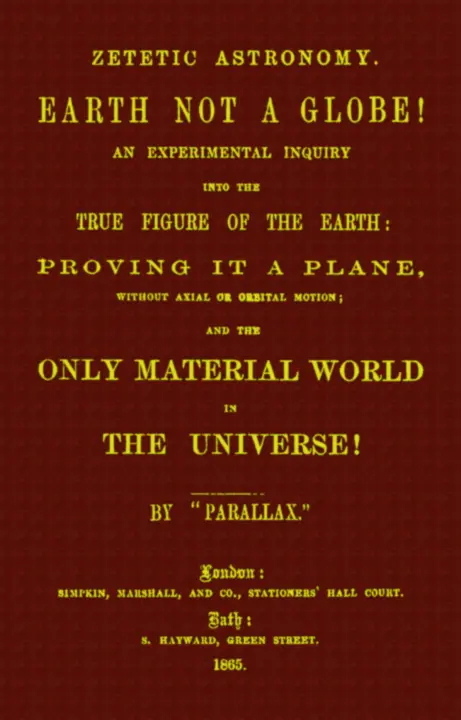
"Zetetic Astronomy: Earth Not a Globe!" by Parallax is a scientific publication written in the mid-19th century. This unique work presents a series of experiments and assertions arguing for the concept that the Earth is a flat plane rather than a globe, challenging widely accepted astronomical theories. The book seeks to dismiss common theories of the Earth's shape and motion through extensive empirical evidence and observations. The opening of this publication sets the stage for its central argument: the advocacy for “zetetic” inquiry, which emphasizes investigation and observation over theoretical assumptions. Parallax critiques established scientific thought and presents a series of observations—ranging from the behavior of water in canals to the visibility of distant landmasses—to support the claim that the Earth's surface is flat and stationary. The author introduces the notion that many phenomena typically attributed to a spherical Earth can be explained through the principles of perspective and the nature of light, laying the groundwork for subsequent chapters that expand on these experiments and claims.
Introduction adapted from the source catalogue; source summaries may be automatically generated.
Free to read · English · 46,039 words · No account needed
MAKE TIME FOR A GOOD BOOK
On by default. Untick to stop anonymous reading totals. Each page counts after 10 seconds in view. How this works.
Anonymous counting is on unless you have switched it off.
“The observations made by M. Arago, in 1821, that the deepest Artesian wells are the warmest, threw great light on the origin of thermal springs, and on the establishment of the law, that terrestrial heat increases with increasing depth. It is a remarkable fact, which has but recently been noticed, that at the close of the third century St Patricius, probably Bishop of Partusa, was led to adopt very correct views regarding the phenomenon of the hot springs at Carthage. On being asked what was the cause of boiling water bursting from the earth, he replied, ‘Fire is nourished in the clouds, and in the interior of the earth, as Etna and other mountains near Naples may teach you. The subterranean waters rise as if through siphons. The cause of hot springs is this: waters which are more remote from the subterranean fire are colder, whilst those which rise nearer the fire, are heated by it, and bring with them to the surface which we inhabit, an insupportable degree of heat.’”[29]
[29] “Humboldt’s Cosmos,” p. 220.
The investigations which have been made, and the evidence which has been brought together, render it undeniable that the lower parts of the earth are on fire. Of the intensity of the combustion, no practical idea can be formed. It is fearful beyond comparison. The lava thrown out from a volcano in Mexico, “was so hot that it continued to smoke for twenty years; and after three years and a half, a piece of wood took fire in it, at a distance of five miles from the crater.” In various parts of the world, large islands have been thrown up from the sea, in a red-hot glowing condition, and so intensely heated, that after being forced through many fathoms of salt water, and standing in the midst of it, exposed to wind and rain for several months, they were not sufficiently cooled for persons to approach and stand upon them. “A notable fact is the force exerted in volcanic action, Cotopaxi, in 1738, threw its fiery rockets 3,000 feet above its crater, while in 1744 the blazing mass, struggling for an outlet, roared like a furnace, so that its awful voice was heard at a distance of more than six hundred miles. In 1797, the crater of Tunguragua, one of the great peaks of the Andes, flung out torrents of mud, which dammed up rivers, opened new lakes, and in valleys of a thousand feet wide made deposits six hundred feet deep. The stream from Vesuvius which, in 1737, passed through Torre del Greco, contained thirty-three million cubic feet of solid matter; and, in 1794, when Torre del Greco was destroyed a second time, the mass of lava amounted to forty-five million cubic feet. In 1669 Etna poured forth a flood which covered 84 square miles of surface, and measured nearly 100,000,000 cubic feet. On this occasion the sand and scoriæ formed the Monte Rossi, near Nicolosi, a cone two miles in circumference, and four hundred and fifty feet high. The stream thrown out by Etna, in 1819, was in motion, at the rate of a yard per day, for nine months after the eruption; and it is on record that the lavas of the same mountain, after a terrible eruption, were not thoroughly cooled and consolidated ten years after the event. In the eruption of Vesuvius, A.D. 79, the scoriæ and ashes vomited forth far exceeded the entire bulk of the mountain; while, in 1660, Etna disgorged more than twenty times its own mass. * * * Vesuvius has thrown its ashes as far as Constantinople, Syria, and Egypt; it hurled stones eight pounds in weight to Pompeii, a distance of six miles; while similar masses were tossed up 2,000 feet above its summit. Cotopaxi has projected a block one hundred cubic yards in volume a distance of nine miles, while Sumbawa, in 1815, during the most terrible eruption on record, sent its ashes as far as Java, a distance of three hundred miles. * * * In viewing these evidences of enormous power, we are forcibly struck with the similarity of action with which they have been associated; and, carrying our investigation a step further, the same similarity of the producing power is hinted at in the identity of the materials ejected. Thus, if we classify the characteristics of all recorded eruptions, we shall find that the phenomena are all reducible to upheavals of the earth, rumblings and explosions, ejections of carbonic acid, fiery torrents of lava, cinders, and mud, with accompanying thunder and lightning. The last-named phenomena are extrajudicial in character; they are merely the result of the atmospheric disturbance consequent on the escape of great heat from the earth, just as the burning of an American forest causes thunder and rain. The connection that apparently exists, too, between neighbouring craters is strongly confirmed by the fact that in every distinct volcanic locus but one crater is usually active at a time. Since Vesuvius has resumed his activity, the numerous volcanic vents on the other side of the bay have sunk into comparative inactivity; for ancient writers, who are silent respecting the former, speak of the mephitic vapours of the Lake Avernus as destructive to animal existence, and in earlier days than these Homer pictures the Phlegrean Fields as the entrance to the infernal regions, placed at the limits of the habitable world, unenlightened by rising or setting sun, and enveloped in eternal gloom. * * * * The earth contains within it a mass of heated material; nay, it is a heated and incandescent body, habitable only because surrounded with a cool crust--the crust being to it a mere shell, within which the vast internal fires are securely inclosed: and yet not securely, perhaps, unless such vents existed as those to which we apply the term volcano. * * * * Every volcano is a safety-valve, ready to relieve the pressure from within when that pressure rises to a certain degree of intensity; or permanently serving for the escape of conflagrations, which, if not so provided with escape, might rend the habitable crust to pieces.”[30]
Your reading position is saved on this browser. Take it to another device with a library code. Reading pages adapt to text, rather than matching a printed edition.
BEHIND THE BOOK
This eBook is for the use of anyone anywhere in the United States and most other parts of the world at no cost and with almost no restrictions whatsoever. You may copy it, give it away or re-use it under the terms of the Project Gutenberg License included with this eBook or online at www.gutenberg.org. If you are not located in the United States, you will have to check the laws of the country where you are located before using this eBook. Read the source licence.
The original source file, including credits and licence, is retained by this library. Request an original-format copy at no charge. Please include the book title and Project Gutenberg identifier #69892.
KEEP YOUR CURIOSITY GOING
John Muir

Asa Gray
Asa Gray

Florence Nightingale
Elizabeth Robins Pennell
Denison Olmsted