
Letters to a Friend, Written to Mrs. Ezra S. Carr, 1866-1879
John Muir
THE CLASSIC COLLECTION · 1881
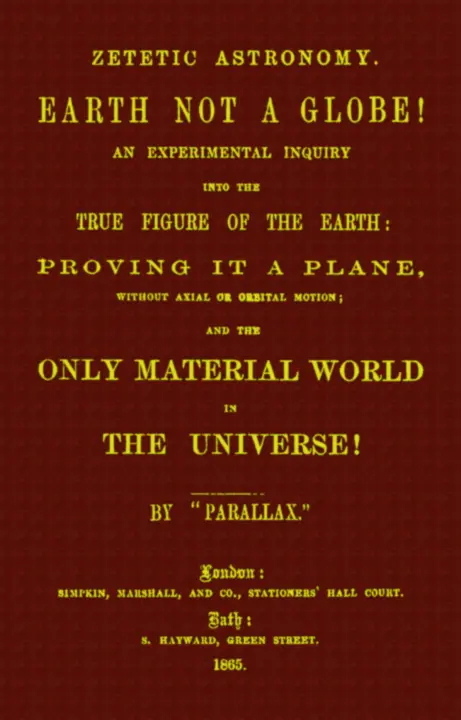
"Zetetic Astronomy: Earth Not a Globe!" by Parallax is a scientific publication written in the mid-19th century. This unique work presents a series of experiments and assertions arguing for the concept that the Earth is a flat plane rather than a globe, challenging widely accepted astronomical theories. The book seeks to dismiss common theories of the Earth's shape and motion through extensive empirical evidence and observations. The opening of this publication sets the stage for its central argument: the advocacy for “zetetic” inquiry, which emphasizes investigation and observation over theoretical assumptions. Parallax critiques established scientific thought and presents a series of observations—ranging from the behavior of water in canals to the visibility of distant landmasses—to support the claim that the Earth's surface is flat and stationary. The author introduces the notion that many phenomena typically attributed to a spherical Earth can be explained through the principles of perspective and the nature of light, laying the groundwork for subsequent chapters that expand on these experiments and claims.
Introduction adapted from the source catalogue; source summaries may be automatically generated.
Free to read · English · 46,039 words · No account needed
MAKE TIME FOR A GOOD BOOK
On by default. Untick to stop anonymous reading totals. Each page counts after 10 seconds in view. How this works.
Anonymous counting is on unless you have switched it off.
Transcriber’s Notes
Texts printed in italics and blackletter have been transcribed between underscores and ~tildes~ respectively. Small capitals have been replaced with ALL CAPITALS.
More Transcriber’s Notes may be found at the end of this text.
[Entered at Stationer’s Hall.]
AN EXPERIMENTAL INQUIRY
INTO THE
TRUE FIGURE OF THE EARTH:
PROVING IT A PLANE,
WITHOUT AXIAL OR ORBITAL MOTION;
AND THE
ONLY MATERIAL WORLD
IN
THE UNIVERSE!
~London:~
SIMPKIN, MARSHALL, AND CO., STATIONERS’ HALL COURT.
~Bath:~
S. HAYWARD, GREEN STREET.
1865.
[The Right of Translation is Reserved by the Author.]
SECTION I.
Introduction--Experiments proving the Earth to be a Plane.
SECTION II.
The Earth no Axial or Orbital Motion.
SECTION III.
The true distance of the Sun and Stars.
SECTION IV.
The Sun moves in a Circle over the Earth, concentric with the North
Pole.
SECTION V.
Diameter of Sun’s path constantly changing.
SECTION VI.
Cause of Day and Night, Seasons, &c.
SECTION VII.
Cause of “Sun rise” and “Sun set.”
SECTION VIII.
Cause of Sun appearing larger when “Arising” and “Setting” than when
on the Meridian.
SECTION IX.
Cause of Solar and Lunar Eclipses.
SECTION X.
Cause of Tides.
SECTION XI.
Constitution, Condition, and ultimate Destruction of the Earth by
Fire.
SECTION XII.
Miscellanea--Moon’s Phases--Moon’s appearance--Planet Neptune--
Pendulum Experiments as Proofs of Earth’s motion.
SECTION XIII.
Perspective on the Sea.
SECTION XIV.
General Summary--Application--“CUI BONO.”
The term “zetetic” is derived from the Greek verb zeteo; which means to search or examine--to proceed only by inquiry. None can doubt that by making special experiments and collecting manifest and undeniable facts, arranging them in logical order, and observing what is naturally and fairly deducible, the result will be far more consistent and satisfactory than by framing a theory or system and assuming the existence of causes for which there is no direct evidence, and which can only be admitted “for the sake of argument.” All theories are of this character--“supposing instead of inquiring, imagining systems instead of learning from observation and experience the true constitution of things. Speculative men, by the force of genius may invent systems that will perhaps be greatly admired for a time; these, however, are phantoms which the force of truth will sooner or later dispel; and while we are pleased with the deceit, true philosophy, with all the arts and improvements that depend upon it, suffers. The real state of things escapes our observation; or, if it presents itself to us, we are apt either to reject it wholly as fiction, or, by new efforts of a vain ingenuity to interweave it with our own conceits, and labour to make it tally with our favourite schemes. Thus, by blending together parts so ill-suited, the whole comes forth an absurd composition of truth and error. * * These have not done near so much harm as that pride and ambition which has led philosophers to think it beneath them to offer anything less to the world than a complete and finished system of nature; and, in order to obtain this at once, to take the liberty of inventing certain principles and hypotheses, from which they pretend to explain all her mysteries.”[1]
Your reading position is saved on this browser. Take it to another device with a library code. Reading pages adapt to text, rather than matching a printed edition.
BEHIND THE BOOK
This eBook is for the use of anyone anywhere in the United States and most other parts of the world at no cost and with almost no restrictions whatsoever. You may copy it, give it away or re-use it under the terms of the Project Gutenberg License included with this eBook or online at www.gutenberg.org. If you are not located in the United States, you will have to check the laws of the country where you are located before using this eBook. Read the source licence.
The original source file, including credits and licence, is retained by this library. Request an original-format copy at no charge. Please include the book title and Project Gutenberg identifier #69892.
KEEP YOUR CURIOSITY GOING
John Muir

Asa Gray
Asa Gray

Florence Nightingale
Elizabeth Robins Pennell
Denison Olmsted