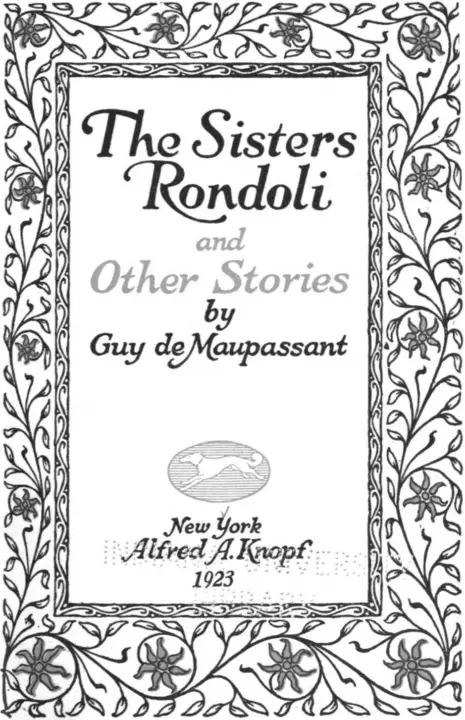
The Sisters Rondoli, and Other Stories
Guy de Maupassant
THE CLASSIC COLLECTION · 1885
"Yvette" by Guy de Maupassant is a novel written during the late 19th century. It explores themes of love, social life, and the complexities of female relationships in a Parisian context, centering around the titular character, Yvette, the daughter of the Marquise Obardi, and her interactions with various suitors, including Jean de Servigny and Leon Saval. The opening of "Yvette" introduces readers to the lively Parisian nightlife through the conversation between Jean de Servigny and Leon Saval as they stroll along the boulevard after leaving a café. It sets the scene with vivid descriptions of the summer atmosphere and explores the friendship between the two men, with Jean teasing Saval about becoming infatuated with the Marquise Obardi, an enigmatic figure in the Parisian social scene, and her captivating daughter, Yvette. As Jean describes Yvette, he portrays her as an enchanting yet puzzling character who embodies conflicting notions of innocence and experience, setting the stage for a narrative that promises exploration of seduction, youthful desire, and the obscured boundaries of social class and morality.
Introduction adapted from the source catalogue; source summaries may be automatically generated.
Free to read · English · 24,688 words · No account needed
MAKE TIME FOR A GOOD BOOK
On by default. Untick to stop anonymous reading totals. Each page counts after 10 seconds in view. How this works.
Anonymous counting is on unless you have switched it off.
"No, mamma, you know what I said, I won't alter my determination. I shall not leave my room till they have gone. I never want to see one of those people again, never, never. If they come back, you will see no more of me."
The Marquise had dried her eyes, and wearied with emotion, she
murmured:
"Come, reflect, be reasonable."
Then, after a moment's silence:
"Yes, you had better rest this morning. I will come up to see you this afternoon." And having kissed her daughter on the forehead, she went to dress herself, already calmed.
Yvette, as soon as her mother had disappeared, rose, and ran to bolt the door, to be alone, all alone; then she began to think. The chambermaid knocked about eleven o'clock, and asked through the door: "Madame the Marquise wants to know if Mademoiselle wishes anything, and what she will take for her breakfast."
Yvette answered: "I am not hungry, I only ask not to be disturbed."
And she remained in bed, just as if she had been ill. Toward three o'clock, some one knocked again. She asked:
"Who is there?"
It was her mother's voice which replied: "It is I, darling, I have
come to see how you are."
She hesitated what she should do. She opened the door, and then went back to bed. The Marquise approached, and, speaking in low tones, as people do to a convalescent, said:
"Well, are you better? Won't you eat an egg?"
"No, thanks, nothing at all."
Madame Obardi sat down near the bed. They remained without saying anything, then, finally, as her daughter stayed quiet, with her hands inert upon the bedclothes, she asked:
"Don't you intend to get up?"
Yvette answered: "Yes, pretty soon."
Then in a grave and slow tone she said: "I have thought a great deal, mamma, and this--this is my resolution. The past is the past, let us speak no more of it. But the future shall be different or I know what is left for me to do. Now, let us say no more about it."
The Marquise, who thought the explanation finished, felt her impatience gaining a little. It was too much. This big goose of a girl ought to have known about things long ago. But she did not say anything in reply, only repeating:
"You are going to get up?"
"Yes, I am ready."
Then her mother became maid for her, bringing her stockings, her corset, and her skirts. Then she kissed her.
"Will you take a walk before dinner?"
"Yes, mamma."
And they took a stroll along the water, speaking only of commonplace
things.
Your reading position is saved on this browser. Take it to another device with a library code. Reading pages adapt to text, rather than matching a printed edition.
Guy de Maupassant
Guy de Maupassant
Guy de Maupassant
Guy de Maupassant
BEHIND THE BOOK
This eBook is for the use of anyone anywhere in the United States and most other parts of the world at no cost and with almost no restrictions whatsoever. You may copy it, give it away or re-use it under the terms of the Project Gutenberg License included with this eBook or online at www.gutenberg.org. If you are not located in the United States, you will have to check the laws of the country where you are located before using this eBook. Read the source licence.
The original source file, including credits and licence, is retained by this library. Request an original-format copy at no charge. Please include the book title and Project Gutenberg identifier #3664.
KEEP YOUR CURIOSITY GOING
Coulson Kernahan

Maurice Baring
Frances Wright
Cécile Tormay

Frederic Jesup Stimson

W. H. P. (William Henry Pope) Jarvis