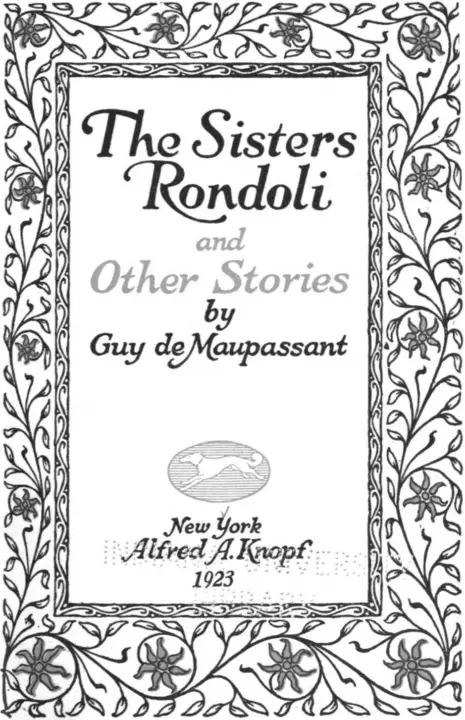
The Sisters Rondoli, and Other Stories
Guy de Maupassant
THE CLASSIC COLLECTION · 1885
"Yvette" by Guy de Maupassant is a novel written during the late 19th century. It explores themes of love, social life, and the complexities of female relationships in a Parisian context, centering around the titular character, Yvette, the daughter of the Marquise Obardi, and her interactions with various suitors, including Jean de Servigny and Leon Saval. The opening of "Yvette" introduces readers to the lively Parisian nightlife through the conversation between Jean de Servigny and Leon Saval as they stroll along the boulevard after leaving a café. It sets the scene with vivid descriptions of the summer atmosphere and explores the friendship between the two men, with Jean teasing Saval about becoming infatuated with the Marquise Obardi, an enigmatic figure in the Parisian social scene, and her captivating daughter, Yvette. As Jean describes Yvette, he portrays her as an enchanting yet puzzling character who embodies conflicting notions of innocence and experience, setting the stage for a narrative that promises exploration of seduction, youthful desire, and the obscured boundaries of social class and morality.
Introduction adapted from the source catalogue; source summaries may be automatically generated.
Free to read · English · 24,688 words · No account needed
MAKE TIME FOR A GOOD BOOK
On by default. Untick to stop anonymous reading totals. Each page counts after 10 seconds in view. How this works.
Anonymous counting is on unless you have switched it off.
A great shout of joy rang out from all mouths, while the poor pianist, bewildered, paddled, swore, coughed, and spluttered, and though sticking in the mud managed to get to the shore. His hat which floated down the stream was picked up by a boat. Yvette danced with joy, clapping and repeating: "Oh! Muscade, what fun! what fun!"
Servigny looked on, having become serious, a little disturbed, a little chilled to see her so much at her ease in this common place. A sort of instinct revolted in him, that instinct of the proper, which a well-born man always preserves even when he casts himself loose, that instinct which avoids too common familiarities and too degrading contacts. Astonished, he muttered to himself:
"Egad! Then YOU are at home here, are you?" And he wanted to speak familiarly to her, as a man does to certain women the first time he meets them. He no longer distinguished her from the russet-haired, hoarse-voiced creatures who brushed against them. The language of the crowd was not at all choice, but nobody seemed shocked or surprised. Yvette did not even appear to notice it.
"Muscade, I want to go in bathing," she said. "We'll go into the
river together."
"At your service," said he.
They went to the bath-office to get bathing-suits. She was ready the first, and stood on the bank waiting for him, smiling on everyone who looked at her. Then side by side they went into the luke-warm water.
She swam with pleasure, with intoxication, caressed by the wave, throbbing with a sensual delight, raising herself at each stroke as if she were going to spring from the water. He followed her with difficulty, breathless, and vexed to feel himself mediocre at the sport.
But she slackened her pace, and then, turning over suddenly, she floated, with her arms folded and her eyes wide open to the blue sky. He observed, thus stretched out on the surface of the river, the undulating lines of her form, her firm neck and shoulders, her slightly submerged hips, and bare ankles, gleaming in the water, and the tiny foot that emerged.
He saw her thus exhibiting herself, as if she were doing it on purpose, to lure him on, or again to make sport of him. And he began to long for her with a passionate ardor and an exasperating impatience. Suddenly she turned, looked at him, and burst into laughter.
"You have a fine head," she said.
He was annoyed at this bantering, possessed with the anger of a baffled lover. Then yielding brusquely to a half felt desire for retaliation, a desire to avenge himself, to wound her, he said:
Your reading position is saved on this browser. Take it to another device with a library code. Reading pages adapt to text, rather than matching a printed edition.
Guy de Maupassant
Guy de Maupassant
Guy de Maupassant
Guy de Maupassant
BEHIND THE BOOK
This eBook is for the use of anyone anywhere in the United States and most other parts of the world at no cost and with almost no restrictions whatsoever. You may copy it, give it away or re-use it under the terms of the Project Gutenberg License included with this eBook or online at www.gutenberg.org. If you are not located in the United States, you will have to check the laws of the country where you are located before using this eBook. Read the source licence.
The original source file, including credits and licence, is retained by this library. Request an original-format copy at no charge. Please include the book title and Project Gutenberg identifier #3664.
KEEP YOUR CURIOSITY GOING
Coulson Kernahan

Maurice Baring
Frances Wright
Cécile Tormay

Frederic Jesup Stimson

W. H. P. (William Henry Pope) Jarvis