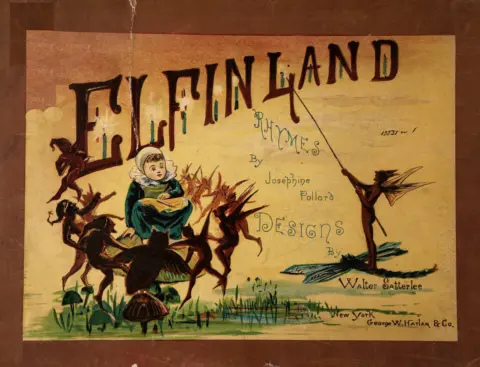
Elfin Land
Josephine Pollard
THE CLASSIC COLLECTION · 1890
"Young Folks' Bible in Words of Easy Reading" by Josephine Pollard is a children's adaptation of biblical stories, likely written in the late 19th century. The book simplifies traditional biblical texts and presents them in accessible language for young readers, aiming to instill a genuine love for the Bible. Through these retellings, it provides foundational stories from both the Old and New Testaments, featuring key figures like Adam, Noah, Abraham, and Jesus. The opening of this adaptation sets the stage for an engaging exploration of the stories from the Bible. It begins by explaining the concept of the Bible as God’s will to humanity, tailored for children's understanding. It emphasizes the importance of stories in conveying moral and religious lessons, presenting a narrative journey from Creation, the Fall of Adam and Eve, the Great Flood, to the lives of key biblical figures. Pollard's focus is on making these stories relatable, encouraging young readers to learn and appreciate the significance of their faith through the rich narratives that have shaped religious culture.
Introduction adapted from the source catalogue; source summaries may be automatically generated.
Free to read · English · 75,472 words · No account needed
MAKE TIME FOR A GOOD BOOK
On by default. Untick to stop anonymous reading totals. Each page counts after 10 seconds in view. How this works.
Anonymous counting is on unless you have switched it off.
Long centuries ago, a young man of aristocratic birth, handsome person, polished manners, brilliant and highly cultivated intellect, was walking, on a day in the reign of the Emperor Julian, by the bank of the river Orontes, not far from the stately city of Antioch, the Paris of that age,--and saw something floating in the stream. The branch of a tree enabled him to drag it ashore; it proved to be a copy of the sacred Scriptures; Julian, the mad master of the world, had issued an edict, annexed to which were heavy penalties, that all copies of that book should be destroyed. The young man who drew the manuscript to shore had been taught the lessons of that volume from a child, by his pious mother, Anthusa; but he had thrown off the yoke of his mother's faith; had become a devotee of heathen philosophy, poetry and rhetoric, and at the same time steeped himself in the licentious pleasures and dissipations of the Grove of Daphne, the Hippodrome and Theatre, and resolved that "the man Christ Jesus should not reign over him." He opened the parchment, some words on the page caught his eye; they were familiar, yet shone with a new light and were armed with irresistible power: he read on; his mother's prayers were answered; he embraced the truth, bowed his neck to the yoke he had foresworn, and the volume he rescued from the flood became a treasure-trove for the world,--through fifteen centuries alike in the east and west,--that man has been known as St. John Chrysostom, the "Mouth of Gold," one of the most saintly and eloquent preachers, whose life, genius, sufferings and death for conscience's sake adorned the history of mankind.
Not far from the same time, a young man bathed in tears lay writhing in agony under a fig tree in the garden of his house at Milan. His devout mother, Monica, in their Numidian home, had taught him the way of life written in God's Word; but as he grew to manhood he strove to shake off the influence and authority of her instruction; became a libertine, reached forth to grasp the crown of heathen eloquence and learning, and for more than ten years wrought steadily to undo the sacred work his mother had performed for him as a child. But the lesson she had taught him lay deeper than his surging passions, imperious intellect, and haughty will, and because of their power over him he could find no rest night or day. He journeyed to Carthage, Rome, Milan, the chief cities of the western world, to study art and eloquence, to drench his soul with the pleasures of sense and lay the ghost of his disquiet; but in vain. In his anguish under the fig tree he heard, or seemed to hear, again and again, "Take it up and read, Take it up and read." Springing to his feet, he ran to a friend near by who was reading the Word. Seizing the volume, his eyes rested on the words, "Let us walk honestly as in the day; not in rioting and drunkenness, not in chambering and wantonness, not in strife and envying. But put ye on the Lord Jesus Christ and make not provisions for the flesh, to fulfill the lusts thereof." The birth-pangs of his conversion were ended; he found peace in believing; and that incident makes an era in the history of the world, for that man was none other than Saint Augustine, the influence of whose writings has swayed with more might than that of an imperial sceptre the destinies of western Christendom for ages. "Therefore, whosoever heareth these sayings of mine and doeth them," saith the Lord, "I will liken him unto a wise man which built his house upon a rock; and the rain descended, and the floods came, and the winds blew and beat upon that house; and it fell not, for it was founded upon a rock. And every one that heareth these sayings of mine, and doeth them not, shall be likened unto a foolish man which built his house upon the sand; and the rains descended, and the floods came, and the winds blew and beat upon that house and it fell, and great was the fall of it." Woe to Randolph! he heard and would not, and his house fell, and great was the fall of it. Mankind with one voice calls Augustine and Chrysostom blessed; they heard, obeyed, and their houses stand forever; they were built upon the rock. "Their Rock is not as our Rock, our enemies themselves being judges" was the boast of Israel at an early day. With how much fuller emphasis may Christendom utter it to-day. Compare India with Britain, China with the United States, and after all other forces are measured and allowed, it will be found that the significant and self-renewing causes for the superiority of the western nations over the eastern are the presence, authority and influence of the Old and New Testament. "And he shewed me a pure river of water of life clear as crystal proceeding out of the throne of God and of the Lamb. In the midst of the street of it, and on either side of the river, was there the tree of life, which bare twelve manner of fruits and yielded her fruit every month; and the leaves of the tree were for the healing of the nations."
Your reading position is saved on this browser. Take it to another device with a library code. Reading pages adapt to text, rather than matching a printed edition.
Josephine Pollard
BEHIND THE BOOK
This eBook is for the use of anyone anywhere in the United States and most other parts of the world at no cost and with almost no restrictions whatsoever. You may copy it, give it away or re-use it under the terms of the Project Gutenberg License included with this eBook or online at www.gutenberg.org. If you are not located in the United States, you will have to check the laws of the country where you are located before using this eBook. Read the source licence.
The original source file, including credits and licence, is retained by this library. Request an original-format copy at no charge. Please include the book title and Project Gutenberg identifier #39431.
KEEP YOUR CURIOSITY GOING

David Patterson (Spirit) Hatch

David Patterson (Spirit) Hatch

David Patterson (Spirit) Hatch

Edwin Abbott Abbott

Richard Watson
T. G. (Theophilus Gould) Steward