In Answer to Prayer
William Boyd Carpenter & Theodore L. (Theodore Ledyard) Cuyler & W. J. (William John) Knox-Little & Ian Maclaren & William Quarrier
THE CLASSIC COLLECTION · 1899
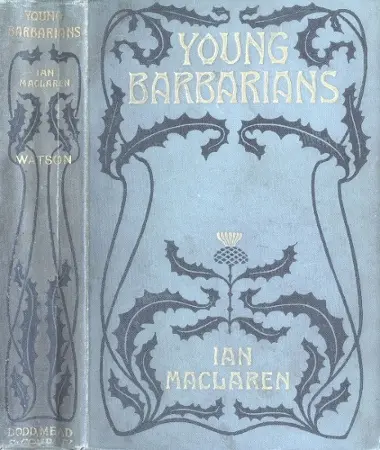
"Youth Barbarians" by Ian Maclaren is a novel written in the late 19th century. Set in a Scottish educational institution called Muirtown Seminary, the story primarily focuses on the life and adventures of its mischievous protagonist, Peter McGuffie, affectionately known as "Speug." The novel captures the essence of childhood innocence, camaraderie, and the often tumultuous experiences of boys navigating school life, particularly in their interactions with authority figures and each other. The opening of "Young Barbarians" introduces the setting of Muirtown Seminary, an imposing building where young boys engage in playful warfare during their education. The narrative centers around "Speug" and his rebellious nature, revealing the dynamics of friendship, rivalry, and the lighthearted skirmishes with other schools. We learn about Peter's fierce spirit, his admiration for his father, and his knack for mischief, shaping him as a charismatic yet troublesome character. This early section builds a vivid world where the struggles and triumphs of boyhood lead to rich character development and highlights the nostalgic essence of schooldays filled with adventure.
Introduction adapted from the source catalogue; source summaries may be automatically generated.
Free to read · English · 74,733 words · No account needed
MAKE TIME FOR A GOOD BOOK
On by default. Untick to stop anonymous reading totals. Each page counts after 10 seconds in view. How this works.
Anonymous counting is on unless you have switched it off.
It was next morning that the truant really paid for his pleasure; and the price was sharp, for there was no caning to be compared with that which followed a day in the country. It was a point of honour that no boy should show distress; but even veterans bit their lips as the cane fell first on the right hand and then on the left, and right across the palm, and sometimes doubling on the back of the hand, if the cane was young and flexible. Speug, though a man of war and able to endure anything, used to warm his hands at the fire, if the weather was cold, before going in to the inquisition, and after he had received a switching of the first order he would go down to the lade and cool his hands in the running water. It was an interesting spectacle to see four able-bodied sinners, who yesterday had given themselves to the study of Nature, now kneeling together, to efface their penalty in our waters of Lethe; but you must remember that they made no moan before the boys, and no complaint against the master. The school received them with respect when they came out, and Speug would indicate with a wink and a jerk of his head that Bulldog had exceeded himself; but he was not to be trifled with for an hour or two, and if any ill-mannered cub ventured to come too near when Peter was giving his hands a cold bath, the chances are that Peter gave the cub a bath, too, "just to teach him to be looking where he had no business."
Possibly fear of consequences might hinder some weak-hearted boys, but it never prevented any of the hardy ruffians from having their day out when the fever seized them. Playing truant was the same thing for a boy as bolting for a high-spirited horse; done once, the animal is bound to try it again, and to both, the joy of their respective sins must be very much the same. Boys did not plan a week ahead and then go astray in cold blood, because this sin was not an act of malice aforethought--it was a sudden impulse, not a matter of the will so much as of the blood. Had one determined on Tuesday night to take Wednesday, it might have turned out in our fickle climate a cheerless day, when a boy would as soon be playing marbles in the breaks, or cricket in the dinner-hour, or, for that matter, amusing himself in Moossy's class. No; a boy rose in the morning ready to go to school, without a thought of wood or water--arranging his marbles, in fact, for the day, and planning how to escape a lesson he had not prepared; but he was helpless against Nature if she set herself to tempt him. No sooner had he put his nose outside the door than the summer air, sweet and fresh, began to play upon his face and reminded him of a certain wood. As he went through the streets of the town, a glimpse of the river, steely blue that morning in the sunshine, brought up a pool where a fat trout was sure to be lying. As he crossed the North Meadow, the wind was blowing free from the Highlands, and was laden with the scent of hay and flowers, and sent his blood a-tingling. The books upon his back grew woefully heavy, and the Seminary reminded him of the city gaol frowning out on the fields with its stately and unrelenting face. He loitered by the lade and saw the clear water running briskly, and across the meadow he could catch a glimpse of the river, and in the distance the Kilspindie Woods with their mysterious depths, and rising high above the houses on the other side of the river was the hill where he spent last Saturday. The bell rings and he goes in, but not to work; the river is running through his heart, and the greenery is before his eyes, and the wind coming in puffs through the open window awakens the instinct of the wild animal in his breast and invites him to be free. Speug has a slate before him, but he is not pretending to do anything, he is looking out on the Meadow, and sniffing the air, just like a horse about to make its bolt. He catches Howieson's eye and reads that Jock is ready. Howieson inquires by signal of Bauldie whether he prefers compound fractions to a swim, and Bauldie explains, also by signal, that, much as he loves fractions, he will be obliging that afternoon and join them in their swim. A fourth would complete the party; and when Speug lifts his eyebrows with great dramatic art to "Piggie" Mitchell, three desks off, "Piggie," like the gallant spirit that he was, answers with a nod that he will not be found wanting. Not a word has been said, and no one will say "Truant" at any time, but at the next break the four separate themselves quietly and unobtrusively from their fellows, and by the time the last boy has gone through the door, they are scudding across the meadow to Speug's stable-yard, where they will make their preparations. Sometimes nothing more is needed than a hunch of bread and some fish-hooks; but as they ran Speug had dropped the word Woody Island, and a day on Woody Island was a work of art. It lay a couple of miles above the town, long and narrow, formed with a division of the river into its main current and a sluggish backwater. It was covered with dense brushwood, except where here and there a patch of green turf was left bare, and the island was indented with little bays where the river rippled on clean sand and gravel. It was only a little island, but yet you could lose yourself in it, so thick was the wood and so mazy, and then you had to find your comrades by signal; and it had little tracks through it, and there was one place where you could imagine a hole in the bank to be a cave, and where certainly two boys could get out of sight if they lay very close together and did not mind being half smothered. When you went to Woody Island, and left the mainland, you were understood to blot out the Seminary and Muirtown and Scotland and civilisation. Woody Island was somewhere in the wild West, and was still in the possession of the children of the forest; the ashes of their fires could be seen any day there, and you could come upon their wigwams in one of the open spots. There was a place where they had massacred three trappers and taken their scalps, and in that cave "Bull's-eye Charlie," the famous Indian scout, lying curled up like a ball, and with only the mouth of his rifle peeping out, had held twenty of the red-skinned braves at bay for a whole day. It was a fairy world in which our Indian tales could be reproduced upon the stage, and we ourselves could be the heroes we had so often admired. The equipment for the day consisted of four tomahawks (three axes out of small tool chests and one axe for breaking coals which "Piggie" used to steal for the day) two pistols (one belonging to Speug and the other to Bauldie); a couple of toy rifles--not things for kids, mark you, but long rifles with bayonets, and which could fire caps; a tent, which was in reality an old carriage cloth from Peter's yard; and a kettle for boiling water--I mean cooking the game--which Jock Howieson abstracted from his kitchen. Each boy had to visit his home on pretence of returning for a book, and bring away the necessary articles of war and as much food as he could steal from the pantry; and then everything, axes included, and, if possible, the rifles had to be hidden away about their persons until the four, skulking by back lanes, and separating from one another, reached the top of the North Meadow, after which they went up the bank of the river, none daring to make them afraid. They were out of bounds now, and the day was before them for weal or woe, and already Speug was changing into an Indian trapper, and giving directions about how they must deal with the Seminoles (see Mayne Reid), while Howieson had begun to speculate whether they would have a chance of meeting with the famous chief, Oceola. "Piggie" might want to try a cap on his rifle, but Speug would not allow him, because, although they had not yet entered the Indian territory, the crafty foe might have scouts out on this side of the river, and in that case there was no hope of Woody Island. The Indians would be in ambush among the trees on the bank, and the four would be shot down as they crossed.
Your reading position is saved on this browser. Take it to another device with a library code. Reading pages adapt to text, rather than matching a printed edition.
William Boyd Carpenter & Theodore L. (Theodore Ledyard) Cuyler & W. J. (William John) Knox-Little & Ian Maclaren & William Quarrier

Ian Maclaren
BEHIND THE BOOK
This eBook is for the use of anyone anywhere in the United States and most other parts of the world at no cost and with almost no restrictions whatsoever. You may copy it, give it away or re-use it under the terms of the Project Gutenberg License included with this eBook or online at www.gutenberg.org. If you are not located in the United States, you will have to check the laws of the country where you are located before using this eBook. Read the source licence.
The original source file, including credits and licence, is retained by this library. Request an original-format copy at no charge. Please include the book title and Project Gutenberg identifier #30089.
KEEP YOUR CURIOSITY GOING
Coulson Kernahan

Maurice Baring
Frances Wright
Cécile Tormay

Frederic Jesup Stimson

W. H. P. (William Henry Pope) Jarvis