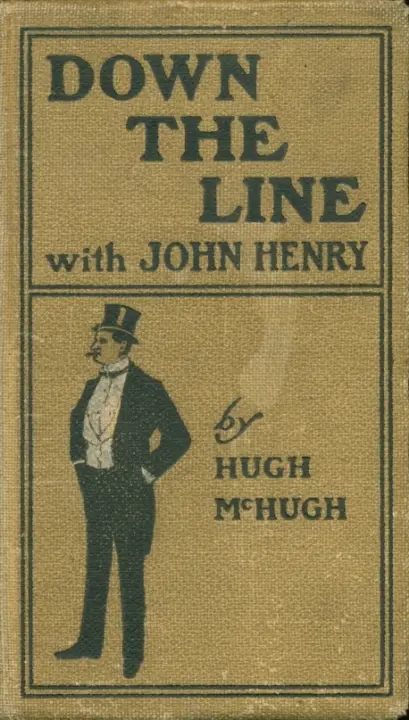
Down the line with John Henry
George V. (George Vere) Hobart
THE CLASSIC COLLECTION · 1914
"You Should Worry Says John Henry" by George V. Hobart is a humorous novel written in the early 20th century. The story revolves around John Henry and his adventures, commonly narrated through a series of comical social situations and misadventures that take place primarily in the context of his interactions with friends and family. The light-hearted tone suggests a satirical take on social norms, relationships, and the humorous complexities of modern life. The opening of the narrative introduces John Henry and his friend Bunch Jefferson as they plan to impress their peers with their newly acquired Tango skills, despite their complete inexperience. Their scheme takes a comedic turn as they blindly prepare for a party, intending to teach their curious friends the trendy dance. Throughout this portion, conversations with spouses and guests reveal playful banter and the lightheartedness of their social circle, laying the groundwork for the ensuing misadventures. The humorous depiction of the couple's interactions, along with the characters they encounter, hints at a delightful exploration of societal expectations and romantic dilemmas.
Introduction adapted from the source catalogue; source summaries may be automatically generated.
Free to read · English · 18,500 words · No account needed
MAKE TIME FOR A GOOD BOOK
On by default. Untick to stop anonymous reading totals. Each page counts after 10 seconds in view. How this works.
Anonymous counting is on unless you have switched it off.
Then she would reply, "No, Simpson; it cannot be. Fate wills it
otherwise."
Then Simpson would bite his finger-nails, pick his hat up out of the coal-scuttle, and say to Lena, "False one! You love Conrad, the floorwalker in the butcher shop. Curses on Conrad, and see what you have missed, Lena. I have tickets for a swell chowder party next Tuesday. Ah! farewell forever!"
Then Simpson would walk out and hunt up one of those places that can't get an all-night license and there, with one arm glued tight around the bar rail, he would fasten his system to a jag which would last a week.
Despair would grab him and, like Dike, he'd be Simpson with the souse
thing for sure.
When he would recover strength enough to walk down town without attracting the attention of the other side of the street, he would call on Lena and say, "Lena, forgive me for what I done, but love is blind--and, besides, I mixed my drinks. Lena, I was on the downward path, and I nearly went to Heligoland."
Then Lena would say, "Oh, Simpsey, I wanted you to prove your love, but I thought you'd prove it with beer and not red-eye--forgive me, darling!"
Then they would kiss and make up, and the wedding bells would ring just as soon as Simp's salary grew large enough to tease a pocketbook.
But these days the idea is altogether different.
Children are hardly out of the cradle before they are arrested for butting into the speed limit with a smoke wagon.
Even when they go courting they have to play to the gallery.
Nowadays Gonsalvo H. Puffenlotz walks into the parlor to see Miss
Imogene Cordelia Hoffbrew.
"Wie geht's, Imogene!" says Gonsalvo.
"Simlich!" says Imogene, standing at right angles near the piano because she thinks she is a Gibson girl.
"Imogene, dearest," Gonsalvo continues; "I called on your papa in Wall Street yesterday to find out how much money you have, but he refused to name the sum, therefore you have untold wealth!"
Gonsalvo pauses to let the Parisian clock on the mantle tick, tick,
tick!
He is making the bluff of his life, you see, and he has to do even that
on tick.
Besides, this furnishes the local color.
Then Gonsalvo bursts forth again, "Imogene! Oh! Imogene! will you be mine and I will be thine without money and without the price."
Gonsalvo pauses to let this idea get noised about a little.
Then he goes on, "Be mine, Imogene! You will be minus the money while I
will have the price!"
Your reading position is saved on this browser. Take it to another device with a library code. Reading pages adapt to text, rather than matching a printed edition.
George V. (George Vere) Hobart
BEHIND THE BOOK
This eBook is for the use of anyone anywhere in the United States and most other parts of the world at no cost and with almost no restrictions whatsoever. You may copy it, give it away or re-use it under the terms of the Project Gutenberg License included with this eBook or online at www.gutenberg.org. If you are not located in the United States, you will have to check the laws of the country where you are located before using this eBook. Read the source licence.
The original source file, including credits and licence, is retained by this library. Request an original-format copy at no charge. Please include the book title and Project Gutenberg identifier #20584.
KEEP YOUR CURIOSITY GOING
Coulson Kernahan

Maurice Baring
Frances Wright
Cécile Tormay

Frederic Jesup Stimson

W. H. P. (William Henry Pope) Jarvis