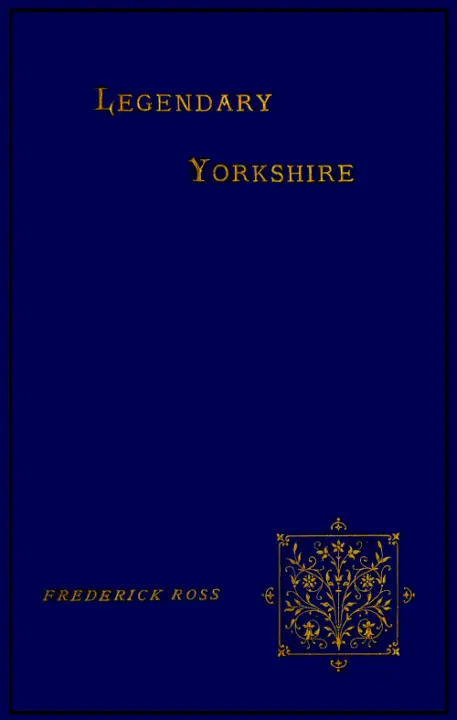
Legendary Yorkshire
Frederick Ross

THE CLASSIC COLLECTION · 1891
"Yorkshire Family Romance" by Frederick Ross is a historical narrative or collection of tales written in the late 19th century. The book delves into the rich tapestry of English history, focusing particularly on significant events and figures connected to Yorkshire. It paints a vivid picture of life during the Saxon era, featuring characters such as Kings, Earls, and Christian missionaries, reflecting the era’s struggles between paganism and the spread of Christianity. The opening of the book centers around a historical recount of Northumbria during a period marked by anarchy and the eventual restoration of Christianity, notably attributed to King Oswald. Key figures, such as Oswy and Eadwine, emerge as central characters in the tumultuous political landscape, engaging in battles against pagan forces and overseeing the establishment of religious practices in their realm. The narrative intertwines personal and political elements, setting the stage for conflicts and resolutions that underscore the era's complexity and the significance of faith in governance.
Introduction adapted from the source catalogue; source summaries may be automatically generated.
Free to read · English · 49,629 words · No account needed
MAKE TIME FOR A GOOD BOOK
On by default. Untick to stop anonymous reading totals. Each page counts after 10 seconds in view. How this works.
Anonymous counting is on unless you have switched it off.
Sir Charles returned to Boston; but in 1757 he was appointed Consul-General to Portugal, and again came to Lisbon. In 1763 he resumed his duties at Boston, retaining his consulship, although absent, until 1767, when he returned to England, and died the following year, being succeeded in the baronetcy by his brother Thomas.
Lady Frankland returned to New England with her son, and they resided upon an estate at Hopkinson which she had inherited through her parents, but at the outbreak of the Revolutionary war in 1775, she, being a Royalist, came to England, and, in 1782, married Mr. John Drew, a banker at Chichester, and died in 1783.
Richard Cromwell, her son, entered the naval service of England, but retired on his ship being ordered to America, as he felt unwilling to fight against his native land. In 1796 he was living in Chichester with a family growing up around him.
In 1865 there was published at Albany, "Sir Charles Henry Frankland, Bart.; or, Boston in the Colonial Times; by Elias Nason, M.A.," who, in the preface, says--"Who was Sir C. H. Frankland? is a question which a brief story entitled 'A legend of New England,' and published by William Lincoln, in 1843, and still more recently the ballad of 'Agnes,' by Dr. Oliver Wendell Holmes here, led the public to entertain: Was he a real person or a myth? Was there ever such a collector of the port of Boston? Was he indeed buried under the ruins of Lisbon at the time of the great earthquake? Was he rescued therefrom by the efforts of a poor girl, named Agnes Surriage, and did he afterwards make her his wife?" These questions the author answers in the subsequent pages of the pamphlet, of which the above is an epitome.
Rise of the House of Phipps.
About the middle of the seventeenth century, during the Civil War and the Restoration, there dwelt in Bristol one James Phipps, a gunsmith by trade. He was blessed with a numerous progeny; of him it might truly be said that "his quiver was full of them," for he had eventually twenty-six children, of whom twenty-one were boys. Having only his gunmaking trade to depend upon for a living, he found it difficult to provide means for feeding, clothing, and educating them, and often lay awake long at nights, pondering in his mind what he should do to meet the necessities of the case. At that time, and for two or three reigns previously, we had been at work laying the foundations of the present great American Republic, by establishing plantations of colonists, aristocratic and Episcopalian, in the south, and Puritanical in the north, most of whom had been driven thither by the persecutions they had undergone in the mother country. Bristol was then the great port of imports and exports of the Western Continent, and James Phipps naturally heard of the unbounded capabilities of the new continent, as also he heard, by tradition, of the vast wealth which the buccaneers of Elizabeth's reign--the old Vikings of Devonshire--brought from the West Indies, Peru, Mexico, etc., into the ports of Bristol, Barnstaple, Bideford, etc., and it occurred to him that here was scope enough for him and all his sons, and he emigrated with them to New England, where William, his youngest son, was born, and he seems to have died soon after, as this son is stated to have been brought up by his mother until he was eighteen years of age.
Your reading position is saved on this browser. Take it to another device with a library code. Reading pages adapt to text, rather than matching a printed edition.
Frederick Ross
Frederick Ross
BEHIND THE BOOK
This eBook is for the use of anyone anywhere in the United States and most other parts of the world at no cost and with almost no restrictions whatsoever. You may copy it, give it away or re-use it under the terms of the Project Gutenberg License included with this eBook or online at www.gutenberg.org. If you are not located in the United States, you will have to check the laws of the country where you are located before using this eBook. Read the source licence.
The original source file, including credits and licence, is retained by this library. Request an original-format copy at no charge. Please include the book title and Project Gutenberg identifier #40522.
KEEP YOUR CURIOSITY GOING
Cécile Tormay

Moritz Busch
Coulson Kernahan
John L. Ransom

Maurice Baring
Frances Wright