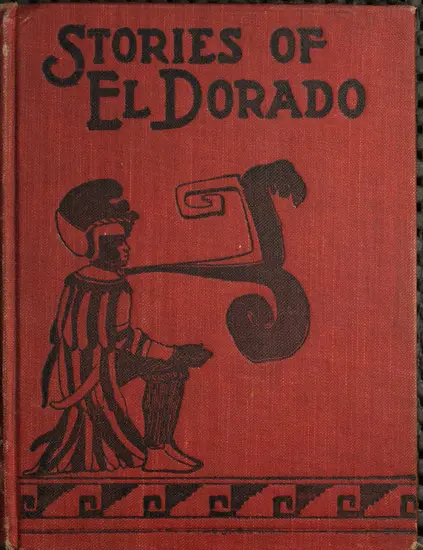
The Stories of El Dorado
Frona Eunice Wait
THE CLASSIC COLLECTION · 1897
"Yermah the Dorado: The story of a lost race" by Frona Eunice Wait is a fantasy novel written in the late 19th century. The story unfolds in the mythical Llama city of Tlamco, depicting the life of the protagonist, Yermah, who emerged from Atlantis and embraces his role as a leader in a civilization that blends magic and spirituality with the enigmatic landscapes of ancient California. The opening of the novel introduces readers to Yermah, who begins his day with a spirited ride accompanied by his horse, Cibolo, and his ocelot, Oghi. The scene sets the stage for the richly imaginative world of Tlamco, highlighting the lush natural environment and the civilization's complex societal structure that links it to Atlantis. Through vivid descriptions and the narrator's reflections on the city's historical significance, readers are drawn into Yermah's life as he navigates his responsibilities amidst the echoes of a lost lineage. As various characters are introduced, including his advisors and companions, the groundwork is laid for an adventure that intertwines themes of exploration, loyalty, and the pursuit of knowledge against a backdrop of both wonder and danger.
Introduction adapted from the source catalogue; source summaries may be automatically generated.
Free to read · English · 110,782 words · No account needed
MAKE TIME FOR A GOOD BOOK
On by default. Untick to stop anonymous reading totals. Each page counts after 10 seconds in view. How this works.
Anonymous counting is on unless you have switched it off.
The word pyramid means a place of fire, while Palai, or Pele, of the Hawaiians, is the spirit of the volcano center, or precipice of fire, as a pyramid was often called. The Arabic word Alcyone means the center, or cone, the spiritual apex around which the sun and all the sidereal galaxy are circling.
The two mountains represented the masculine potency and the feminine passivity of all which is generated in nature giving all things their proportion. Acting on this principle, the ancient sculptors down to and including Phidias, fixed the respective heights of man and woman as twenty and nineteen palms of one-third of a foot each, up to the organs of casualty and comparison, at the roots of the hair on the forehead.
Comparison with casualty on each side is the psychometric eye—the Cyclopean third eye, scouted by the would-be wise. Comparison is feminine; casualty is masculine.
The union of these forms the true vision of the soul, which, developed to its fullest capacity, gives that mysterious faculty of psychic perception, comparison and deduction beyond the intellectual comprehension of ordinary man, and marks the adept.
It was this transcendent power which the Pyramid of Cholula, built to the east of these two volcanoes, symbolized.
Farther in the same direction, towers Orizaba, correlated to the macrocosm, of which the Pyramid of Cholula was the microcosm.
Orizaba equals the height of Popocatepetl, signifying that the adept manifesting energy on the subjective plane is equal in function to the cosmic mind.
In this capacity the initiate is Quetzalcoatl, who, like Osiris, Krishna, etc., was black—that is, the unknowable and mysterious in Deity. This is why Quetzalcoatl is always shown with a black face, although he was called the Fair God. He belonged to the white race, and was the Aztec Yermah.
The antediluvians—the men who invented architecture—used the human form, the pyramid, the pentagram, and the interlaced triangles as a basis of measure and form.
The pyramid and pentagram denote the cone, or center, of sacred fire; the interlaced triangles were the balance of spirit and matter; while the obelisk was intended to show the purified nature of man.
The pillar of fire of Jacob was an obelisk. So were Stonehenge, Ellora, the Babel towers of Central America, Babylon and Judea, the gigantic ruins over all Tartary and India, and the totem-pole of the Eskimo—even the tombstones have the same grand origin.
That the obelisk everywhere outside of Egypt became a sign of the phallus does not alter its primal significance nor militate against it.
Your reading position is saved on this browser. Take it to another device with a library code. Reading pages adapt to text, rather than matching a printed edition.
Frona Eunice Wait
BEHIND THE BOOK
This eBook is for the use of anyone anywhere in the United States and most other parts of the world at no cost and with almost no restrictions whatsoever. You may copy it, give it away or re-use it under the terms of the Project Gutenberg License included with this eBook or online at www.gutenberg.org. If you are not located in the United States, you will have to check the laws of the country where you are located before using this eBook. Read the source licence.
The original source file, including credits and licence, is retained by this library. Request an original-format copy at no charge. Please include the book title and Project Gutenberg identifier #68101.
KEEP YOUR CURIOSITY GOING
Coulson Kernahan

Maurice Baring
Frances Wright
Cécile Tormay
Francis Greenleaf Allinson & Anne C. E. (Anne Crosby Emery) Allinson

Frederic Jesup Stimson