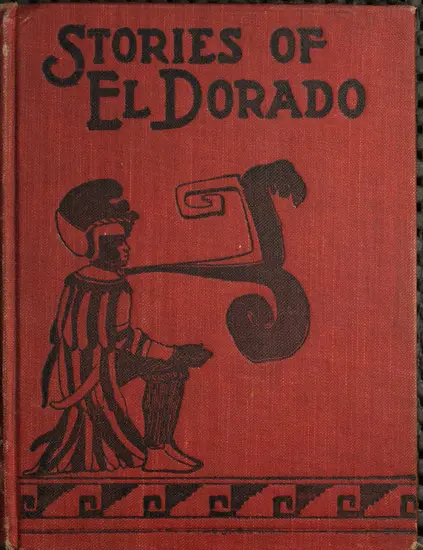
The Stories of El Dorado
Frona Eunice Wait
THE CLASSIC COLLECTION · 1897
"Yermah the Dorado: The story of a lost race" by Frona Eunice Wait is a fantasy novel written in the late 19th century. The story unfolds in the mythical Llama city of Tlamco, depicting the life of the protagonist, Yermah, who emerged from Atlantis and embraces his role as a leader in a civilization that blends magic and spirituality with the enigmatic landscapes of ancient California. The opening of the novel introduces readers to Yermah, who begins his day with a spirited ride accompanied by his horse, Cibolo, and his ocelot, Oghi. The scene sets the stage for the richly imaginative world of Tlamco, highlighting the lush natural environment and the civilization's complex societal structure that links it to Atlantis. Through vivid descriptions and the narrator's reflections on the city's historical significance, readers are drawn into Yermah's life as he navigates his responsibilities amidst the echoes of a lost lineage. As various characters are introduced, including his advisors and companions, the groundwork is laid for an adventure that intertwines themes of exploration, loyalty, and the pursuit of knowledge against a backdrop of both wonder and danger.
Introduction adapted from the source catalogue; source summaries may be automatically generated.
Free to read · English · 110,782 words · No account needed
MAKE TIME FOR A GOOD BOOK
On by default. Untick to stop anonymous reading totals. Each page counts after 10 seconds in view. How this works.
Anonymous counting is on unless you have switched it off.
The niche itself ended in a sharp triangle, and contained a blue enamel swastika, familiarly known to-day as the Keys of Saint Peter.
Astronomically, it is the sign Aquarius, which is Janus, or Saint Peter, while Pisces is the swastika in his hand. It is correlated to the spiral movements in nature everywhere, and its hieroglyph is a dragon, serpent meander, or two rivers of fire.
Three marble steps led to this altar, and there was a constant stream of people praying before it. They entered barefooted, and silently threw themselves on the floor before the altars. The swastika not only indicated the time, but also the unsettled condition, and they implored continually:
“O Thou who art master of all motion, hold Thou the earth fast in the hollow of Thy hand! Grant that it may no longer be swayed in its orbit, but may go in peace, freed from evil influence. Hear and answer, we beseech Thee!”
Rising at daybreak, the whole populace made their ablutions with scrupulous care, and dressed themselves in spotless white.
They waited in vain for a glimpse of the rising sun, and then betook themselves to the housetops.
Turning with infinite yearning to the north, they cried out:
“Spirits of the lost ones, come quickly, since thou art expected!”
This curious practice was kept up at this yearly festival until the time of the conquest of Mexico. All the native races of America believed with the Norsemen that hell was situated in the north doubtless in memory of the overwhelming destruction of the great Ice Age.
Esoterically, ice is spiritual fire.
Reëntering their houses, the populace took their canapas[15] which were the same as the Roman titular deities, and hastened to a great funeral pyre already smoking in front of the Temple of Saturn.
Since fire was the substance of the sun, and since the sun’s ray was the medium through which Deity contacted the earth, the devotees did not venture near it without prostrating themselves, kissing the earth, and making manifestations of abasement.
The worshipers made low obeisance to the four cardinal points, and threw cassia, cinnamon, sweet calamus and myrrh into the flames. Braving the heat, they held the canapas in the smoke until the figures warmed perceptibly, then wrapped them in linen scorched by the fire, and ran back to their houses.
It was no longer possible to summon them to the temples by ringing the big bell on top of the Observatory, as the tower still lay in ruins; so they waited for the trumpet-call.
Your reading position is saved on this browser. Take it to another device with a library code. Reading pages adapt to text, rather than matching a printed edition.
Frona Eunice Wait
BEHIND THE BOOK
This eBook is for the use of anyone anywhere in the United States and most other parts of the world at no cost and with almost no restrictions whatsoever. You may copy it, give it away or re-use it under the terms of the Project Gutenberg License included with this eBook or online at www.gutenberg.org. If you are not located in the United States, you will have to check the laws of the country where you are located before using this eBook. Read the source licence.
The original source file, including credits and licence, is retained by this library. Request an original-format copy at no charge. Please include the book title and Project Gutenberg identifier #68101.
KEEP YOUR CURIOSITY GOING
Coulson Kernahan

Maurice Baring
Frances Wright
Cécile Tormay
Francis Greenleaf Allinson & Anne C. E. (Anne Crosby Emery) Allinson

Frederic Jesup Stimson