THE CLASSIC COLLECTION✦The Brown MouseCLASSIC FREE BOOKS
The Brown Mouse
Herbert Quick
THE CLASSIC COLLECTION · 1911
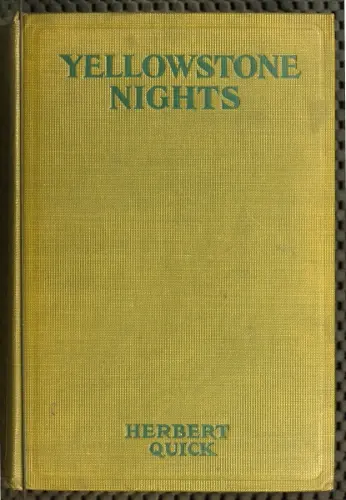
"Yellowstone Nights" by Herbert Quick is a novel written in the early 20th century. The story unfolds in and around Yellowstone Park, featuring a diverse group of characters who embark on an adventure. Central to the narrative is a young couple in love, alongside an assortment of characters including an ornithologist, a minor poet, and a cowboy-like driver, as they navigate both the park’s natural wonders and interpersonal dynamics. The opening of "Yellowstone Nights" introduces us to a picturesque scene in Yellowstone Park, where a young couple, amidst playful affection, are observed by a naturalist engrossed in his studies. As the characters interact, humor and light-hearted banter fill the text, establishing a camaraderie among the eclectic party that forms around them. The presence of the ornithologist with his glasses and note-taking, and the introduction of townsfolk and artists, hint at a broader exploration of both the park’s magnificence and the complexities of human relationships, foreshadowing incidents of adventure and possibly misadventure in the great outdoors. The narrative sets the stage for charming encounters that blend romance with the awe of nature's wonders.
Introduction adapted from the source catalogue; source summaries may be automatically generated.
Free to read · English · 69,638 words · No account needed
MAKE TIME FOR A GOOD BOOK
On by default. Untick to stop anonymous reading totals. Each page counts after 10 seconds in view. How this works.
Anonymous counting is on unless you have switched it off.
Light, airy, daintily flushed, she floated up to the bench. The fine for contempt died in Forceythe Worthington's breast, as he stared in a sort of delighted embarrassment.
"It was raght kahnd of you, Judge Wo'thin'ton," she said, looking up into his face, "to send Captain Winfield to remahnd me of mah engagement hyah. Why, he was at Franklin, and Chickamauga, and knows Tennessee! And now, gentlemen, what can Ah do foh you-all?"
The judge stepped down from the bench and handed Miss Frayn to the witness chair like a lord chancellor placing a queen on her throne. Beasley looked at the witness as if fascinated. Middlekauff seized him by the lapel of his coat.
"Don't look at her, Beasley, more'n yeh c'n help!" he whispered. "I tell
yeh, it's dangerous!"
And yet I am selected to bear blame for a momentary weakness of the
prevailing sort!
"Proceed, gentlemen!" said Judge Worthington.
Beasley gathered up his papers. "Are you the defendant?" asked he.
"Ah don't quite gathah youah meanin' suh," said she, "but Ah think not,
suh."
"You're the teacher of the Boggs School, in Teal Lake Township?"
"Oh, yes, suh!" said she. "Pahdon me! I thought you inquiahed about
something else."
Judge Worthington started as if struck by a dart.
"Let me see the papers in the case," said he excitedly.
Beasley handed them up, and the judge examined them carefully. Then he handed them down, turned his back on Miss Frayn, and spoke in a low tone, like one greatly shocked.
"Proceed!" said he.
Something in his tone or in the turning of his back seemed to strike upon the senses of Miss Frayn as unpleasant or hostile. The few questions put to her by the lawyer to lay the foundation for some other bit of evidence did not appear to affect her at all; and when she took her seat between Chester and my mother, and was reassured by their whispered communications, she looked serene, save when she noted the judge's averted face. Chester's lawyer spoke insinuatingly of spite, prejudice, and unreasonable provincialism as being at the bottom of the case.
"And," he added, "I may add jealousy--jealousy, your Honor, of the defendant's charms of person, which, as a part of the res gestæ, are evidence in this case, if your honor only would observe them."
The judge started and blushed, but still looked steadily away. Mr. Middlekauff looked relieved. Miss Frayn fretted the linoleum with little taps of her toe, and her delicate nostrils fluttered. There was a mystic tension in the air.
"Mr. Chestah," said the girl, in a low voice, "he seems to be alludin'
to--what does he mean?"
Your reading position is saved on this browser. Take it to another device with a library code. Reading pages adapt to text, rather than matching a printed edition.
Herbert Quick
Herbert Quick
Herbert Quick
BEHIND THE BOOK
This eBook is for the use of anyone anywhere in the United States and most other parts of the world at no cost and with almost no restrictions whatsoever. You may copy it, give it away or re-use it under the terms of the Project Gutenberg License included with this eBook or online at www.gutenberg.org. If you are not located in the United States, you will have to check the laws of the country where you are located before using this eBook. Read the source licence.
The original source file, including credits and licence, is retained by this library. Request an original-format copy at no charge. Please include the book title and Project Gutenberg identifier #40587.
KEEP YOUR CURIOSITY GOING
Coulson Kernahan

Maurice Baring
Frances Wright
Cécile Tormay

Frederic Jesup Stimson

W. H. P. (William Henry Pope) Jarvis