
The World of Chance
William Dean Howells
THE CLASSIC COLLECTION · 1916
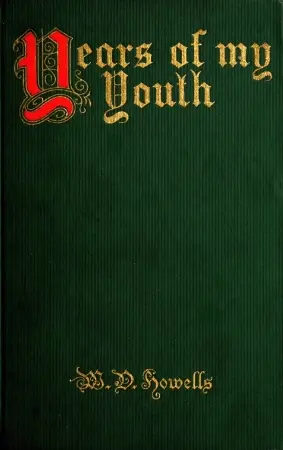
"Years of My Youth" by William Dean Howells is a memoir written in the early 20th century, offering a vivid recounting of the author's early years as he reflects on his childhood experiences in Ohio. The book aims to provide insight into Howells's formative years, focusing on his family background, early memories, and the environments that shaped him. The narrative promises to explore themes of personal growth and the rich tapestry of American life during the mid-19th century, providing readers with a glimpse into the influences that may have informed his later literary career. The opening of the memoir introduces readers to Howells's recollections of his birth and early life in Martin's Ferry, Ohio. He reflects on the blend of family stories and genuine memories that comprise his childhood narrative, sharing details about his parents’ lineage and early family dynamics. The text paints a picture of a young boy surrounded by a loving family, with connections to the history and culture of his heritage, influenced by the backdrop of small-town life in a time of great social and economic change. Howells's writing style conveys a sense of nostalgia, establishing the emotional landscape that readers can expect as they journey through his youthful experiences and the subsequent exploration of his identity.
Introduction adapted from the source catalogue; source summaries may be automatically generated.
Free to read · English · 82,255 words · No account needed
MAKE TIME FOR A GOOD BOOK
On by default. Untick to stop anonymous reading totals. Each page counts after 10 seconds in view. How this works.
Anonymous counting is on unless you have switched it off.
The vision does not seem very clear even to me, now, and I suppose not many of those kind, hard-working country printers and busy city journalists recognized themselves in my forecast of the coming newspaper man. Yet I think there is something in the glowing fancy which is here reflected only in part, and I believe some graduate of our university courses of journalism may possibly do worse than keep my fond dream in mind. In this case, the yawning counting-room may not so soon engulf his high intentions, and, keeping clear of that shining sepulcher of noble ideals for a while, he may thank me for my over-generous faith in him.
No one that I can recall specifically thanked me at the time of that editorial convention, though no doubt the usual resolutions thanking the orator and poet were passed. I should be glad to believe that at the ball which crowned our festival some kind woman-soul may have tried to feign a pleasure in my verse which no man-soul attempted; but I have only the memory of my fearful joy in the dance which I seem to have led. I went back to Columbus with such heart as I could, but in the dense foreshortening of the time's events I cannot find that of my own unhorsing from the shining procession of journalists figured in my poem. I can only be sure that I was unhorsed, and then suddenly, to my great joy and even greater surprise, was caught up and given a new mount, with even larger pay. That is, I was now invited to become professional reader for the young publisher who had issued the Poems of Two Friends, and who, apparently inspired by the signal failure of that book, imagined establishing a general publishing business in our capital. He followed it with several very creditable books, and he seems to have had the offer of many more manuscripts than he could handle. I have no doubt I dealt faithfully with these, and I know that he confided entirely in my judgment, for I was now twenty-three, without a doubt of my own as to my competence. There was one manuscript, offered by a lady who had lived some years in Chile, which I thought so interesting, though so formless, that I wrote it quite over, and my friend published it in a book which I should like to read again; but I have no hope of ever seeing it. He also published a very good Ohio version of Gautier's Romance of a Mummy, but our bravest venture was a book which the publisher himself had fancied doing, and which he had fancied my writing. This was the life of Abraham Lincoln, printed with his speeches in the same volume with the life and speeches of Hannibal Hamlin, who was nominated with him on the Presidential ticket at the Republican Convention in 1860. It was the expectation of my friend, the very just and reasonable expectation, that I should go to Springfield, Illinois, and gather the material for the work from Lincoln himself, and from his friends and neighbors. But this part of the project was distasteful to me, was impossible; I felt that there was nothing of the interviewer in me, at a time when the interviewer was not yet known by name even to himself. Not the most prophetic soul of the time, not the wisest observer of events, could have divined my loss; and I was no seer. I would not go, and I missed the greatest chance of my life in its kind, though I am not sure I was wholly wrong, for I might not have been equal to that chance; I might not have seemed to the man whom I would not go to see, the person to report him to the world in a campaign life. What we did was to commission a young law student of those I knew, to go to Springfield and get the material for me. When he brought it back, a sheaf of very admirable notes, but by no means great in quantity, I felt the charm of the material; the wild poetry of its reality was not unknown to me; I was at home with it, for I had known the belated backwoods of a certain region in Ohio; I had almost lived the pioneer life; and I wrote the little book with none of the reluctance I felt from studying its sources. I will not pretend that I had any prescience of the greatness, the tragical immortality, that underlay the few simple, mostly humble, facts brought to my hand. Those who see that unique historic figure in the retrospect will easily blame my youthful blindness, but those who only knew his life before he overtopped all the history of his time will not be so ready to censure me for my want of forecast. As it was, I felt the inadequacy of my work, and I regretted it in the preface which owned its hasty performance.
Your reading position is saved on this browser. Take it to another device with a library code. Reading pages adapt to text, rather than matching a printed edition.
William Dean Howells

William Dean Howells

William Dean Howells

William Dean Howells
BEHIND THE BOOK
This eBook is for the use of anyone anywhere in the United States and most other parts of the world at no cost and with almost no restrictions whatsoever. You may copy it, give it away or re-use it under the terms of the Project Gutenberg License included with this eBook or online at www.gutenberg.org. If you are not located in the United States, you will have to check the laws of the country where you are located before using this eBook. Read the source licence.
The original source file, including credits and licence, is retained by this library. Request an original-format copy at no charge. Please include the book title and Project Gutenberg identifier #47060.
KEEP YOUR CURIOSITY GOING

Charles G. (Charles Griffith) Ross
Hannah Webster Foster

Emily Lawless
Edwin Hamlin Carr

Charles De Lano Hine
Andrew Ure