
The World of Chance
William Dean Howells
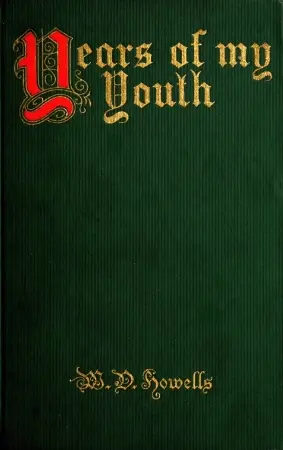
THE CLASSIC COLLECTION · 1916
"Years of My Youth" by William Dean Howells is a memoir written in the early 20th century, offering a vivid recounting of the author's early years as he reflects on his childhood experiences in Ohio. The book aims to provide insight into Howells's formative years, focusing on his family background, early memories, and the environments that shaped him. The narrative promises to explore themes of personal growth and the rich tapestry of American life during the mid-19th century, providing readers with a glimpse into the influences that may have informed his later literary career. The opening of the memoir introduces readers to Howells's recollections of his birth and early life in Martin's Ferry, Ohio. He reflects on the blend of family stories and genuine memories that comprise his childhood narrative, sharing details about his parents’ lineage and early family dynamics. The text paints a picture of a young boy surrounded by a loving family, with connections to the history and culture of his heritage, influenced by the backdrop of small-town life in a time of great social and economic change. Howells's writing style conveys a sense of nostalgia, establishing the emotional landscape that readers can expect as they journey through his youthful experiences and the subsequent exploration of his identity.
Introduction adapted from the source catalogue; source summaries may be automatically generated.
Free to read · English · 82,255 words · No account needed
MAKE TIME FOR A GOOD BOOK
On by default. Untick to stop anonymous reading totals. Each page counts after 10 seconds in view. How this works.
Anonymous counting is on unless you have switched it off.
In one house there was more singing and playing and in another more reading and talking. All the young ladies were beautiful, with the supremacy of that young lady whom it was our poetry to hold so beautiful that no other might contest it. As I believe the use still is in the South, we called them Miss Lilly, Miss Julia, Miss Sally, Miss Fanny, Miss Maggie, whether they were the older or the younger daughters of the family. We were always meeting them at parties or, failing that or including that, we went to call upon them at their houses. We called in the evening and it was no strange thing for a young man to call every evening of the week, not at one house, but at three or four. How, in the swift sequence of the parties, we managed so often to find the young ladies at home remains one of the mysteries which age must leave youth to solve. Possibly in that sharply foreshortened perspective of the past the parties show of closer succession than they really were.
At most of the houses we saw only the young ladies; it was they whom we asked for; but there were other houses where the mothers of the family received with the daughters, and at one of these my welcome was immediately of a kindness and always of a conscience which it touches me to realize. I was taken at the best I meant as well as the best I was by the friend who was the exquisite spirit of the house, and made me at home in it. My world had been very small, and it has never since been the greatest, but I think yet, as I divined then, that she was of a social genius which would have made her in any great-worldlier capital the leader she was in ours, where her supremacy in that sort was no more questioned than the incomparable loveliness of that most beautiful girl whom every one worshiped. Her house expressed her, so that when her home finally changed to another the new house obeyed the magic of her taste and put on the semblance of the first, with a conservatory breathing through it the odor of her flowers and the murmur of the dove that lived among them: herself a flower-like and birdlike presence, delicate, elegant, such as might have been fancied of some fine, old-world condition in a new-world reading of it. She lived to rule socially in a community which attested its gentleness by its allegiance to her until she was past eighty, but when I knew her first she was too young to be titularly accepted as their mother by her stepdaughters and was known to them as their cousin in what must have been her own convention; but I suppose she liked to be not less than sovereign among her equals. With me she was not only the kindest, but the most candid of my friends; my literary journalism and later my literature may have been to her liking, but she never flattered me for them when, as I now know, too much praise had made me hungry for flattery. No young man such as I was then could have had a wiser and faithfuler friend, and I render her memory my tribute after so many years from a gratitude which cannot be spoken. After so many years I cannot make out whether she accepted or merely suffered my extreme opinions in politics; though she was wholly Ohioan, her husband's family had close affiliations with the South; but hers was certainly a Republican house, as nearly all the houses I frequented were. What may have made her even anticipatively my friend was our common acceptance of the Swedenborgian philosophy, which long, long afterward, the last time I saw her, I spoke of as a philosophy. But then she rejected the notion with scorn; it might be a pleasant fancy, she said, but a philosophy, no; and I perceived that she had come the way of that agnosticism which the whole cultivated world had taken. Now I have heard that in her last years she went back to the faith which was perhaps more inherited than reasoned in both of us. But I am sure that it was at first a bond and that she was conscientiously true to this bond of a common spiritual tradition, when upon some public recognition of my work she reminded me how according to Swedenborg every beautiful thing we said or did was by an influx from the divine. I submitted outwardly, but inwardly I rebelled: not that my conceit of the things I did was so very great; I believe I thought rather modestly of myself for doing them, and I always meant to do much better things; in fact I still have my masterpiece before me; but, poor things as they were, I wished to feel them wholly mine.
Your reading position is saved on this browser. Take it to another device with a library code. Reading pages adapt to text, rather than matching a printed edition.
William Dean Howells

William Dean Howells

William Dean Howells

William Dean Howells
BEHIND THE BOOK
This eBook is for the use of anyone anywhere in the United States and most other parts of the world at no cost and with almost no restrictions whatsoever. You may copy it, give it away or re-use it under the terms of the Project Gutenberg License included with this eBook or online at www.gutenberg.org. If you are not located in the United States, you will have to check the laws of the country where you are located before using this eBook. Read the source licence.
The original source file, including credits and licence, is retained by this library. Request an original-format copy at no charge. Please include the book title and Project Gutenberg identifier #47060.
KEEP YOUR CURIOSITY GOING

Charles G. (Charles Griffith) Ross
Hannah Webster Foster

Emily Lawless
Edwin Hamlin Carr

Charles De Lano Hine
Andrew Ure