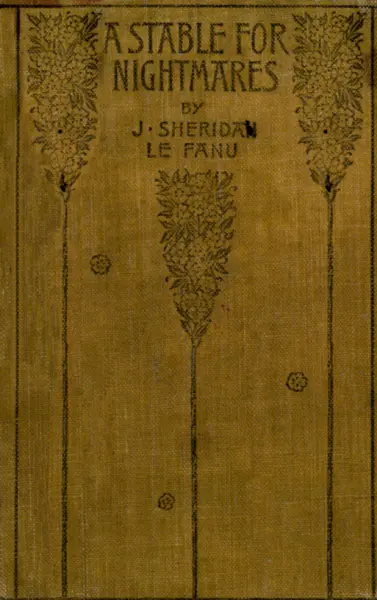
A Stable for Nightmares; or, Weird Tales
Joseph Sheridan Le Fanu & Charles L. (Charles Lawrence), Sir Young
THE CLASSIC COLLECTION · 1864
"Wylder's Hand" by Joseph Sheridan Le Fanu is a novel written during the mid-19th century. The story unfolds with the protagonist, Charles de Cresseron, as he journeys to Gylingden while carrying a letter from Mark Wylder, hinting at a complex interplay of family relations and an impending marriage. The narrative is characterized by its rich descriptions of the English countryside and a focus on the entangled lineage of Wylders and Brandons, which sets the stage for themes of madness, inheritance, and the intricacies of interpersonal relationships. The opening of "Wylder's Hand" introduces us to Charles de Cresseron as he reflects upon his past while driving through Gylingden. He encounters memories of his childhood, particularly connected to the Brandon family, which are laced with a sense of nostalgia and foreboding. The letter from Mark Wylder reveals his recent inheritance and his plans to marry Dorcas Brandon, stirring apprehension in Charles as he remembers the intertwined histories of their families. As Charles arrives at Brandon Hall, the dynamics between characters become clear, highlighting the complexities at play, including the impending marriage and potential conflicts that could arise from it. This opening sets a tone of mystery and tension, inviting the reader to delve deeper into the unfolding drama.
Introduction adapted from the source catalogue; source summaries may be automatically generated.
Free to read · English · 173,466 words · No account needed
MAKE TIME FOR A GOOD BOOK
On by default. Untick to stop anonymous reading totals. Each page counts after 10 seconds in view. How this works.
Anonymous counting is on unless you have switched it off.
'Well, though the book is lost, we retain the moral, you see,' said Rachel with a little laugh; 'and it has always seemed to me that if it had not been necessary to say, "my honey, my love, and my dear," that good soul would not have said it, and you may be pretty sure that if she had not, and with the suitable by-play too, she might not have ridden to Gamwell that day.'
'And you don't think you could have persuaded yourself to repeat that little charm, which obtained her boon and one of his horses straightway?' said Lord Chelford.
'Well, I don't know what a great temptation and a contumacious husband might bring one to; but I'm afraid I'm a stubborn creature, and have not the feminine gift of flattery. If, indeed, he felt his inferiority and owned his dependence, I think I might, perhaps, have called him "my honey, my love, and my dear," and encouraged and comforted him; but to buy my personal liberty, and the right to visit my brother at Gamwell--never!'
And yet she looked, Lord Chelford thought, very goodhumoured and pleasant, and he fancied a smile from her might do more with some men than all gentle Joan's honeyed vocabulary.
'I own,' said Lord Chelford, laughing, 'that, from prejudice, I suppose, I am in favour of the apostolic method, and stand up for the divine right of my sex; but then, don't you see, it is your own fault, if you make it a question of right, when you may make it altogether one of fascination?'
'Who, pray, is disputing the husband's right to rule?' demanded old Lady
Chelford unexpectedly.
'I am very timidly defending it against very serious odds,' answered her
son.
'Tut, tut! my dears, what's all this; you must obey your husbands,' cried the dowager, who put down nonsense with a high hand, and had ruled her lord with a rod of iron.
'That's no tradition of the Brandons,' said Miss Dorcas, quietly.
'The Brandons--pooh! my dear--it is time the Brandons should grow like other people. Hitherto, the Brandon men have all, without exception, been the wickedest in all England, and the women the handsomest and the most self-willed. Of course the men could not be obeyed in all things, nor the women disobeyed. I'm a Brandon myself, Dorcas, so I've a right to speak. But the words are precise--honour and obey--and obey you must; though, of course you may argue a point, if need be, and let your husband hear reason.'
And, having ruled the point, old Lady Chelford leaned back and resumed
her doze.
Your reading position is saved on this browser. Take it to another device with a library code. Reading pages adapt to text, rather than matching a printed edition.
Joseph Sheridan Le Fanu & Charles L. (Charles Lawrence), Sir Young
Joseph Sheridan Le Fanu
Joseph Sheridan Le Fanu
Joseph Sheridan Le Fanu
BEHIND THE BOOK
This eBook is for the use of anyone anywhere in the United States and most other parts of the world at no cost and with almost no restrictions whatsoever. You may copy it, give it away or re-use it under the terms of the Project Gutenberg License included with this eBook or online at www.gutenberg.org. If you are not located in the United States, you will have to check the laws of the country where you are located before using this eBook. Read the source licence.
The original source file, including credits and licence, is retained by this library. Request an original-format copy at no charge. Please include the book title and Project Gutenberg identifier #9983.
KEEP YOUR CURIOSITY GOING
Coulson Kernahan

Maurice Baring
Frances Wright
Cécile Tormay

Frederic Jesup Stimson

W. H. P. (William Henry Pope) Jarvis