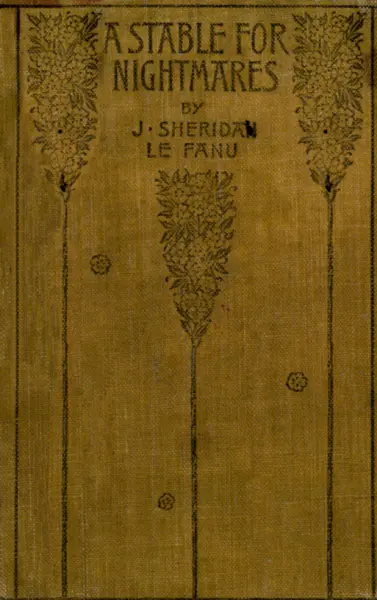
A Stable for Nightmares; or, Weird Tales
Joseph Sheridan Le Fanu & Charles L. (Charles Lawrence), Sir Young
THE CLASSIC COLLECTION · 1864
"Wylder's Hand" by Joseph Sheridan Le Fanu is a novel written during the mid-19th century. The story unfolds with the protagonist, Charles de Cresseron, as he journeys to Gylingden while carrying a letter from Mark Wylder, hinting at a complex interplay of family relations and an impending marriage. The narrative is characterized by its rich descriptions of the English countryside and a focus on the entangled lineage of Wylders and Brandons, which sets the stage for themes of madness, inheritance, and the intricacies of interpersonal relationships. The opening of "Wylder's Hand" introduces us to Charles de Cresseron as he reflects upon his past while driving through Gylingden. He encounters memories of his childhood, particularly connected to the Brandon family, which are laced with a sense of nostalgia and foreboding. The letter from Mark Wylder reveals his recent inheritance and his plans to marry Dorcas Brandon, stirring apprehension in Charles as he remembers the intertwined histories of their families. As Charles arrives at Brandon Hall, the dynamics between characters become clear, highlighting the complexities at play, including the impending marriage and potential conflicts that could arise from it. This opening sets a tone of mystery and tension, inviting the reader to delve deeper into the unfolding drama.
Introduction adapted from the source catalogue; source summaries may be automatically generated.
Free to read · English · 173,466 words · No account needed
MAKE TIME FOR A GOOD BOOK
On by default. Untick to stop anonymous reading totals. Each page counts after 10 seconds in view. How this works.
Anonymous counting is on unless you have switched it off.
Poor Dolly! Her Willie would not tell her yet. He kneeled down in the study--'Little man's' top, and some cut paper nondescripts, were lying where he had left them, at his elbow--and he tried to pray, and then he remembered that his darling ought to know that he was going into the presence of his Maker.
Yes, he would tell poor Dolly first, and then his little man. He would repeat his hymn with him, and pray--and so he went up the nursery stairs.
Poor Dolly, very tired, had gone to lie down for a little. He would not disturb her--no, let her enjoy for an hour more her happy illusion.
When he went into the nursery little Fairy was sitting up, taking his medicine; the nurse's arm round his thin shoulders. He sat down beside him, weeping gently, his thin face turned a little away, and his hand on the coverlet.
Little man looked wonderingly from his tired eyes on Wapsie, and his thin fingers crept on his hand, and Wapsie turned about, drying his eyes, and said--
'Little man! my darling!'
'He's like himself, Sir, while he's sitting up--his little head quite
right again.'
'My head's quite right, Wapsie,' the little man whispered, sadly.
'Thank God, my darling!' said the vicar. The tears were running down his cheeks while he parted little Fairy's golden hair with his fingers.
'When I am quite well again,' whispered the little man, 'won't you bring me to the castle meadow, where the wee river is, and we'll float races with daisies and buttercups--the way you did on my birthday.'
'They say that little mannikin----' suddenly the vicar stopped. 'They say that little mannikin won't get well.'
'And am I always to be sick, here in my little bed, Wapsie?' whispered little Fairy, in his dreamy, earnest way, that was new to him.
'No, darling; not always sick: you'll be happier than ever--but not here; little man will be taken by his Saviour, that loves him best of all--and he'll be in heaven--and only have a short time to wait, and maybe his poor Wapsie will come to him, please God, and his darling mamma--and we'll all be happy together, for ever, and never be sick or sorry any more, my treasure--my little Fairy--my darling.'
And little man looked on him with his tired eyes, not quite understanding what it meant, nor why Wapsie was crying; and the nurse said--
'He'd like to be dozin', Sir, he's so tired, please.' So down the poor little fellow lay, his 'Wapsie' praying by his bedside.
Your reading position is saved on this browser. Take it to another device with a library code. Reading pages adapt to text, rather than matching a printed edition.
Joseph Sheridan Le Fanu & Charles L. (Charles Lawrence), Sir Young
Joseph Sheridan Le Fanu
Joseph Sheridan Le Fanu
Joseph Sheridan Le Fanu
BEHIND THE BOOK
This eBook is for the use of anyone anywhere in the United States and most other parts of the world at no cost and with almost no restrictions whatsoever. You may copy it, give it away or re-use it under the terms of the Project Gutenberg License included with this eBook or online at www.gutenberg.org. If you are not located in the United States, you will have to check the laws of the country where you are located before using this eBook. Read the source licence.
The original source file, including credits and licence, is retained by this library. Request an original-format copy at no charge. Please include the book title and Project Gutenberg identifier #9983.
KEEP YOUR CURIOSITY GOING
Coulson Kernahan

Maurice Baring
Frances Wright
Cécile Tormay

Frederic Jesup Stimson

W. H. P. (William Henry Pope) Jarvis