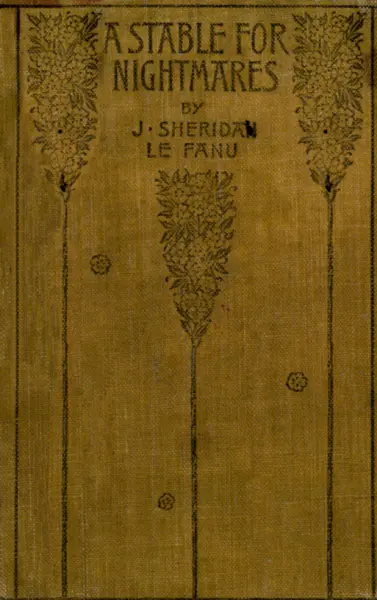
A Stable for Nightmares; or, Weird Tales
Joseph Sheridan Le Fanu & Charles L. (Charles Lawrence), Sir Young
THE CLASSIC COLLECTION · 1864
"Wylder's Hand" by Joseph Sheridan Le Fanu is a novel written during the mid-19th century. The story unfolds with the protagonist, Charles de Cresseron, as he journeys to Gylingden while carrying a letter from Mark Wylder, hinting at a complex interplay of family relations and an impending marriage. The narrative is characterized by its rich descriptions of the English countryside and a focus on the entangled lineage of Wylders and Brandons, which sets the stage for themes of madness, inheritance, and the intricacies of interpersonal relationships. The opening of "Wylder's Hand" introduces us to Charles de Cresseron as he reflects upon his past while driving through Gylingden. He encounters memories of his childhood, particularly connected to the Brandon family, which are laced with a sense of nostalgia and foreboding. The letter from Mark Wylder reveals his recent inheritance and his plans to marry Dorcas Brandon, stirring apprehension in Charles as he remembers the intertwined histories of their families. As Charles arrives at Brandon Hall, the dynamics between characters become clear, highlighting the complexities at play, including the impending marriage and potential conflicts that could arise from it. This opening sets a tone of mystery and tension, inviting the reader to delve deeper into the unfolding drama.
Introduction adapted from the source catalogue; source summaries may be automatically generated.
Free to read · English · 173,466 words · No account needed
MAKE TIME FOR A GOOD BOOK
On by default. Untick to stop anonymous reading totals. Each page counts after 10 seconds in view. How this works.
Anonymous counting is on unless you have switched it off.
'Wonderful place Shillingsworth, Sir; one does not really, until one has visited it two or three times over, at all comprehend its wealth and importance; and how justly high it deserves to hold its head amongst the provincial emporia of our productive industry.'
The shapeless traveller in the corner touched his ear with his pudgy dogskin fingers, and shook his hand and head a little, in token either that he was deaf, or the noise such as to prevent his hearing, and in the next moment the glittering eyes closed, and the pantomimist appeared to be asleep.
And now, again, the train subsided to a stand-still, and Shillingsworth resounded through the night air, and Larkin scrambled forward to the window, by which sat the enveloped gentleman, and called the porter, and, with many unheeded apologies, pulled out his various properties, close by the knees of the tranquil traveller. So, Mr. Larkin was on the platform, and his belongings stowed away against the wall of the station-house.
He made an enquiry of the guard, with whom he was acquainted, about his companion; but the guard knew nothing of the 'party,' neither did the porter, to whom the guard put a similar question.
So, as Larkin walked down the platform, the whistle sounded and the train glided forward, and as it passed him, the gentleman in the cloak and queer hat was looking out. A lamp shone full on him. Mr. Larkin's heart stood still for a moment, and then bounded up as if it would choke him.
'It's him, by ----!' and Mr. Larkin, forgetting syntax, and propriety, and religion, all together, and making a frantic race to keep up with the train, shouted--
'Stop it, stop it--hollo!--stop--stop--ho, stop!'
But he pleaded with the winds; and before he had reached the end of the platform, the carriage windows were flying by him with the speed of wheel-spokes, and the end of the coupe, with its red lantern, sailed away through the cutting.
'Forgot summat, Sir,' said the porter, touching his hat.
'Yes--signal--stop him, can you?'
The porter only scratched his head, under his cap, and smiled sheepishly after the train. Jos. Larkin knew, the next moment, he had talked nonsense.
'I--I--yes--I have--have you an engine here:--express--I'll pay
anything.'
But, no, there was 'no engine--not nearer than the junction, and she
might not be spared.'
'How far is the junction?'
'Nineteen and a-half.'
Your reading position is saved on this browser. Take it to another device with a library code. Reading pages adapt to text, rather than matching a printed edition.
Joseph Sheridan Le Fanu & Charles L. (Charles Lawrence), Sir Young
Joseph Sheridan Le Fanu
Joseph Sheridan Le Fanu
Joseph Sheridan Le Fanu
BEHIND THE BOOK
This eBook is for the use of anyone anywhere in the United States and most other parts of the world at no cost and with almost no restrictions whatsoever. You may copy it, give it away or re-use it under the terms of the Project Gutenberg License included with this eBook or online at www.gutenberg.org. If you are not located in the United States, you will have to check the laws of the country where you are located before using this eBook. Read the source licence.
The original source file, including credits and licence, is retained by this library. Request an original-format copy at no charge. Please include the book title and Project Gutenberg identifier #9983.
KEEP YOUR CURIOSITY GOING
Coulson Kernahan

Maurice Baring
Frances Wright
Cécile Tormay

Frederic Jesup Stimson

W. H. P. (William Henry Pope) Jarvis