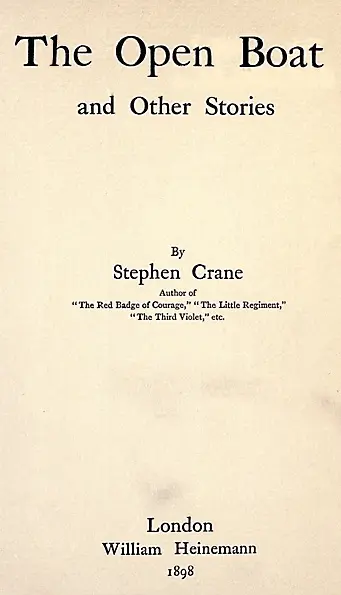
The Open Boat and Other Stories
Stephen Crane
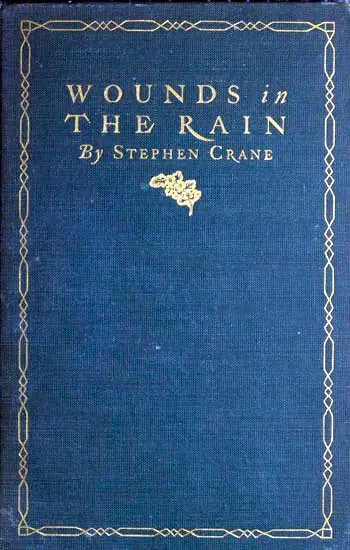
THE CLASSIC COLLECTION · 1899
"Wounds in the Rain: War Stories" by Stephen Crane is a collection of war stories written in the late 19th century. This work delves into the experiences of soldiers during the American-Spanish War, portraying the harsh realities and emotional tribulations faced on the battlefield. The stories feature various characters, particularly focusing on individual soldiers and their experiences, often framed within the chaos of combat and their personal reflections on courage, fear, and mortality. At the start of the collection, the narrative unfolds with a scene of soldiers laboriously constructing a road in Cuba amid the tension of impending battle. The men reflect their weariness, hunger, and camaraderie as they work together under a stifling sun. The peace is shattered by gunfire, as they prepare to engage in combat, navigating through the stark realities of war that intertwine elements of humor and despair. The opening highlights the duality of soldiering, where mundane tasks juxtaposed against the backdrop of conflict deepen the exploration of their inner lives and the broader implications of war.
Introduction adapted from the source catalogue; source summaries may be automatically generated.
Free to read · English · 72,654 words · No account needed
MAKE TIME FOR A GOOD BOOK
On by default. Untick to stop anonymous reading totals. Each page counts after 10 seconds in view. How this works.
Anonymous counting is on unless you have switched it off.
"Boys," he said in his ordinary voice, "I'm clean played out. I can't go another step. You fellows go on, and leave me to come as soon as I am able."
"Oh, no, that wouldn't do at all," said Little Nell and Tailor
together.
Point moved over to a soft place, and dropped amid whatever traps he
was himself carrying.
"Don't know whether it's ancestral or merely from the--sun--but I've got a stroke," said Shackles, and gently slumped over to a prostrate position before either Little Nell or Tailor could reach him.
Thereafter Shackles was parental; it was Little Nell and Tailor who were really suffering from a stroke, either ancestral or from the sun.
"Put my blanket-roll under my head, Nell, me son," he said gently. "There now! That is very nice. It is delicious. Why, I'm all right, only--only tired." He closed his eyes, and something like an easy slumber came over him. Once he opened his eyes. "Don't trouble about me," he remarked.
But the two fussed about him, nervous, worried, discussing this plan and that plan. It was Point who first made a business-like statement. Seated carelessly and indifferently upon his soft place, he finally blurted out:
"Say! Look here! Some of us have got to go on. We can't all stay here. Some of us have got to go on."
It was quite true; the Eclipse could take no account of strokes. In the end Point and Tailor went on, leaving Little Nell to bring on Shackles as soon as possible. The latter two spent many hours in the grass by the roadside. They made numerous abrupt acquaintances with passing staff officers, privates, muleteers, many stopping to inquire the wherefore of the death-faced figure on the ground. Favours were done often and often, by peer and peasant--small things, of no consequence, and yet warming.
It was dark when Shackles and Little Nell had come slowly to where they could hear the murmur of the army's bivouac.
"Shack," gasped Little Nell to the man leaning forlornly upon him, "I guess we'd better bunk down here where we stand."
"All right, old boy. Anything you say," replied Shackles, in the bass and hollow voice which arrives with such condition.
They crawled into some bushes, and distributed their belongings upon the ground. Little Nell spread out the blankets, and generally played housemaid. Then they lay down, supperless, being too weary to eat. The men slept.
At dawn Little Nell awakened and looked wildly for Shackles, whose empty blanket was pressed flat like a wet newspaper on the ground. But at nearly the same moment Shackles appeared, elate.
"Come on," he cried; "I've rustled an invitation for breakfast."
Your reading position is saved on this browser. Take it to another device with a library code. Reading pages adapt to text, rather than matching a printed edition.
Stephen Crane
Stephen Crane
Stephen Crane
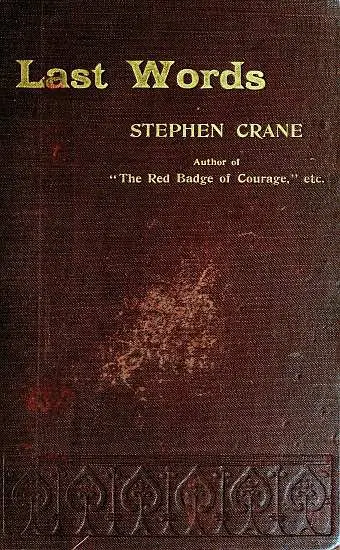
Stephen Crane
BEHIND THE BOOK
This eBook is for the use of anyone anywhere in the United States and most other parts of the world at no cost and with almost no restrictions whatsoever. You may copy it, give it away or re-use it under the terms of the Project Gutenberg License included with this eBook or online at www.gutenberg.org. If you are not located in the United States, you will have to check the laws of the country where you are located before using this eBook. Read the source licence.
The original source file, including credits and licence, is retained by this library. Request an original-format copy at no charge. Please include the book title and Project Gutenberg identifier #43706.
KEEP YOUR CURIOSITY GOING
Cécile Tormay

Moritz Busch
Coulson Kernahan
John L. Ransom

Maurice Baring
Frances Wright