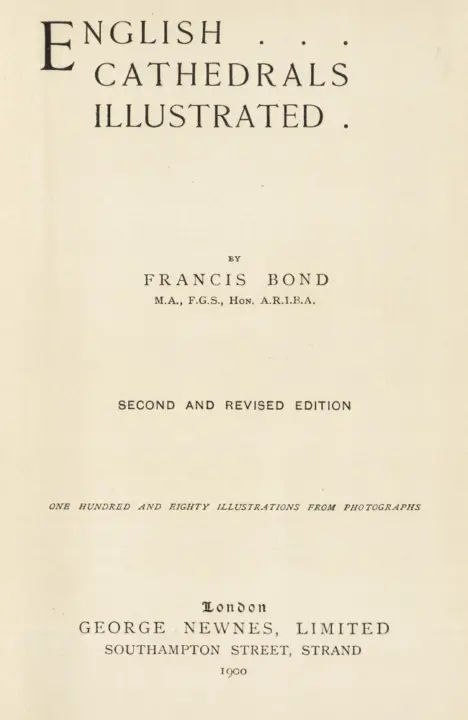
English Cathedrals Illustrated Second and Revised Edition
Francis Bond
THE CLASSIC COLLECTION · 1910
"Wood Carvings in English Churches" by Francis Bond is a historical account written in the early 20th century. The book explores the art of wood carving in English churches, focusing specifically on stalls, tabernacle work, bishops' thrones, and chancel chairs from the medieval period to the Renaissance. It aims to highlight the significance and beauty of these often-overlooked examples of ecclesiastical craftsmanship, offering insights into their design, construction, and historical context. At the start of the book, the author provides a preamble stressing the value of stallwork in English churches, noting its rarity compared to similar works in other countries, many of which have been lost to neglect or destruction. Bond describes the architectural and artistic features of stalls used by monks and canons during services, detailing their intricate design elements such as canopies, supports, and ornamentation. He aims not only to inform readers about the significance of these wood carvings but also to inspire pride in England's rich artistic heritage.
Introduction adapted from the source catalogue; source summaries may be automatically generated.
Free to read · English · 30,464 words · No account needed
MAKE TIME FOR A GOOD BOOK
On by default. Untick to stop anonymous reading totals. Each page counts after 10 seconds in view. How this works.
Anonymous counting is on unless you have switched it off.
In many cases the chair is a composite product, made up of fragments of screens, bench ends and the like; this seems to be the case with the chairs in the churches of Bridford, Devon, and Othery, Somerset; that at Much Hadham, Hertfordshire, appears to be put together out of the fragments of a screen (126). In the Chapter House of Gloucester cathedral are two chairs, on the inner panels of the back of which are carved "The Last Supper" and "The Ascension" respectively; the panels were presented in the time of Dean Law, and, provided with a framework, now form part of two chairs.
Where, however, the chair has a representation of some ecclesiastical subject, the presumption is that it was made for the church in which it is placed. In Cartmel Priory church is a fine chair on the back of which is represented the Resurrection; below are seen the Roman soldiers; above, Christ shews the wounds in His hands (127). At Sanderstead, Surrey, Abraham {130} with uplifted sword is about to slay Isaac; on the right is shewn the ram, on the left an angel. The same subject appears, better carved, on the back of one of two chairs brought from a church in Suffolk, now pulled down; on the other chair is a representation of what looks like the Temptation (128). In Halsall church, Lancashire, are two beautiful chairs with the initials IHS; beneath them is a scroll on which is inscribed Ecce quomodo amabat (128). In the Victoria and Albert Museum is a similar "winged" chair, which bears the initials IPI and the date 1670. In the chancel of Combmartin church, Devon, is a mahogany chair with wheat and grapes, apparently referring to the sacramental bread and wine; it had been for many years in the family of the present incumbent, Rev. F. W. Jones, and was presented by him to the church; it is possible that it was originally made for a church (129).
Numbers followed by the name of the Photographer or the Draughtsman refer
to Illustrations
Aberdeen, King's College, 29, 68
Abergavenny Priory, Monmouth, 46, G. G. Buckley. 29, 40, 47
Amiens, 11
Aquileia, 101
Avignon, 104, F. Bond. 104
Balsham, Cambs., 3, G. G. Buckley. 1, 5, 100, 124
Barnack, Northants, 124
Basing, Hants, 79
Bedford, 116
Beeston Regis, Norfolk, 119, C. F. Nunneley. 124
Belgium, 29, 31
Beverley Minster, Yorks., 3, 14, 14; C. Goulding. 7, Alan Potter. 27, 63,
64, and frontispiece; W. E. Wigfall. 64, 65, 106; F. H. Crossley. 5,
7, 26, 29, 40, 51, 65, 66, 68, 74, 106
Beverley St Mary, 2, F. H. Crossley. 1, 5
Bishop Auckland, Durham, 31, 67
Bishop Cannings, Wilts., 118, Wilts. Archæological Society. 119
Blythburgh, Suffolk, 11, S. Gardner. 7
Bologna, St Stefano, 101
Bossal, Yorks., 92
Boston, Lincs., 86, 95
Brancepeth, Durham, 93, F. Bond. 31, 67, 100
Braunton, Devon, 96
Brescia, Sta. Maria dei Miracoli, 82
Bristol Cathedral, 29, 50. St Nicholas, 97
Bruges, 68, 70
Burlingham St Edmund, Norfolk, 85
Your reading position is saved on this browser. Take it to another device with a library code. Reading pages adapt to text, rather than matching a printed edition.
BEHIND THE BOOK
This eBook is for the use of anyone anywhere in the United States and most other parts of the world at no cost and with almost no restrictions whatsoever. You may copy it, give it away or re-use it under the terms of the Project Gutenberg License included with this eBook or online at www.gutenberg.org. If you are not located in the United States, you will have to check the laws of the country where you are located before using this eBook. Read the source licence.
The original source file, including credits and licence, is retained by this library. Request an original-format copy at no charge. Please include the book title and Project Gutenberg identifier #43530.
KEEP YOUR CURIOSITY GOING
Cécile Tormay

Moritz Busch
John L. Ransom
Frances Wright
Cécile Tormay

Mabel Potter Daggett