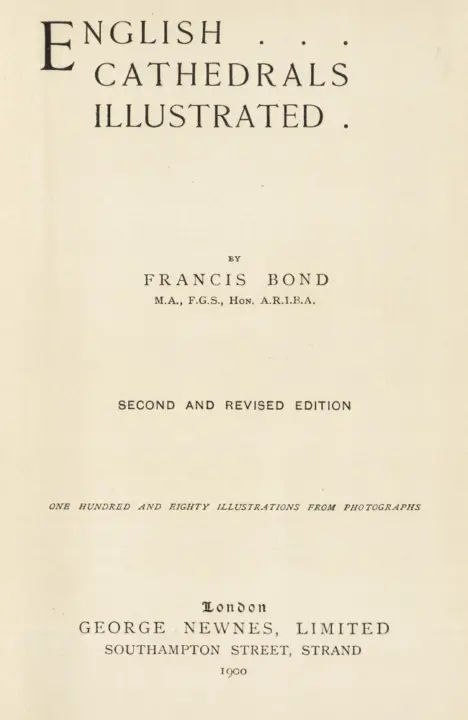
English Cathedrals Illustrated Second and Revised Edition
Francis Bond
THE CLASSIC COLLECTION · 1910
"Wood Carvings in English Churches" by Francis Bond is a historical account written in the early 20th century. The book explores the art of wood carving in English churches, focusing specifically on stalls, tabernacle work, bishops' thrones, and chancel chairs from the medieval period to the Renaissance. It aims to highlight the significance and beauty of these often-overlooked examples of ecclesiastical craftsmanship, offering insights into their design, construction, and historical context. At the start of the book, the author provides a preamble stressing the value of stallwork in English churches, noting its rarity compared to similar works in other countries, many of which have been lost to neglect or destruction. Bond describes the architectural and artistic features of stalls used by monks and canons during services, detailing their intricate design elements such as canopies, supports, and ornamentation. He aims not only to inform readers about the significance of these wood carvings but also to inspire pride in England's rich artistic heritage.
Introduction adapted from the source catalogue; source summaries may be automatically generated.
Free to read · English · 30,464 words · No account needed
MAKE TIME FOR A GOOD BOOK
On by default. Untick to stop anonymous reading totals. Each page counts after 10 seconds in view. How this works.
Anonymous counting is on unless you have switched it off.
But there is another purpose which parochial stalls subserved, and that is the most important of all: viz., to accommodate a surpliced choir. The introduction of surpliced choirs into chancels in modern days was an innovation at first deeply resented, and seems to have been usually made in ignorance of the existence of mediæval precedent. Precedent there is, however, in abundance. England was a merry, tuneful land before the Reformation, and nowhere more than in the churches. The musical part of the service grew more and more ornate, especially in the last years immediately preceding the Dissolution; the parishes--village and town parishes alike--delighted in "the cheerful noise of organs and fiddles and anthems," and spent on music a very large part of the church income. The early years of the sixteenth century were a glorious time for church music; the parishioners loved it and would have it, and were willing to pay for it; it was not forced on them from above; it was the people and the people's churchwardens who would have it. What a joyful sound we should hear from the church doors if we could enter once more an English church of the sixteenth century and hear the surpliced men and boys a singing in the choir, accompanied by organs and citterns and fiddles and crowdes and dulcimers and all instruments of music in the rood loft, with perhaps an anthem or a solo on high festival days from distinguished vocalists of the neighbouring villages; those were happy times. Take the churchwardens' accounts of St Mary at Hill, London.[60] In this church in 1523 there was "paid 15d. for 6 round mats of wicker for the clerks." If we assume six more for the boys, we get a regular choir of six men and six boys. But besides these an extra choir of choirmen and boys was engaged for special days. In 1527 there was "paid 9d. at the Sun tavern for the drinking of Mr Colmas and others of the King's chapel {96} that had sung in the church of St Mary at Hill." In 1553 there was "paid 16d. to the gentlemen of the Queen's chapel for singing a mass at St Mary at Hill." Again, in 1527 there was "paid 7s. for bread, ale and wine for the quire, and for strangers at divers feasts in the year past"; these "strangers" would probably be singers hired from other churches. The above entry shews that the choir was paid in kind as well as in money. The choirmen received quite handsome salaries. In 1524 Morres, the bass, was receiving from the parish 20 nobles a year. John Hobbes was the most expensive member of the choir. In 1556 there was paid to John Hobbes 56s. 8d., being one quarter's wages, for his services in the choir. This choirman therefore had a salary of £11. 6s. 8d. per annum, which would be equivalent to about £113 of our money. Sir John Parkyns, a bass, received a quarterly salary of 15s. 8d. "for the help the quire when Hobbes was dead, and to have 8d. a day every holy day and Sunday." On the other hand there was "paid 12s. to Mr Hilton, priest, for three quarters of a year, for keeping daily service in the quire in 1528"; this was at the rate of 16s. per annum; this compares remarkably with John Hobbes' salary of £11. 6s. 8d. per annum; even allowing for the fact that Mr Hilton had other sources of revenue, we cannot but infer that priests were cheap and good singers dear in the sixteenth century. The parishes were quite willing to pay for good music. At Braunton, Devon, c. 1580, i.e., after the Reformation, the churchwardens were still paying four or five expensive choirmen, as well as singing boys; the highest salary for a choirman was 26s. 8d.; say £13. 6s. 8d. per annum; the choir in this village church could not have cost the parish less than £100 per annum of our money. In all the choirs there seem to have been "singing boys" as well as men. We hear in 1477 of four choristers being brought over to St Mary at Hill for a special service, for which they received the modest sum of 1d. each. At this church it was finally arranged to have a permanent choir, and what we should call a choir school was established, with John Norfolk, the organist, at the head of it to train the boys: for there "was paid for making clean of a chamber in the Abbot's Inn to be a school for Norfolk's children." The same year "Mr parson gave the boys a playing week to make merry," and the churchwardens kindly presented the boys and choirmen with 3s. 4d. to spend on their holiday. Next year there was again a payment of 3s. 4d. "in the playing week after Christmas to disport them." Both the boys and the men wore surplices, bought at the expense of the parish. In 1496 there were at St Mary at Hill "8 surplices for the quire, of which {97} 2 have no sleeves; and 7 rochets for children, and 6 albs for children." In 1499 there was "paid 12d. for the making of 6 rochets for children that were in the quire." At St Nicholas', Bristol, in 1521 there was paid "1d. for making a child's surplice belonging to the quire"; and in 1542 iiis. viid. for material "to make 2 lads' surplices." An inventory of Huntingfield church, Suffolk, shews that the church possessed "vii rochettys ffor men and vii for chyldern," and that the material of the rochets cost 6d. each; it would seem that this Suffolk village had seven men and seven boys in the church choir. At St Mary at Hill there was paid in 1523 "for making 12 surplices for men at 6d. each, 6s.; and for 12 surplices for children at 5d. each, 5s."; this was a rich city parish, and could afford to have a pair for each choir man and boy, one to be in use, the other at the wash. Then music had to be paid for. In the same church in 1523 there was paid "for 4 hymnals and a processioner, noted, for the clerks in the quire, 6s. 8d."; in the same year there was paid "for two quires of paper to prick songs in, 8d." In 1555 at St Mary the Great, Cambridge, there was "paid 3s. 4d. for the copy of the service in English set out by note; and 1s. 4d. for writing and noting part of it to sing on both sides of the quire"; i.e., they sang antiphonally. There are numerous entries as to the cost of the organ and of the constant repairs which it required. Lastly, there was the organist's salary, which if it was anything like the sum received by John Hobbes, would be a heavy item. An eminent organist like John Norfolk, who was in charge of a choir school, would expect and no doubt get a large salary. In village churches, however, the boys would be trained, sometimes by a chantry priest if he was under statutory obligation to do so, more often by the parish clerk. The latter was a permanent official with a freehold, as he is still, and a person of much importance and dignity. Before the Reformation, in addition to serving at the daily Mass in a village church, carrying holy water and "blessed bread" round the parish, and many other functions, he was more especially in charge of the musical part of the services. He was expected to sing or chant himself, especially the psalms; he had to read the epistles; and, at any rate in the sixteenth century, he had to train the choir boys. It was ordered at Faversham in 1506 that "the clerks, or one of them, so much as in them is, shall endeavour themselves to teach children to read and sing in the quire." And at St Giles', Reading, in 1544 there was a payment of 12s. "to Whitborne the clerk towards his wages, and he to be bound to teach 2 children for the quire."
Your reading position is saved on this browser. Take it to another device with a library code. Reading pages adapt to text, rather than matching a printed edition.
BEHIND THE BOOK
This eBook is for the use of anyone anywhere in the United States and most other parts of the world at no cost and with almost no restrictions whatsoever. You may copy it, give it away or re-use it under the terms of the Project Gutenberg License included with this eBook or online at www.gutenberg.org. If you are not located in the United States, you will have to check the laws of the country where you are located before using this eBook. Read the source licence.
The original source file, including credits and licence, is retained by this library. Request an original-format copy at no charge. Please include the book title and Project Gutenberg identifier #43530.
KEEP YOUR CURIOSITY GOING
Cécile Tormay

Moritz Busch
John L. Ransom
Frances Wright
Cécile Tormay

Mabel Potter Daggett