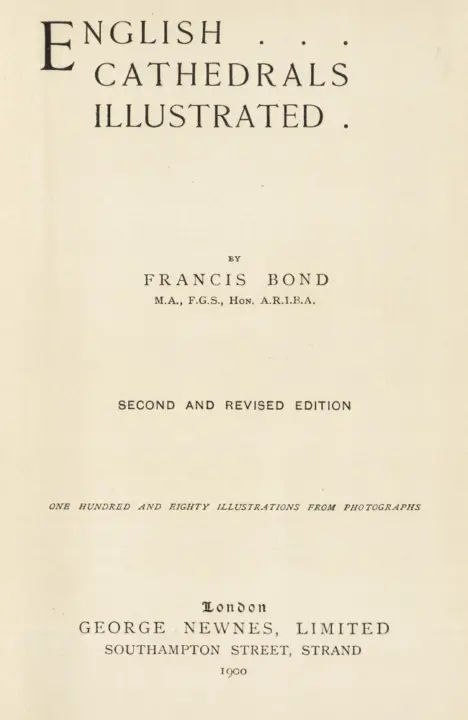
English Cathedrals Illustrated Second and Revised Edition
Francis Bond
THE CLASSIC COLLECTION · 1910
"Wood Carvings in English Churches" by Francis Bond is a historical account written in the early 20th century. The book explores the art of wood carving in English churches, focusing specifically on stalls, tabernacle work, bishops' thrones, and chancel chairs from the medieval period to the Renaissance. It aims to highlight the significance and beauty of these often-overlooked examples of ecclesiastical craftsmanship, offering insights into their design, construction, and historical context. At the start of the book, the author provides a preamble stressing the value of stallwork in English churches, noting its rarity compared to similar works in other countries, many of which have been lost to neglect or destruction. Bond describes the architectural and artistic features of stalls used by monks and canons during services, detailing their intricate design elements such as canopies, supports, and ornamentation. He aims not only to inform readers about the significance of these wood carvings but also to inspire pride in England's rich artistic heritage.
Introduction adapted from the source catalogue; source summaries may be automatically generated.
Free to read · English · 30,464 words · No account needed
MAKE TIME FOR A GOOD BOOK
On by default. Untick to stop anonymous reading totals. Each page counts after 10 seconds in view. How this works.
Anonymous counting is on unless you have switched it off.
Instances might be multiplied to any extent of the obligation laid on chantry priests to attend and assist the rector or vicar in the services. Thus at Rothwell in 1494 the chantry priest attached to the altar of Our Lady was not only required by the foundation deed to celebrate Mass and other service daily at this altar, but was directed to be in the high choir all festival days at matins, Mass, and evensong. In 1505 Margaret Blade, widow, endowed a chantry of Our Lady in Kildewick parish for a priest who, in addition to his special duties, was to help Divine service in the choir and to help the curate in time of necessity.[51] Sometimes quite a considerable number of chantry priests were attached to a parish church. When all chantry endowments were confiscated by Edward VI., the loss of the services of the chantry priests was in many cases severely felt. At Nottingham indeed the parishioners of St Mary's made formal protest; stating that in their parish there were "1,400 houseling people and that the vicar there had no other priest to help but the two chantry priests."[52] We may take it therefore that seats in the chancel were required not only for the parish priest and the parish clerk, but in some cases for chantry priests as well.
But the above explanation does not cover the whole ground. There are often many more stalls than could be used as above. And in some churches there were no chantry priests at all, and yet there are stalls. Who else then occupied seats in the chancel? Some of the stalls probably, usually but a few, may have been occupied by laymen even so early as the thirteenth century. {91}
As regards the occupancy of seats in the chancel it is quite clear that it has always been the wish of the Church that they should be reserved for the clergy and that no laymen should be admitted. It is equally clear that the Church has never been able to carry out the injunction. In the Trullan Council of 683 or 692 it was laid down, "Nulli omnium liceat, qui quidem sit in laicorum numero, intra septa sacri altaris ingredi, nequaquam tamen ab eo prohibita potestate et auctoritate imperiali, quandoquidem voluerit Creatori dona offerre, ex antiquissima traditione"; i.e., "No layman may enter the chancel, except the Emperor, who by venerable tradition is allowed to do so when he wishes to present offerings to his Maker." But this does not explicitly allow the Emperor to sit down in the chancel. And even this much was objected to by many; for a gloss follows: "Nemo liceat laico intra, &c." ... "Adulatione et timore victi, per gravem errorem concedunt imperatori, quod magna cum laude sanctorum patrum Ambrosius Theodosio negavit"; i.e., "The permission given to the Emperor was given under the influence of adulation and timidity, and the action of St Ambrose in refusing it to the Emperor Theodosius was greatly applauded by the Fathers." But it was a perilous thing to exclude emperors, and what was conceded to emperors was claimed by princes, and what was conceded to princes was claimed by and had to be conceded to the nobility generally. So in Scotland in 1225 by an episcopal order the King and his nobles also were allowed to stand and to sit in the chancel: "Ne laici secus altare, quum sacra mysteria celebrantur, stare vel sedere inter clericos presumant, excepto domino rege et majoribus regni, quibus propter suam excellentiam in hac parte duximus referendum." And if the nobles, then certainly the patron of the living could not be excluded from a parochial chancel. So in the diocese of Worcester in 1240 a canon was agreed to that patrons as well as high personages might stand in the chancel: "nec laici stent in Cancellis dum celebrantur divina; salva tamen reverentia patronorum et sublimium personarum"; in Lincoln diocese also Bishop Grosstête in 1240 restricts the permission to the patron. Again in 1255 in Lincoln diocese the patron or any other "venerable" person was allowed to sit and stand in the chancel. Archbishop Greenfield of York (1304-1315) found it necessary to make a rule against laymen intruding into the choir during service. So also at Ely, Simon Langham in 1364 wrote: "Lay people are not to stand or sit amongst the clerks in the chancel during the celebration of divine service, unless {92} it be done to shew respect or for some other reasonable and obvious reason; but this is allowed for the patrons of churches only."[53] Then what had been claimed successfully by those of noble birth, and by patrons in particular, was claimed with equal success by any good Churchman of consideration and wealth, especially if he were a benefactor of the church. For in the fourteenth century Alan de Alnewyk of York, goldsmith, wills that his body be buried in the quire of St Michael Belfry near the place where I used to sit ("ubi sedere solebam"). Another century later, Robert Constable of Bossall, leaves this direction in 1454: "First, I devise my soul to God Almighty and his mother Blessed Saint Mary and to Saint Botolph and to the holy court of heaven; and my body to be buried in the quire afore the place where my seat is."[54] In 1511 Robert Fabyan, the chronicler, citizen and draper of London, devises as follows: "I will that my corps be buried between my pew and the high altar, within the quire of the church of Allhallows, Theydon Gardon, Essex." Finally, at Yatton, Somerset, in 1529, 2s. was "paid for a sege in ye chaunsell."[55] It is to be remembered moreover that though it may have been unusual for laymen to have seats in the chancel, yet it was by no means uncommon for them to stand or kneel there; there are enough representations of laymen so standing to establish that point satisfactorily: they are shewn standing or kneeling, sometimes with lighted tapers in their hands. At a St Martin's mass in France in the fourteenth century,[56] two women are shewn near the altar steps, one standing and attending to her duties, the other inattentive and seriously distracting the attention of an acolyte kneeling near. We know definitely that in Salisbury cathedral laymen were allowed to be present in the sanctuary before the Sunday procession; for after the hallowing of the water it was ordered that the priest should asperge the laity in the presbytery as well as the clergy in the choir. "Post aspersionem clericorum laicos in presbiterio hinc inde stantes aspergat."[57] At Salisbury the Sunday procession was marshalled in the ample space between the choir and the high altar, which space the laity entered in order to follow the clerks in the procession. {93}
Your reading position is saved on this browser. Take it to another device with a library code. Reading pages adapt to text, rather than matching a printed edition.
BEHIND THE BOOK
This eBook is for the use of anyone anywhere in the United States and most other parts of the world at no cost and with almost no restrictions whatsoever. You may copy it, give it away or re-use it under the terms of the Project Gutenberg License included with this eBook or online at www.gutenberg.org. If you are not located in the United States, you will have to check the laws of the country where you are located before using this eBook. Read the source licence.
The original source file, including credits and licence, is retained by this library. Request an original-format copy at no charge. Please include the book title and Project Gutenberg identifier #43530.
KEEP YOUR CURIOSITY GOING
Cécile Tormay

Moritz Busch
John L. Ransom
Frances Wright
Cécile Tormay

Mabel Potter Daggett