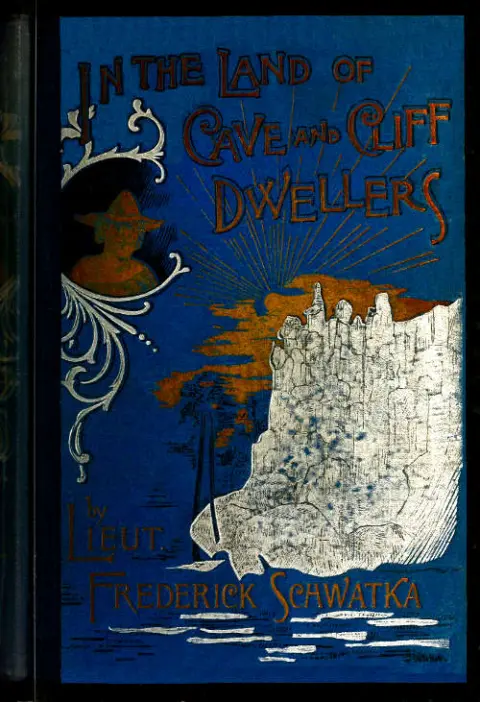
In the Land of Cave and Cliff Dwellers
Frederick Schwatka
THE CLASSIC COLLECTION · 1886
"Wonderland; or, Alaska and the Inland Passage" by Lieut. Frederick Schwatka is a travelogue written in the late 19th century. This work offers a comprehensive exploration of the natural beauty and economic potential of the American Northwest, particularly focusing on Alaska and the regions traversed by the Northern Pacific Railroad. It presents a detailed account of the landscapes, resources, and burgeoning cities in this relatively uncharted territory, aiming to enthrall both travelers and those interested in nature and economic expansion. The opening of the text describes the transformative nature of travel in the 19th century, highlighting the wonders that await travelers venturing into the Northwest. It discusses the unique natural features of the region, from the majestic landscapes of the Columbia River to the expansive wheat fields of Dakota and the gold-rich mountains of Montana. It sets the stage for the journey into Wonderland, inviting readers to discover not only the sublime beauty of the region but also its burgeoning wealth and opportunities for civilization. The narrative implies that a visit to this area is both an adventure and a revelation, offering insights into both nature and the economic prospects of frontier life.
Introduction adapted from the source catalogue; source summaries may be automatically generated.
Free to read · English · 41,695 words · No account needed
MAKE TIME FOR A GOOD BOOK
On by default. Untick to stop anonymous reading totals. Each page counts after 10 seconds in view. How this works.
Anonymous counting is on unless you have switched it off.
In the town proper the Greek Church is the most conspicuous and interesting object to the tourist, and especially those who have never seen one of this religion. It is built in the form of a Greek cross, in plan, and is surmounted by an Oriental dome over the centre, which has been painted an emerald green color. One wing is used as a chapel, and contains, besides a curious font, an exquisite painting of the Virgin and Child, copied from the celebrated picture at Moscow. All the drapery is of silver, and the halo of gold; so, of the painting itself, nothing is seen but the faces and background. The chancel, which is raised above the body of the church, is approached by three broad steps leading to four doors, two of which are handsomely carved and richly gilded, and contain four oval and two square bas reliefs. Above is a large picture of the Last Supper, covered, like that of the Madonna, with silver, as are two others, one on each side of the altar. Across the threshold of these doors no woman may set her foot, and across the inner ones to the innermost sanctuary none but the priest himself, or his superiors in the general Greek Church, or the white Czar, can enter. The doors, however, usually stand open; and the priest in residence, Father Metropaulski, is exceedingly courteous to visitors, showing them the costly and magnificent vestments and the bishop's crown, almost covered with pearls and amethysts. The ornaments and the candelabra are all of silver, the walls are hung with portraits of princes and prelates, and the general effect is rich in the extreme.
Next to the church in interest--with some visitors, probably, ranking before it--is the old Muscovite castle on the hill. Here, in days gone by, the stern Romanoff ruled this land, and Baron Wrangell, one of Russia's many celebrated Polar explorers, held sway. It is said that it has been twice destroyed, once by fire and then by an earthquake, but was again erected with such staunch belongings that it will probably stand for ages much as it is to-day. It is now used as an office for United States Government officials, and it has a ball-room and theatre, with the same old brass chandeliers and huge bronze hinges that adorned it in its glory. The whole building has a semi-deserted and melancholy appearance; but it is of exceeding interest, speaking to us as it does of a grander history, when Sitka was the metropolis of the Pacific coast of North America, and it was the centre from which such power emanated. To sentimental tourists I will relate a tradition that has been published concerning the stern old castle; and, whether it fits the truth or not, it fits the sombre surroundings of the ancient pile. It runs, that, when Baron Romanoff was governor, he had living with him an orphan niece and ward, who, like all orphan nieces in feudal castles, especially those who figure in tradition, was very beautiful. But, when the baron commanded her to marry a beautiful prince, who was a guest at the castle, she refused, having given her heart to a handsome young lieutenant of the household. The old baron, who, like the rest of his race in traditional accounts, was an accomplished diplomate, feigning an interest in the young lieutenant which he did not feel, sent him away on a short expedition, and in the mean time hurried on the preparations for the marriage of the unhappy girl to the prince. Deprived of the support of her lover's counsels and presence, she yielded to the threats of her uncle, and the ceremony was solemnized. Half an hour after the marriage, while the rejoicing and the gayety were at their height, the young lieutenant strode into the ball-room, his travel-stained dress and haggard appearance contrasting strangely with the glittering costumes and gay faces of the revelers; and, during the silence which followed his ominous appearance, he stepped up to the hapless girl, and took her hand. After gazing for a few moments on the ring the prince had placed there, he, without a word, and before any one could interfere, drew a dagger from his belt, and stabbed her to the heart. In the wild confusion that followed, he escaped from the castle; and, overcome with grief, unable to live without the one he so fondly loved, yet ruthlessly murdered, he threw himself into the sea. And now her spirit is seen on the anniversary of her wedding night, her slender form robed in heavy silk brocade, pressing her hands on the wound in her heart, the tears streaming from her eyes. Sometimes, before a severe storm, she makes her appearance in the little tower at the top of the building once used as a lighthouse. There she burns a light until dawn for the spirit of her lover at sea.
Your reading position is saved on this browser. Take it to another device with a library code. Reading pages adapt to text, rather than matching a printed edition.
Frederick Schwatka

Frederick Schwatka
BEHIND THE BOOK
This eBook is for the use of anyone anywhere in the United States and most other parts of the world at no cost and with almost no restrictions whatsoever. You may copy it, give it away or re-use it under the terms of the Project Gutenberg License included with this eBook or online at www.gutenberg.org. If you are not located in the United States, you will have to check the laws of the country where you are located before using this eBook. Read the source licence.
The original source file, including credits and licence, is retained by this library. Request an original-format copy at no charge. Please include the book title and Project Gutenberg identifier #36435.
KEEP YOUR CURIOSITY GOING
Wilfrid Scawen Blunt
Wilfrid Scawen Blunt

E. W. (Edgar Watson) Howe
Cécile Tormay

Moritz Busch
John L. Ransom