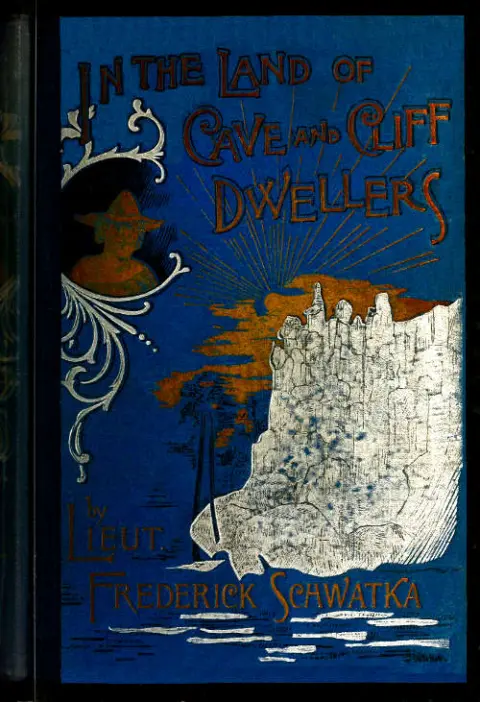
In the Land of Cave and Cliff Dwellers
Frederick Schwatka
THE CLASSIC COLLECTION · 1886
"Wonderland; or, Alaska and the Inland Passage" by Lieut. Frederick Schwatka is a travelogue written in the late 19th century. This work offers a comprehensive exploration of the natural beauty and economic potential of the American Northwest, particularly focusing on Alaska and the regions traversed by the Northern Pacific Railroad. It presents a detailed account of the landscapes, resources, and burgeoning cities in this relatively uncharted territory, aiming to enthrall both travelers and those interested in nature and economic expansion. The opening of the text describes the transformative nature of travel in the 19th century, highlighting the wonders that await travelers venturing into the Northwest. It discusses the unique natural features of the region, from the majestic landscapes of the Columbia River to the expansive wheat fields of Dakota and the gold-rich mountains of Montana. It sets the stage for the journey into Wonderland, inviting readers to discover not only the sublime beauty of the region but also its burgeoning wealth and opportunities for civilization. The narrative implies that a visit to this area is both an adventure and a revelation, offering insights into both nature and the economic prospects of frontier life.
Introduction adapted from the source catalogue; source summaries may be automatically generated.
Free to read · English · 41,695 words · No account needed
MAKE TIME FOR A GOOD BOOK
On by default. Untick to stop anonymous reading totals. Each page counts after 10 seconds in view. How this works.
Anonymous counting is on unless you have switched it off.
The leading silver mines of the district are the Alice, Moulton, Lexington and Silver Bow, which alone employ 210 stamps and produce 230 tons of ore daily. The magnificent appliances of the Alice mine, including the great Cornish pump that cost $40,000, are the wonder of every visitor. The process of reduction, here as elsewhere, is somewhat complex, especially in the case of the baser ores, being in part chemical and in part mechanical. It involves the crushing of the ore to powder, under the pressure of enormous bars of iron, weighing 900 pounds each, and known as "stamps," and its subsequent roasting in large, hollow cylinders, salt being largely employed in the former, and quicksilver in the latter, stage of the operation. The roasting mills of the Alice mines treat 100 tons of ore per day, and their bullion product approaches $100,000 per month.
The great Lexington property, which has produced $1,000,000 per annum for four years, is owned by a French company. It claims to be the most complete mine in the entire West, and it is certainly one of the richest and most extensive.
The Moulton and Silver Bow have a daily capacity of forty and thirty tons of ore respectively. They are magnificent properties, well developed and exceedingly productive. The former makes the proud boast of working its ore to a higher percentage of its value than any other mill in the district.
But it is the copper mines and smelters that represent the largest capital; give employment to the greatest number of men; have the largest production, both in tonnage and aggregate value; and, it may be added, make the most smoke.
At the head of the rich and powerful companies engaged in this industry, stands the Anaconda,--its mine at Butte, the greatest copper property in America; its smelting works, at the neighboring town of Anaconda, the largest of their kind in the world. Sold, five years ago, for an amount that would not now be more than sufficient to pay its employes a week's wages, its property is roughly estimated to be worth $15,000,000. With certain contemplated additions to its smelting capacity, it will handle daily 1,200 tons of ore, yielding 180 tons of matte, or 108 tons of pure copper. Its entire machinery run by water-power, it yet requires for its furnaces no less than 180 cords of wood per day; in view of which enormous consumption it is stated to have recently let a contract for 300,000 cords, representing upward of $1,000,000. Second only to this gigantic concern, is the Parrott Company, whose total matte output for 1884 was 14,856,323 pounds, containing 9,324,805 pounds of pure copper, valued, including its silver contents, at about $1,250,000. With largely increased capacity, its production of pure copper will probably have reached 15,000,000 pounds in the year just drawing to a close. Among other leading companies, may be mentioned the Montana, owning some of the richest and most steadily productive mining property in process of development; Clark's Colusa, said to have in sight, above the 300-foot level, at least 150,000 tons of valuable ore; and the Bell and Colorado, two of the richest copper-silver mines in the district.
Your reading position is saved on this browser. Take it to another device with a library code. Reading pages adapt to text, rather than matching a printed edition.
Frederick Schwatka
Frederick Schwatka
BEHIND THE BOOK
This eBook is for the use of anyone anywhere in the United States and most other parts of the world at no cost and with almost no restrictions whatsoever. You may copy it, give it away or re-use it under the terms of the Project Gutenberg License included with this eBook or online at www.gutenberg.org. If you are not located in the United States, you will have to check the laws of the country where you are located before using this eBook. Read the source licence.
The original source file, including credits and licence, is retained by this library. Request an original-format copy at no charge. Please include the book title and Project Gutenberg identifier #36435.
KEEP YOUR CURIOSITY GOING
Wilfrid Scawen Blunt
Wilfrid Scawen Blunt

E. W. (Edgar Watson) Howe
Cécile Tormay

Moritz Busch
John L. Ransom