THE CLASSIC COLLECTION✦An outlaw’s diary: the CommuneCLASSIC FREE BOOKS
An outlaw’s diary: the Commune
Cécile Tormay
THE CLASSIC COLLECTION · 1920
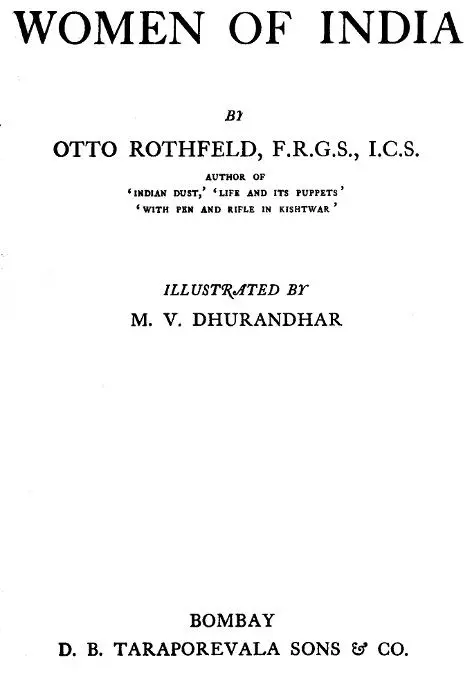
"Women of India" by Otto Rothfield is a historical account written in the early 20th century. The book explores the roles, lives, and experiences of women in India, reflecting on how their identities have been shaped by various cultural, social, and religious influences throughout history. It offers insight into different classes of women, from those in aristocracy to working-class women, shedding light on their strengths, struggles, and societal expectations. The opening of the text sets a vivid scene that intertwines historical context with an exploration of women's identities in India. Rothfield draws from ancient texts, referencing Vatsyana to categorize women into different types based on their attributes and virtues. He contrasts these classical ideals with the modern reality of Indian women, emphasizing their resilience and beauty amidst changing societal norms, especially in the bustling environment of contemporary Bombay. The narrative begins to delve into the profound significance of marriage in Indian culture, suggesting that for women, it represents the pinnacle of their existence and identity, a theme that is likely to evolve in the subsequent chapters. The initial portion establishes a blend of admiration and critique, reflecting both on traditional values and the transformations being witnessed in Indian society.
Introduction adapted from the source catalogue; source summaries may be automatically generated.
Free to read · English · 54,978 words · No account needed
MAKE TIME FOR A GOOD BOOK
On by default. Untick to stop anonymous reading totals. Each page counts after 10 seconds in view. How this works.
Anonymous counting is on unless you have switched it off.
The bizarre is again to be found prevailing even over form on the Mongolian borderland of Northern India. In Nepal, whence come the brave Gurkha soldiers of our wars, dress, like the shape and decoration of the wooden temples of the people, has in it something alien to the normal lines of Aryan and Indian womanhood. And the strangeness is heightened by the quaintness of the jewelry and the uncut turquoises in which they delight.
But in most of India proper the essence of dress is simple. Shoes are not in general worn, though loose wide slippers of velvet or of leather may be sometimes seen. The natural result is that the foot retains a beauty which can never be expected when it is cramped by constant pressure. The working woman, tramping miles along the roads or over fields, with heavy burdens on her head or her child upon the hip, loses of course too quickly the springing instep and sinks to a flat and sprawling foot. But in the higher classes, or among the womanhood whom caste preserves in a moderate seclusion, the foot is small, well-curved, and light. It is a thing of infinite fascination, tinted perhaps with the henna’s pink, almost like a flower. Even aged women there are to be seen, their faces worn and wrinkled, who still have the unspoilt feet of youth and well-born blood. Among the richer ladies of the greater cities, where it is smart to be “advanced,” Parisian shoes and silken stockings are nowadays worn, at least out of doors--a habit enforced by the security thus gained against plague infection; but the greater number still preserves the foot free and beautiful.
For the rest, among Hindu women the dress consists of three portions only, never more, though they may be only two. These are a skirt, a bodice, and a mantle. The skirt is not very different from the petticoat of Europe in cut, but may either drop simply or be made up in accordion pleats, something as a kilt is pleated, so cut as to stand out a considerable way at the ankle. The latter shape, worn mainly by the women of Márwár, but in painting invariably given to Rádha and the loves of the god Krishna, is most beautiful with its brush and swing. The skirt is fastened plainly by a silken cord tied fast at the waist and is sometimes girdled by a silver belt. The Indian bodice again is designed in the main to support the breast whose form it defines and even, by its pattern, accentuates. It may either fit all round the person, fastening in front by buttons or a ribbon, or be a covering for the chest only, put on from the front and tied across the open back by two tapes. But the most distinctive feature of all is certainly the glorious drapery of the sari, which has been translated “mantle” in default of a better word. The sari is an article of dress as distinctive as the Spanish mantilla and as difficult to wear with the right charm and manner. It is an oblong of material, hemmed when possible at one side with gold embroidery and edged with a sort of closed fringe. When, as is most common, it is worn with a skirt, its length is about fifteen feet and its breadth about three. When, however, as in a contrasting style, it has by its intricacies to take the place of an absent skirt as well, it measures some twenty-five feet in length. It is to these mantles that the Indian lady devotes her deftest thoughts and on them, within the limits conceded by caste and fashion, that she displays her personal tastes. Their hues and patterns have an infinite range. Some are in plain natural colours, white or red or blue--solid, unbroken colour, not least beautiful in the stark sunlight. Others are delicate cotton prints, flowered and sprigged and dainty. Sometimes they are printed in a bold decorative pattern, formal and conventional. Neutral and half tints at times mix in a bewildering wealth of hue, till the eye is at a loss to know whether the ground be green or pink or purple. The border may be a plain hem-stitch or a two-inch broad piece of gold brocade, sumptuously woven in the acanthus pattern or in the shape of birds and flowers. But in the draping of the mantle, so simple in cut yet of such infinite variety, consists the highest art and the true expression of personality. One end is taken round the waist a couple of times and tucked into the waist-band at the centre, falling to the feet in formal folds; the other passes over head and shoulder, with the breadth decorated and displayed across the upper half of the body. In the management of the upper half lies the true secret. It must show the full beauty of the cloth, yet by a sort of innocent accident, without a hint of ostentation. At the same time it must be loose enough to allow graceful folds to drop naturally from the head to the shoulders, and tight enough to sit close at the breast whose curves it accentuates while it seems to veil. Enough but not too much of the bodice must be shown with a fine nicety. The border is at times allowed to turn carelessly up, till the gold armlet above the elbow can be seen even on the covered right arm. At one moment, a modest gesture brings the mantle across the face, as in shy courtesy before an elder or an illustrious man; in a crowd it is draped to hide both arms and conceal the figure; when it slips, it is quickly drawn forward over the head with a charming pretence of timidity. The Márwári woman by a trick peculiar to herself makes of her mantle a screen held open between two fingers, through which only her lustrous eye appears, melting and languorous; and in the armoury of every Indian woman the mantle by its nice management is the chief instrument of love.
Your reading position is saved on this browser. Take it to another device with a library code. Reading pages adapt to text, rather than matching a printed edition.
BEHIND THE BOOK
This eBook is for the use of anyone anywhere in the United States and most other parts of the world at no cost and with almost no restrictions whatsoever. You may copy it, give it away or re-use it under the terms of the Project Gutenberg License included with this eBook or online at www.gutenberg.org. If you are not located in the United States, you will have to check the laws of the country where you are located before using this eBook. Read the source licence.
The original source file, including credits and licence, is retained by this library. Request an original-format copy at no charge. Please include the book title and Project Gutenberg identifier #50346.
KEEP YOUR CURIOSITY GOING
Cécile Tormay

Moritz Busch
John L. Ransom
Frances Wright
Cécile Tormay

Mabel Potter Daggett