THE CLASSIC COLLECTION✦An outlaw’s diary: the CommuneCLASSIC FREE BOOKS
An outlaw’s diary: the Commune
Cécile Tormay
THE CLASSIC COLLECTION · 1920
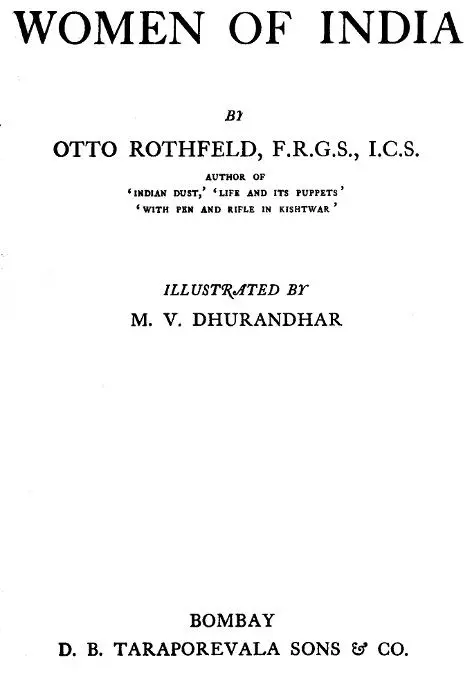
"Women of India" by Otto Rothfield is a historical account written in the early 20th century. The book explores the roles, lives, and experiences of women in India, reflecting on how their identities have been shaped by various cultural, social, and religious influences throughout history. It offers insight into different classes of women, from those in aristocracy to working-class women, shedding light on their strengths, struggles, and societal expectations. The opening of the text sets a vivid scene that intertwines historical context with an exploration of women's identities in India. Rothfield draws from ancient texts, referencing Vatsyana to categorize women into different types based on their attributes and virtues. He contrasts these classical ideals with the modern reality of Indian women, emphasizing their resilience and beauty amidst changing societal norms, especially in the bustling environment of contemporary Bombay. The narrative begins to delve into the profound significance of marriage in Indian culture, suggesting that for women, it represents the pinnacle of their existence and identity, a theme that is likely to evolve in the subsequent chapters. The initial portion establishes a blend of admiration and critique, reflecting both on traditional values and the transformations being witnessed in Indian society.
Introduction adapted from the source catalogue; source summaries may be automatically generated.
Free to read · English · 54,978 words · No account needed
MAKE TIME FOR A GOOD BOOK
On by default. Untick to stop anonymous reading totals. Each page counts after 10 seconds in view. How this works.
Anonymous counting is on unless you have switched it off.
For by its very nature dress is a means selected to heighten the attraction of the sexes for each other. The use of clothes as a protection against the extremes of climate is merely secondary and is even something of a reproach to natural adaptation. It is as adornment, and in its purpose of attraction, that it has its real and ultimate meaning. That dress comes to be used incidentally to preserve modesty does not affect its primary purpose. Modesty itself is one of the secondary properties of love and one of its most powerful weapons. But it is when mankind becomes sophisticated that the value and function of modesty are properly understood; and it is then that dress and ornament are so designed as to combine their direct and, under the guise of modesty, their indirect attractions. It follows, therefore, that in any people the use of the means of attraction which are supplied by dress and jewelry must correspond to the attributes of the persons whom it is desired to attract. If the dress did not conform to some inbred desire in those who see it, it could have no power to please; even it might become repellent. But similarity of birth and training tends to mould the majority of each nation to something of an average, and it is after all as a response to the desires of the average person that dress is designed. It responds, therefore, to the psychology of the people in which it is found.
Looked at from this aspect, the fundamental difference between the costumes of European and of Indian women becomes at once more deeply significant. In Europe, during the long centuries that have succeeded the fall of Rome, one quality above all has clung to dress, that is, bizarrerie of form. The Teutonic barbarians who uprooted the Mediterranean civilizations and imposed in their place those tribal feudalisms and customary rules from which Europe is not yet fully freed, seem whether from their primitive particularism or their inborn brutality to have largely been lacking in the sense of form. Symmetry and simplicity were conceptions beyond their northern brains and outside their temperament. Even to this day the German (who with least admixture of blood or education represents the primeval Teutonic savage) is hardly able by any effort of reason to comprehend the meaning of these words. In essence, it would seem, his mind is formless, vague, amorphous. So in their buildings, the Goths could find no use for purity of form. What they sought always and with a great effectiveness achieved was a shape, or rather a conglomeration of shapes, complicated and exaggerated, with lengthy spires and cumbrous altitudes, that should be curious, awful, and bizarre. They never sought to soothe the mind. Their churches do not so much attract attention, but capture it, as it were, by an audacious ravishment. And as this purpose was congenial to their own psychology, so did they win their effect among their own and kindred peoples. Similarly their women, if they were to excite the desires of men habituated to bloodshed and the strong stress of war, had to take their attention by storm, with the aid of the fantastic and unexpected in their costume. Without the subtlety of imagination and finesse to excel by a fine harmony or a graceful nicety, they were forced upon the extravagant and exuberant. The lines of their dress were not designed to be congruous with the human body or to agree in beautiful drapery, but were meant rather to amaze the onlooker by a sudden onslaught upon his vision. At any cost they were to be effective--to produce, that is, an immediate effect by the strangeness and extravagance of their form. In regard to colour they had less invention and hardly any taste; and the grey skies of the north are not suited to the richer hues. So it was to contortions of line and form that they had recourse. However mitigated, these are characteristics that remain to this day. Even in modern dress, the lines tend to be abrupt and exaggerated, and an ever-changing fashion varies them in a discordant manner. Every ten years, it has been said, the shape of womankind, as it is visible, changes in Europe. Each new change means, of course, an attempt to capture attention by a novel attitude. This is the cause that, out of the whole nineteenth century, it was only for a few years under the Consulate and early Empire that woman’s dress appears tolerable to an artist’s eye or even, upon reflection, to the common man or woman.
Your reading position is saved on this browser. Take it to another device with a library code. Reading pages adapt to text, rather than matching a printed edition.
BEHIND THE BOOK
This eBook is for the use of anyone anywhere in the United States and most other parts of the world at no cost and with almost no restrictions whatsoever. You may copy it, give it away or re-use it under the terms of the Project Gutenberg License included with this eBook or online at www.gutenberg.org. If you are not located in the United States, you will have to check the laws of the country where you are located before using this eBook. Read the source licence.
The original source file, including credits and licence, is retained by this library. Request an original-format copy at no charge. Please include the book title and Project Gutenberg identifier #50346.
KEEP YOUR CURIOSITY GOING
Cécile Tormay

Moritz Busch
John L. Ransom
Frances Wright
Cécile Tormay

Mabel Potter Daggett