THE CLASSIC COLLECTION✦An outlaw’s diary: the CommuneCLASSIC FREE BOOKS
An outlaw’s diary: the Commune
Cécile Tormay
THE CLASSIC COLLECTION · 1920
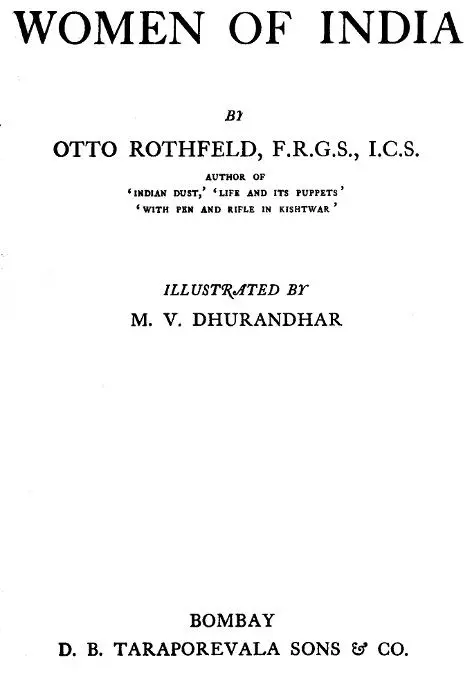
"Women of India" by Otto Rothfield is a historical account written in the early 20th century. The book explores the roles, lives, and experiences of women in India, reflecting on how their identities have been shaped by various cultural, social, and religious influences throughout history. It offers insight into different classes of women, from those in aristocracy to working-class women, shedding light on their strengths, struggles, and societal expectations. The opening of the text sets a vivid scene that intertwines historical context with an exploration of women's identities in India. Rothfield draws from ancient texts, referencing Vatsyana to categorize women into different types based on their attributes and virtues. He contrasts these classical ideals with the modern reality of Indian women, emphasizing their resilience and beauty amidst changing societal norms, especially in the bustling environment of contemporary Bombay. The narrative begins to delve into the profound significance of marriage in Indian culture, suggesting that for women, it represents the pinnacle of their existence and identity, a theme that is likely to evolve in the subsequent chapters. The initial portion establishes a blend of admiration and critique, reflecting both on traditional values and the transformations being witnessed in Indian society.
Introduction adapted from the source catalogue; source summaries may be automatically generated.
Free to read · English · 54,978 words · No account needed
MAKE TIME FOR A GOOD BOOK
On by default. Untick to stop anonymous reading totals. Each page counts after 10 seconds in view. How this works.
Anonymous counting is on unless you have switched it off.
Divest her of poetic association. Rob her of the hues cast by the distant dreams of romanticism. Strip her even of the facts of history and the traditions of the Indian classics. Yet she remains a figure sufficiently remarkable. Not tragic and certainly not gay, she embodies in herself so much of India, both its past and present, that without understanding her life and significance it is impossible to comprehend the social whole which she explains and commentates.
The very name of dancing girl, it must be noted, is a misnomer. For as an artist she finds expression primarily in song, not in the dance. In the Indian theory of music, dancing is but an adjunct, one rhythm the more, to the sung melody. It is the singer’s voice which, is the ultimate means of music, her song which is its real purpose. To embellish its expression and heighten its enjoyment the singer takes the aid of instruments, the pipe, the strings, the drum and not least of the dance. Regarded in its first elements, the dance is one means the more of marking the time of the melody. Throughout the Indian dance the feet, like the tuned drums, are means to mark the beats. The time is divided into syllables or bars and the dancer’s beating feet, circled with a belt of jingling bells, must move and pause in the strictest accordance. The right foot performs the major part, the left completes the rhythmic syllable. But further by her dance the singer’s art is to make more clear and more magnetic the meaning of her song. With her attitudes and gestures she accords her person to her melody and sense, till her whole being, voice and movement, is but one living emotion. Her veil half-drawn over her features, her head averted, a frown wrinkling her brow, she portrays modesty recoiling from a lover. With joined hands uplifted to her forehead, with body bent, and eyes cast upon the ground, she accompanies the hymns of worship and resignation to God’s will. With quickly moving gesture, she marks the harsher sounds of rage or mortified indignation. Even pleasure and the tenderer joy she represents by the softly swaying body and slow waving movements of her upturned hands. But it is not enough that gesture should be natural and appropriate. Mere realism would not harmonize with the songs and instrumental music to which it is an accompaniment. Its crudities would be out of tune, conspicuous, even brutal. The dancer’s gestures and pantomime must be soft, rhythmic, and restrained. Like every other art, dancing too has its economy and its self-restraint. And the way to this ideal harmony is through the simplifications of convention and the discipline of a graceful technique. The dancer has to learn by painful practice to move her limbs in harmony with the rhythms of her melody, to avoid all that is abrupt or unsymmetrical. Each pose should be that of a statue, emotion poising in a harmony of line and balance. In order to attain this complete accord of movement and melody, this union of grace and emotional expression, it is necessary to conventionalize the means by strict attention to the material presented to the creative artist--in the case of the dance, the youthful female figure. As in a painting, to the trained eye, a line presents the transition between two differently lit surfaces, so in the dance, by an habitual agreement between the spectator and the performer, certain simple movements are made to evoke wider imaginations. Indian dancing, like every art, must have its own conventions. But they are conventions finally based upon actual mimicry, simplifications, one may say, of natural movements. They are attained by the exclusion of all that is superfluous, leaving only the essential curve or contour of the movement. They are the actual made spiritual, by the excision of all excess, by the suppression of the uncouthness which defective material and stiff muscles force upon human action. The movements of the Indian dancer bear to the primitive gestures of men and women, in the moments of actual impulse, the same relation as the simplified form of Indian painting and sculpture bear to the realities of living flesh and blood in light and shadow. To the European the conventions are difficult to understand, as they presuppose a different training; and in him they do not readily awake the required emotion. For European art has for many centuries been in the main realistic, concerned above all with the material appearance of things and actions. The art of the East, on the other hand, has in all its leading schools sought the spiritual, striving with the jejunest outlines to interpret the significance which may underlie the outward clothing of form and colour and surface. Moreover, the oriental eye has a natural aptitude for decorative pattern, to which the excessive devotion of the Indian intellect to deduction and abstract analysis affords a parallel. The artist, therefore, does not rest content with simplification but further seeks to manipulate the conventions, through which he realizes his spiritual meaning, into a symmetric and decorative pattern. The same tendencies appear in the dance, when practised as an art, in India.
Your reading position is saved on this browser. Take it to another device with a library code. Reading pages adapt to text, rather than matching a printed edition.
BEHIND THE BOOK
This eBook is for the use of anyone anywhere in the United States and most other parts of the world at no cost and with almost no restrictions whatsoever. You may copy it, give it away or re-use it under the terms of the Project Gutenberg License included with this eBook or online at www.gutenberg.org. If you are not located in the United States, you will have to check the laws of the country where you are located before using this eBook. Read the source licence.
The original source file, including credits and licence, is retained by this library. Request an original-format copy at no charge. Please include the book title and Project Gutenberg identifier #50346.
KEEP YOUR CURIOSITY GOING
Cécile Tormay

Moritz Busch
John L. Ransom
Frances Wright
Cécile Tormay

Mabel Potter Daggett