THE CLASSIC COLLECTION✦An outlaw’s diary: the CommuneCLASSIC FREE BOOKS
An outlaw’s diary: the Commune
Cécile Tormay
THE CLASSIC COLLECTION · 1920
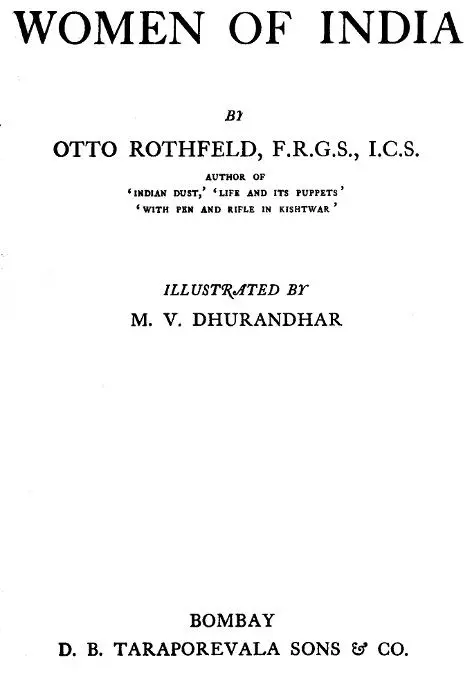
"Women of India" by Otto Rothfield is a historical account written in the early 20th century. The book explores the roles, lives, and experiences of women in India, reflecting on how their identities have been shaped by various cultural, social, and religious influences throughout history. It offers insight into different classes of women, from those in aristocracy to working-class women, shedding light on their strengths, struggles, and societal expectations. The opening of the text sets a vivid scene that intertwines historical context with an exploration of women's identities in India. Rothfield draws from ancient texts, referencing Vatsyana to categorize women into different types based on their attributes and virtues. He contrasts these classical ideals with the modern reality of Indian women, emphasizing their resilience and beauty amidst changing societal norms, especially in the bustling environment of contemporary Bombay. The narrative begins to delve into the profound significance of marriage in Indian culture, suggesting that for women, it represents the pinnacle of their existence and identity, a theme that is likely to evolve in the subsequent chapters. The initial portion establishes a blend of admiration and critique, reflecting both on traditional values and the transformations being witnessed in Indian society.
Introduction adapted from the source catalogue; source summaries may be automatically generated.
Free to read · English · 54,978 words · No account needed
MAKE TIME FOR A GOOD BOOK
On by default. Untick to stop anonymous reading totals. Each page counts after 10 seconds in view. How this works.
Anonymous counting is on unless you have switched it off.
These are defects which are not unnatural when a small and isolated community finds itself confined to commerce and is from its history devoid of higher interests. They are defects which do not alter the fact that not a few among the Parsis, especially those who have for generations reposed upon inherited wealth and have taken to the learned professions, are charming men and women and true and worthy friends. Among those who have such a position--who do not aspire to dazzle fashion in the wealthiest circles and do not require to increase their incomes by further trading--the women are attractive by their education and their rational freedom. They preserve a place of dignity and reserve, while quietly taking from life the benefits it offers to a liberal mind. They may even rise above the touchy vanity which is all too common.
It must, however, be admitted that Parsi womanhood has suffered harm from the excessive imitation of English habits--or what are taken to be such. From the nature of the case, because of their own inclinations and environment, the English life they have sought to imitate has inevitably been that of the middle classes. And the effect has been heightened by the enormous consumption of English novels among Parsi women. Owing partly to national character and partly to the demoralizing secret censorship which broods over the publishing world, nearly all English novels have to be “pretty-pretty” falsehoods, distorted away from the facts of life and the truths of nature. The consequence has been to produce a dangerous mental confusion in which spirituality and idealism are suppressed and replaced by a fruitless sentimentality. Reality on the other hand is known and presented only in the shape of hard cash. The harm done by such popular writings is not so apparent in England, where they are part of the normal tissue wastage of the nation. In a foreign and not immune constitution, they produce rapid inflammation. One finds therefore among Parsi women, as one does among the women of the United States, a mentality in which impracticable and silly sentimentalism is mixed up inextricably with a thirst for the solid advantages of wealth. They sigh for courtships of the kind depicted in their favourite “literature,” with scores of “dears” and “darlings” scribbled over scented letters, with moon-calf glances and clammy squeezings of hands; they and the heroes of their fancy get photographed together like any German braut and brautigam; they enter marriage with a blind eye turned to the hard realities of human nature, to discipline for instance and duty, but with the expectation of finding a husband on his knees to pamper every wish and petulance. Yet at the same time, the Parsi, like the American, girl will not let herself slide into these sentimentalities till she is assured of her admirer’s income and position. Both restraints--that which keeps her from love till she knows how money stands, and that which keeps her during her courtship within the bounds of technical chastity--come easy enough as she is, with a few honourable exceptions, free from passion. She would never give herself to the wild love of Romeo and Juliet or the abandoned ecstasy of Tristan and Isolde. Hermann and Dorothea, or a drawing-room ballad, would appeal more readily to her sympathies. That in England there is also another type of womanhood, truer and greater, she does not know--how could she? That there are girls of a fine candour and simplicity who are taught in childhood to obey and to have quiet, effacing manners, who respect a father whom they see controlling a large estate, honoured in Parliament, perhaps governing a great dependency, who are bred in a society of equals in which true and natural superiorities alone, whether of age or seniority, of success in the hunting-field or in the council, are admitted and publicly recognized, that such girls bring to their husbands with their love, respect, and the heritage of discipline, that as wives, while expecting to find fulfilment and the realization of their hopes, they are ready to subserve the higher and enduring interests of a family, of such facts and such nobilities of life--worthy indeed of imitation if such there must be--there can be little knowledge. Vital facts are not always plain upon the surface, and in England no class is so quiet and unobtrusive as the one which really counts.
Your reading position is saved on this browser. Take it to another device with a library code. Reading pages adapt to text, rather than matching a printed edition.
BEHIND THE BOOK
This eBook is for the use of anyone anywhere in the United States and most other parts of the world at no cost and with almost no restrictions whatsoever. You may copy it, give it away or re-use it under the terms of the Project Gutenberg License included with this eBook or online at www.gutenberg.org. If you are not located in the United States, you will have to check the laws of the country where you are located before using this eBook. Read the source licence.
The original source file, including credits and licence, is retained by this library. Request an original-format copy at no charge. Please include the book title and Project Gutenberg identifier #50346.
KEEP YOUR CURIOSITY GOING
Cécile Tormay

Moritz Busch
John L. Ransom
Frances Wright
Cécile Tormay

Mabel Potter Daggett