THE CLASSIC COLLECTION✦An outlaw’s diary: the CommuneCLASSIC FREE BOOKS
An outlaw’s diary: the Commune
Cécile Tormay
THE CLASSIC COLLECTION · 1920
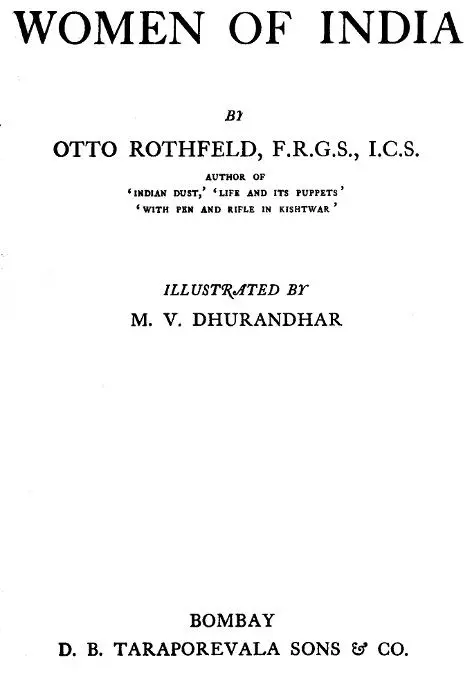
"Women of India" by Otto Rothfield is a historical account written in the early 20th century. The book explores the roles, lives, and experiences of women in India, reflecting on how their identities have been shaped by various cultural, social, and religious influences throughout history. It offers insight into different classes of women, from those in aristocracy to working-class women, shedding light on their strengths, struggles, and societal expectations. The opening of the text sets a vivid scene that intertwines historical context with an exploration of women's identities in India. Rothfield draws from ancient texts, referencing Vatsyana to categorize women into different types based on their attributes and virtues. He contrasts these classical ideals with the modern reality of Indian women, emphasizing their resilience and beauty amidst changing societal norms, especially in the bustling environment of contemporary Bombay. The narrative begins to delve into the profound significance of marriage in Indian culture, suggesting that for women, it represents the pinnacle of their existence and identity, a theme that is likely to evolve in the subsequent chapters. The initial portion establishes a blend of admiration and critique, reflecting both on traditional values and the transformations being witnessed in Indian society.
Introduction adapted from the source catalogue; source summaries may be automatically generated.
Free to read · English · 54,978 words · No account needed
MAKE TIME FOR A GOOD BOOK
On by default. Untick to stop anonymous reading totals. Each page counts after 10 seconds in view. How this works.
Anonymous counting is on unless you have switched it off.
Religion again effects a distinction. Those who adhere to the worship of Shiva, the God of Destruction, the Lord of Death, the Master of Ascetics, are apt to turn from the goods of this life to a final absorption in an abstract oneness. But in Krishna, the very human incarnation of God the Preserver, the inhabitants of the richer and more fertile tracts of the continent have found a congenial saviour. From the devotees of his creed he demands only love, a constant and all-absorbing offering of the heart: and he bestows upon them in return the free ease of the world through which they are passing on the way to the love-laden groves of Paradise. While the followers of the theology that centres upon Shankar see the universe as one, an abstract God-in-himself, indivisible, unchanging, a pure spirit that alone is and has being, and define the aim of life as, after reiterated births into further action, the final liberation from the senses by absorption into this infinite and unqualified spirit, the worshippers of Krishna adopt a teaching which admits an eternal dualism. Force and nature, spirit and matter, are to them an everlasting pair, which can never be finally united. So they tend readily to a view of life in which man and the Deity, as he can know Him, are circumscribed by nature, and in which man can find salvation in the love of all things. And in the love of all things, if there be inward grace, the enjoyment of the nature that God has granted to the world must be allowable. Freedom is attained when the enjoyment is unconditioned and the soul is wholly united to the spirit of all nature. It is only the conditions of life, and the need for transcending the wants of the world in order to reach that grace in which God is directly felt, which can impose restrictions and prohibitions. So, naturally enough, the disciple of the gracious, kind, and loving Krishna is more likely to demand love from the companion of life than the ascetic votary of Shiva. The practical meaning of marriage is again very different in the warrior caste, now represented by the Rajput clans. Comparatively recent invaders of mixed Scythian and Turkish or Hunnish tribes, they almost alone in India have become what in Europe is meant by a gentry or an aristocracy. Feudal in their concept of the state, cavaliers and men-at-arms, seeking in war a profession, in the acquisition of landed estates their fulfilment, and in sport their relaxation, they have brought to the brown monotony of India the splendour of gallantry, chivalry, and romance. Exempted even by priestly ordinance from the oppressive asceticism that is in general obligatory to the Hindu mind, they have formed for themselves a code of honour coloured by the legitimate hopes and enjoyments of a warrior clan. In the traditions of their caste they still preserve the memory of the bride’s choosing. The suitors sat assembled, each in his own place, in the palace hall, with sword and shield to his hand. The curtain was uplifted and the bride stepped round the hall, a garland of flowers on her arm. Then when she reached the man whom she chose to be her own prince and beloved husband, she slipped the garland on his neck. Thus they became man and wife, and no one could deny their will. That time is long since gone, and no bride has now such a choosing. Yet to this day the heroines of all Indian plays and the great women of Indian poetry are all of the Rajput class. Marriage is with them even now a practice adapted to the aristocratic temper partly from the earlier Brahman books and partly from the traditions of Central Asia, tinged also by the fashions set by Mussulman emperors in the Courts at Delhi. Polygamy is recognized as lawful and is practised by the Ruling Chiefs and the richer of their cadets. The maid-servant may be the concubine of her master and the dancing girl who enlivens the Courts is often in private a mistress. But great is the power of the wife behind the curtain, deep and warm-blooded the love she hopes to win, great also her valorous devotion. And through the whole fabric runs a woof as of old, half-faded brocade, a thread of chivalry and pure reverence and protective delight. A strand of silk at the wrist may make the Rajput gentleman at any moment the knight-errant of a lady whom he shall never see, and for whom his honour shall yet be as a brother’s.
Your reading position is saved on this browser. Take it to another device with a library code. Reading pages adapt to text, rather than matching a printed edition.
BEHIND THE BOOK
This eBook is for the use of anyone anywhere in the United States and most other parts of the world at no cost and with almost no restrictions whatsoever. You may copy it, give it away or re-use it under the terms of the Project Gutenberg License included with this eBook or online at www.gutenberg.org. If you are not located in the United States, you will have to check the laws of the country where you are located before using this eBook. Read the source licence.
The original source file, including credits and licence, is retained by this library. Request an original-format copy at no charge. Please include the book title and Project Gutenberg identifier #50346.
KEEP YOUR CURIOSITY GOING
Cécile Tormay

Moritz Busch
John L. Ransom
Frances Wright
Cécile Tormay

Mabel Potter Daggett