THE CLASSIC COLLECTION✦An outlaw’s diary: the CommuneCLASSIC FREE BOOKS
An outlaw’s diary: the Commune
Cécile Tormay
THE CLASSIC COLLECTION · 1920
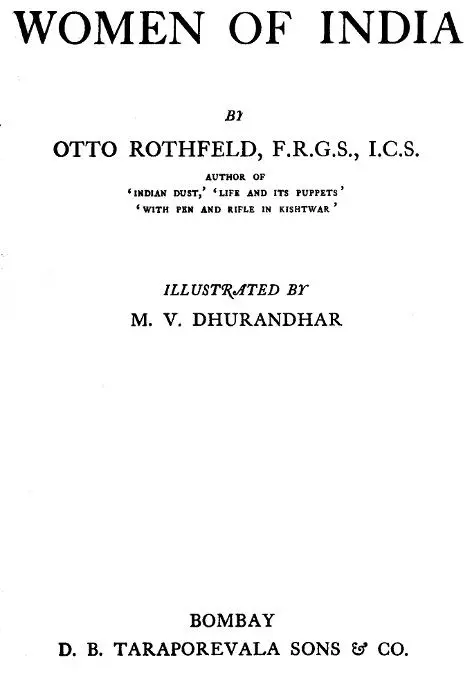
"Women of India" by Otto Rothfield is a historical account written in the early 20th century. The book explores the roles, lives, and experiences of women in India, reflecting on how their identities have been shaped by various cultural, social, and religious influences throughout history. It offers insight into different classes of women, from those in aristocracy to working-class women, shedding light on their strengths, struggles, and societal expectations. The opening of the text sets a vivid scene that intertwines historical context with an exploration of women's identities in India. Rothfield draws from ancient texts, referencing Vatsyana to categorize women into different types based on their attributes and virtues. He contrasts these classical ideals with the modern reality of Indian women, emphasizing their resilience and beauty amidst changing societal norms, especially in the bustling environment of contemporary Bombay. The narrative begins to delve into the profound significance of marriage in Indian culture, suggesting that for women, it represents the pinnacle of their existence and identity, a theme that is likely to evolve in the subsequent chapters. The initial portion establishes a blend of admiration and critique, reflecting both on traditional values and the transformations being witnessed in Indian society.
Introduction adapted from the source catalogue; source summaries may be automatically generated.
Free to read · English · 54,978 words · No account needed
MAKE TIME FOR A GOOD BOOK
On by default. Untick to stop anonymous reading totals. Each page counts after 10 seconds in view. How this works.
Anonymous counting is on unless you have switched it off.
Society, it must be said, and social converse had in India ceased to exist some fifteen hundred years ago. It does not happen that a company of men and women meet on easy terms for entertainment with the pleasures of light and familiar conversation, not learned, never, please heaven, didactic or instructive, but clever, witty, illumined by intuitions and swift generalizations, light of touch, and near to laughter. Nor is anything known of that innocent coquetry of well-bred womanhood, which seeks no particular stimulations but appeals for a general admiration, impersonally given to that fine spirited, finely attractive being who is the last word in luxury and taste and womanly moderation.
In India as one knows it--whatever it may have been in the remoter age pictured in the caves of Ajanta--the aspirations of women have taken a different course through a more placid water. Where they steer is no ebb and flow of conflicting purpose and sometimes, as they pass listlessly to the shore, it looks almost as if the roadstead had come to a stagnation. And yet--yet the course is set correctly and the sun is rightly taken. It may be that the horizon is viewed too low and that the profundities of the human spirit are not yet plumbed; but the Indian woman crosses the waters of life on a line true to her nature and her functions.
There is in all the Indian languages which derive from Sanscrit a word whose habitual usage is significant of a whole attitude to life, by whose meaning alone it is possible to understand the position sought by and accorded to womanhood. It is the word “dharma” which has been constantly mistranslated into English as “religion.” But when an Indian speaks of “dharma” he means really the duties, divinely imposed if you like or valid in nature, of his station. Between this “dharma” and that, between the “dharma” of his own class or sex and that of others, he draws a sharp distinction. In England, too, this sense is not unknown and the great landlord, for instance, speaks with right of the duties of his position, contrasting them with a broad distinction to those of the merchant, for example, or the workman. Noblesse oblige is a proverb that has been applied in all countries. But throughout Western thought there runs the idea that duty and morals must at bottom be one and the same for all. It is only, one might say, as a concession that the special duties of each station are recognized; and at most they are referred rather to the accidentals of life, to those supererogatory virtues which may be expected, like magnanimity or liberality from the rich and powerful, or that exceptional patience and humility which many persons seem to expect from the needy and unfortunate. The basic more permanent rules of moral conduct are regarded as something absolute, unalterable, unconditioned. Even the differences of sex are forgotten in the abstract contemplation of fixed moral laws. In practice, of course, facts have often compelled peoples to admit that differences do exist in the application of rules of conduct. Thus, to take a recent instance, in the crisis of war public opinion has allowed that even the supreme duties of citizenship press with divergent force upon married and unmarried men. Similarly it was until recently recognized by all and is even now by the greatest number that there are matters in which the conduct of men and women cannot be the same and that the same rights and duties cannot be applied indiscriminately to both sexes. But the recognition was seldom more than tacit. It was never co-ordinated, at least in England, to a reasoned view of life. It was not built upon a deliberate analysis of natural differences in function and in sensory and nervous force. It tended rather to be a mere concession to passing conditions of life. Thought, when it was explicit, dwelt chiefly upon abstract ideas of equality and equal duties. Some writers even tried to explain away the differences of character between men and women by referring them to mere accidents of environment, to women getting a less thorough education, for instance, or less of a chance in life, as it was called. It was not openly and clearly recognized that the natures and functions of men and women were different in essentials, and that the rules of conduct must in consequence be relative to different needs and purposes.
Your reading position is saved on this browser. Take it to another device with a library code. Reading pages adapt to text, rather than matching a printed edition.
BEHIND THE BOOK
This eBook is for the use of anyone anywhere in the United States and most other parts of the world at no cost and with almost no restrictions whatsoever. You may copy it, give it away or re-use it under the terms of the Project Gutenberg License included with this eBook or online at www.gutenberg.org. If you are not located in the United States, you will have to check the laws of the country where you are located before using this eBook. Read the source licence.
The original source file, including credits and licence, is retained by this library. Request an original-format copy at no charge. Please include the book title and Project Gutenberg identifier #50346.
KEEP YOUR CURIOSITY GOING
Cécile Tormay

Moritz Busch
John L. Ransom
Frances Wright
Cécile Tormay

Mabel Potter Daggett