
Moving the Mountain
Charlotte Perkins Gilman

THE CLASSIC COLLECTION · 1898
"Women and Economics" by Charlotte Perkins Gilman is a book published in 1898. Gilman argues that women's economic dependence on men has stunted their development and harmed society. She challenges traditional notions of marriage, motherhood, and domestic life, proposing radical reforms like professionalizing housework and creating cooperative kitchens. Her central claim: women must achieve economic independence to transform themselves and improve civilization. The book became wildly popular, establishing Gilman as a leading voice in the women's movement virtually overnight.
Introduction adapted from the source catalogue; source summaries may be automatically generated.
Free to read · English · 78,963 words · No account needed
MAKE TIME FOR A GOOD BOOK
On by default. Untick to stop anonymous reading totals. Each page counts after 10 seconds in view. How this works.
Anonymous counting is on unless you have switched it off.
—— promoted by the sexuo-economic relation, 312.
Vices of the slave in woman, 333.
—— of the master in man, 338.
Vigor of Greece, 72.
Virtue vs. vice, 109.
—— of loyalty, growth of, 274.
—— a relative term, 274.
—— of faith in religion, 322.
—— human distinction in, 322.
—— altruism the main distinction of human, 323.
—— Huxley on, 324.
—— of obedience, 325.
Virtues, savage, reflection of savage conditions, 321.
—— changing scale of, 322.
Voice of God, our good impulses called the, 328.
Wage-earners, women, with families, ideal home for, 242.
—— in New York, 242.
War, woman in, 165.
Ward, Lester F., quotation from, 171.
Wealth a social product, 101.
Wider human relationship not a wider sex-relationship, a, 304.
Wife, husband and, not business partners, 12.
—— supported by her husband, 18.
Will and action, discord of, in servitude, 333.
Wives as earners through domestic service, 14.
—— not salaried as mothers, 17.
Woman’s Christian Temperance Union, 166.
—— club movement, 164.
—— movement, 122, 139, 144, 146.
Womanliness of home duties, 225.
Women as economic factors in society, 13;
labor of, not a factor in economic exchange, 15.
—— as mothers, 15.
—— house service of, 20.
—— extra-maternal duties of, 21.
—— modification of, to sex, 39.
—— in proverb, 43, 50, 65, 71, 114.
—— development of sex-activity of, 44.
—— of the harem, 45.
—— of the Germanic tribes, 46.
—— feebleness of, a sex-distinction, 46.
—— of fiction, 50.
—— over-sexed, 54.
—— first enslaving of, 60.
—— results of enslaving of, 61.
—— fed and defended by men, 61.
—— economic profit of, won through sex-attraction, 63.
—— restrictions upon, 66.
—— work of, 67.
—— specialization and organization forbidden to, 67.
—— Paul’s command to, 68.
—— question of soul in, 68.
—— attitude of, toward marriage, 86.
—— independence of, 91.
—— results of repression of, 119.
—— past sacrifices of, 134.
—— economic dependence of, ending, 138.
—— as martyrs, 147.
—— among the pioneers, 147.
—— progress of, 148, 149.
—— as workers, 152, 153.
—— specialized, 155.
—— desire of, for work, 157.
—— extension of functions in, 160.
—— social interest among, 163.
—— relation of, to society, 164.
—— in war, 165.
—— spirit of heroic, 166.
—— development of, 168.
—— specialization of, 169, 171.
—— economic dependence of rich, 170.
—— place of, in nature, 171.
—— and home life, 204.
—— food and, 226, 227.
—— practice of cooking by, 229.
—— preparation of food by, a sex-function, 235–237.
—— wage-earners, with families, ideal home for, 242.
—— wage-earners in New York, 242.
—— motherhood of, and the choice of professions by, 246.
—— free, and their homes, 257.
—— household decoration of, an expression of economic dependence, 257.
—— share of, in social intercourse, 295.
—— gradual individualization of, 295.
—— entrance of, upon a more individual life, 297.
—— peace and comfort for, 300.
—— forced by their needs to marriage, 300.
—— result of economic independence of, 304.
—— unsatisfactory association of, 307.
—— amusements of, gained through sex-attraction, 308.
—— embarrassments of young man visiting, 311.
—— cost of pleasing, 312.
—— new estimate of true manhood by, 315.
—— personality of, 315.
—— becoming economically independent, 316.
—— condition of, the doorway of evil, 329.
—— result of arrested development of, 330.
—— vices of the slave in, 333.
—— development of submission in, 333.
—— restriction of thought in, 335.
—— large moral sense of, 335.
—— one-sided contribution of, to moral progress, 335.
—— retarding influence of, restricted, 336.
—— self-conscious centres of moral influence, 336.
—— psychic qualities of, a result of the sexuo-economic relation, 337.
World, a servile, 262.
—— organized motherhood productive of a nobler, 294.
—— a humanly related, 313.
—— the, the flesh, and the devil, 328.
Work, woman’s, 67.
Your reading position is saved on this browser. Take it to another device with a library code. Reading pages adapt to text, rather than matching a printed edition.
Charlotte Perkins Gilman

Charlotte Perkins Gilman

Charlotte Perkins Gilman
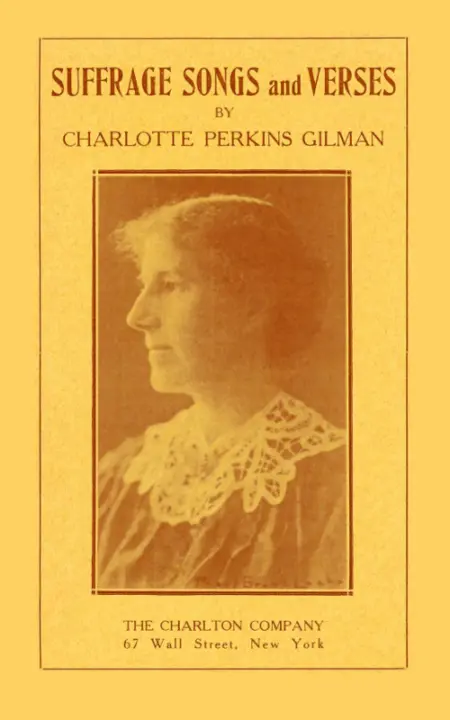
Charlotte Perkins Gilman
BEHIND THE BOOK
This eBook is for the use of anyone anywhere in the United States and most other parts of the world at no cost and with almost no restrictions whatsoever. You may copy it, give it away or re-use it under the terms of the Project Gutenberg License included with this eBook or online at www.gutenberg.org. If you are not located in the United States, you will have to check the laws of the country where you are located before using this eBook. Read the source licence.
The original source file, including credits and licence, is retained by this library. Request an original-format copy at no charge. Please include the book title and Project Gutenberg identifier #57913.
KEEP YOUR CURIOSITY GOING

Charles G. (Charles Griffith) Ross
Hannah Webster Foster

Emily Lawless
Edwin Hamlin Carr

Charles De Lano Hine
Andrew Ure