Moving the Mountain
Charlotte Perkins Gilman
THE CLASSIC COLLECTION · 1898
"Women and Economics" by Charlotte Perkins Gilman is a book published in 1898. Gilman argues that women's economic dependence on men has stunted their development and harmed society. She challenges traditional notions of marriage, motherhood, and domestic life, proposing radical reforms like professionalizing housework and creating cooperative kitchens. Her central claim: women must achieve economic independence to transform themselves and improve civilization. The book became wildly popular, establishing Gilman as a leading voice in the women's movement virtually overnight.
Introduction adapted from the source catalogue; source summaries may be automatically generated.
Free to read · English · 78,963 words · No account needed
MAKE TIME FOR A GOOD BOOK
On by default. Untick to stop anonymous reading totals. Each page counts after 10 seconds in view. How this works.
Anonymous counting is on unless you have switched it off.
Profession, cooking as a, 239.
Professional cleaners, advantage of, 255.
—— preparation of food increasing, 249.
—— service in cooking, 241.
Professions, women’s choice of, 246.
—— unsuitable to motherhood, 246.
Profit of egoism to the isolated individual, 325.
—— of altruism to the socialized individual, 325.
Progeny of Anglo-Saxon and Oriental, 332.
—— of Anglo-Saxon and African, 332.
Progress of humanity accomplished by men, 74.
—— of individualization, 139.
—— true social, based on a spirit of inter-human love, 142.
—— of women, 148, 149.
—— unorganized home industries a check to social, 156.
—— human, lies in perfecting the social organization, 162.
—— the duty of human life, 207.
—— definition of human, 208.
—— home a limit to social, 223.
—— woman’s one-sided contribution to moral, 335.
Proofs of excessive sex-development, 84.
Prostitution, social estimate of, 28.
—— the flower of the sexuo-economic relation, 171.
Proverb, woman in, 43, 50, 65, 71, 114.
—— the martyr in, 80.
—— the old maid in, 88.
“Proverbs of All Nations,” facts concerning the “Handbook of,” 49.
Provision for individuals not members of families, 297, 298.
Psychic hybrids, our race of, 331.
—— qualities of woman, a result of the sexuo-economic relation, 337.
—— relation, disadvantageous, of home life, 273.
Public house, the, 264.
Punch, advice of, in regard to marriage, 28.
Qualities, survival of harmful, 327.
—— woman’s psychic, the result of the sexuo-economic relation, 337.
Quality of patriotism, the social, 325.
—— of philanthropy, the social, 325.
—— of statesmanship, the social, 325.
Question of woman’s soul, 68.
Race of psychic hybrids, our, 331.
—— attributes different from sex-attributes, 51.
—— development, a check to, 65.
—— distinction, civilization our, 74.
—— function, cooking retarded as a, 241.
—— myth, a, 92.
—— preservation, process of, not self-preservation, 34, 52.
Races, dead, 25.
Racial advance, woman’s share in, 9;
motherhood and, 189.
—— habits, force of, 78.
Reasons for the inefficiency of the individual mother, 293.
Reflection of savage conditions, savage virtues the, 321.
Relation, extension of the social, 123.
—— woman’s, to society, 164.
—— change of basis in the family, 271.
—— the wrong, between parent and child, 272.
—— psychic, of home life disadvantageous, 273.
—— permanence of the marriage, 301.
—— of the sexes, effect of, 318.
—— sexuo-economic, changes of, 122;
benefit of, 136;
evil results of, 187, 339;
servant-motherhood a result of, 279;
outgrown, 316;
woman’s psychic qualities a result of, 337;
selfishness fostered by, 338.
Relations, economic, good results of sex-equality in, 340.
Relationship, broader, for the child, 291.
—— wider human, not wider sex-relationship, 304.
Relative term, virtue a, 274.
Religion, virtue of faith in, 322.
Religious development, dead-line of, 68.
Repression of woman, results of, 119.
Reproduction, excessive indulgence an injury to, 42.
—— and education, processes of, 179.
Responsibilities of motherhood, 186, 200.
Restricted sense of duty, of the mother, 277.
Restriction of woman, in freedom of expression, 66.
—— in thought, 335.
—— retarding influence of, 336.
Result of excessive sex-energy, the, 141.
—— of the sexuo-economic relation, servant-motherhood the, 279.
—— of the development of the kindergarten, 286.
—— of the arrested development of woman, 330.
—— of the economic independence of woman, 331.
—— of the servitude of the mother, 334.
Result of the sexuo-economic relation, woman’s psychic qualities a,
337.
Results of chattel slavery, 82.
—— motherhood to be measured by its, 178.
—— of the untrained maternal instinct, 198.
—— of the future development of cooking, 254.
—— evil, of the sexuo-economic relation, 339.
Your reading position is saved on this browser. Take it to another device with a library code. Reading pages adapt to text, rather than matching a printed edition.
Charlotte Perkins Gilman
Charlotte Perkins Gilman

Charlotte Perkins Gilman
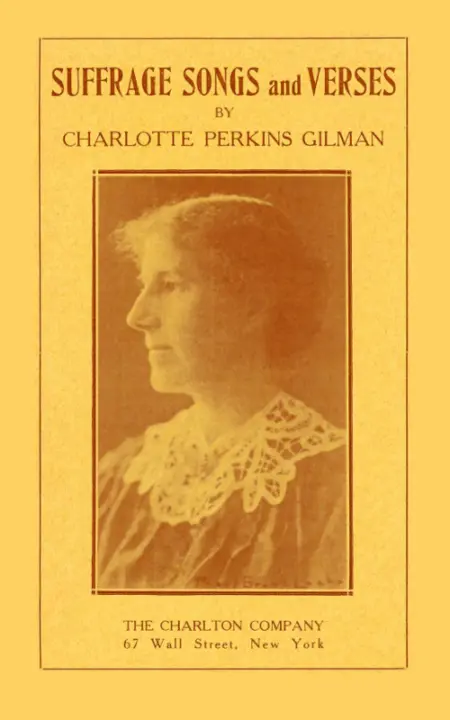
Charlotte Perkins Gilman
BEHIND THE BOOK
This eBook is for the use of anyone anywhere in the United States and most other parts of the world at no cost and with almost no restrictions whatsoever. You may copy it, give it away or re-use it under the terms of the Project Gutenberg License included with this eBook or online at www.gutenberg.org. If you are not located in the United States, you will have to check the laws of the country where you are located before using this eBook. Read the source licence.
The original source file, including credits and licence, is retained by this library. Request an original-format copy at no charge. Please include the book title and Project Gutenberg identifier #57913.
KEEP YOUR CURIOSITY GOING

Charles G. (Charles Griffith) Ross
Hannah Webster Foster

Emily Lawless
Edwin Hamlin Carr

Charles De Lano Hine
Andrew Ure