
Moving the Mountain
Charlotte Perkins Gilman

THE CLASSIC COLLECTION · 1898
"Women and Economics" by Charlotte Perkins Gilman is a book published in 1898. Gilman argues that women's economic dependence on men has stunted their development and harmed society. She challenges traditional notions of marriage, motherhood, and domestic life, proposing radical reforms like professionalizing housework and creating cooperative kitchens. Her central claim: women must achieve economic independence to transform themselves and improve civilization. The book became wildly popular, establishing Gilman as a leading voice in the women's movement virtually overnight.
Introduction adapted from the source catalogue; source summaries may be automatically generated.
Free to read · English · 78,963 words · No account needed
MAKE TIME FOR A GOOD BOOK
On by default. Untick to stop anonymous reading totals. Each page counts after 10 seconds in view. How this works.
Anonymous counting is on unless you have switched it off.
—— health, 238.
Force of habit, individual and social, 78.
Form of sex-union, marriage a sanctioned, 213.
Forms of social service, high and low, 279.
Fort Sumter, 146.
Forum, the, 171, 172.
Fostering of selfishness, 280.
France, the noblesse of, 146.
Free France, birth of, 137.
Free woman and her home, 257.
Freedom, social, before marriage, 309.
—— after marriage, 310.
Frederic the Great, 182.
Friendship means more to men than to women, 306.
—— between men and women a laughing-stock, 309.
—— often destroyed by marriage, 310.
—— no opportunity for true, 312.
Friction in families increasing, 273.
Fry, Elizabeth, 163.
Fulfilment of true family life, 268.
Function, extension of, in woman, 60.
—— education a human, 180.
—— cooking a social, 240.
—— education a social, 283.
—— educative maternity, a social, 293.
Functions, development of, masculine and feminine, 29.
—— of femininity, 159.
—— home duties as feminine, 225.
—— specialization of social, 241.
Future development of cooking, results of, 254.
—— good, present evil and, 206.
—— home life, 298.
Games, Olympian, 308.
—— men the real players of, 308.
Garrison, William Lloyd, 137.
Gates of death in child-birth, 181.
Germanic women, 46.
Getting and giving, 132.
Ghetto, survivors of the, 4.
Gibson girl, the, 148.
Giving, getting and, 132.
God, our good impulses the voice of, 328.
Good, present evil and future, 206.
—— and evil, perceptions of, 324.
—— the struggle between, 329.
Good family man, a, 303.
—— food, effects of standard of, 250.
—— impulses, the voice of God, 328.
—— results of sex-equality in economic relations, 340.
Gomorrah, 72.
Government, parental, 175.
—— patriarchal, in the family, 214.
—— home the seat of, 222.
Gradual individualization of woman, 295.
Greece, vigor of, 72.
—— minds of, 161.
—— Plato’s relation to, 162.
Greece, academic groves of, 285.
Greek commander and his Persian captives, 72.
Griselda not satisfactory, 218.
Groves of Greece, the academic, 285.
Growing need of human beings for each other, 305.
Growth of civilization, effect of, 63.
—— of the family hotel, 265.
—— of the virtue of loyalty, 274.
—— of systematic education, 285.
Guide to conduct, instinct not always a true, 209.
Habit, force of industrial and racial, 78.
Habit of species, man’s inversion of the usual, 54.
“Handbook of Proverbs of all Nations,” facts concerning, 49.
Harmful qualities, survivals of, 327.
Hayrick’s Food, 196.
Health foods, 238.
Heart, the social, 161.
Hebrew prayer, the, 56.
Hebrews, race-modification of, 3.
Height of filial devotion, 176.
Heredity, no Salic law of, 69, 334.
—— equalizing action of, 70.
—— and the development of higher psychic attributes, 95.
—— power of, 134.
—— a mixed, 330.
Heroic women, spirit of, 166.
High and low forms of social service, 279.
Higher sex-life, 143.
Hindu, sex-prejudice of, 69.
Historic crises, birth of, 146.
History of the family, 213.
Home, sanctuary of the, 203.
—— our jealousy of innovation in the, 205.
—— meaning of, 220.
—— marriage not identical with the, 220.
—— associations with, 221.
—— the first seat of government, 222.
—— highest development comes from outside the, 222.
—— does not produce the virtues needed in: society, 223.
—— a limit to social progress, 223.
—— ideal, for women wage-earners with families, 242.
—— the free woman and her, 257.
—— faults of the sexuo-economic, 261.
—— of the servant-wife, 263.
—— of the individual, development of the, 264.
Home, the kitchenless, 267.
—— treason to society the price of comfort in the, 278.
—— children brought up in the, 282.
—— necessary for all, 298.
Your reading position is saved on this browser. Take it to another device with a library code. Reading pages adapt to text, rather than matching a printed edition.
Charlotte Perkins Gilman

Charlotte Perkins Gilman

Charlotte Perkins Gilman
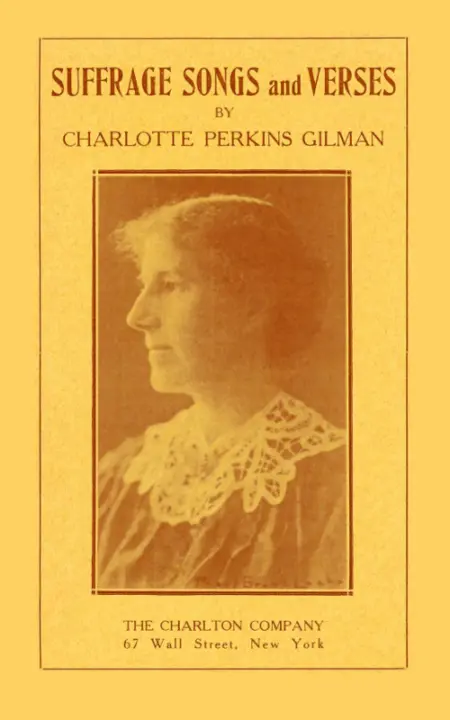
Charlotte Perkins Gilman
BEHIND THE BOOK
This eBook is for the use of anyone anywhere in the United States and most other parts of the world at no cost and with almost no restrictions whatsoever. You may copy it, give it away or re-use it under the terms of the Project Gutenberg License included with this eBook or online at www.gutenberg.org. If you are not located in the United States, you will have to check the laws of the country where you are located before using this eBook. Read the source licence.
The original source file, including credits and licence, is retained by this library. Request an original-format copy at no charge. Please include the book title and Project Gutenberg identifier #57913.
KEEP YOUR CURIOSITY GOING

Charles G. (Charles Griffith) Ross
Hannah Webster Foster

Emily Lawless
Edwin Hamlin Carr

Charles De Lano Hine
Andrew Ure