THE CLASSIC COLLECTION✦The Women of the French SalonsCLASSIC FREE BOOKS
The Women of the French Salons
Amelia Gere Mason
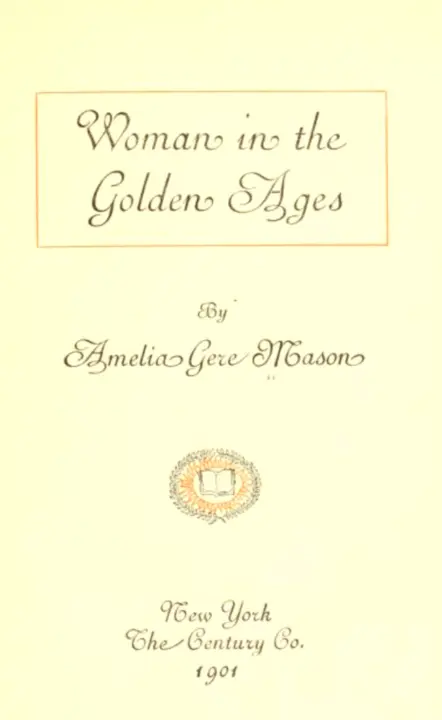
THE CLASSIC COLLECTION · 1901
"Woman in the Golden Ages" by Amelia Gere Mason is a collection of historical essays written in the early 20th century. The work explores the roles, influences, and intellectual contributions of women throughout pivotal periods of history, particularly focusing on Greece, Rome, and the Renaissance. The essays examine notable female figures and their significance in shaping cultural, social, and political landscapes, challenging the historical narrative that has often marginalized women's contributions. The opening of the book presents a preface in which the author articulates the challenge of uncovering the lives of women from ancient times, as traditional historical accounts have primarily reflected male perspectives. Mason expresses a desire to provide a more nuanced understanding of women's roles during different historical epochs, highlighting their intellectual achievements and the societal obstacles they faced. She emphasizes the contrast between the neglect and contempt women often received in historical discourse and the myriad ways in which they impacted history, culture, and society. The preface sets the stage for the essays that follow, which promise to illuminate the importance of women's voices in historical narratives.
Introduction adapted from the source catalogue; source summaries may be automatically generated.
Free to read · English · 93,434 words · No account needed
MAKE TIME FOR A GOOD BOOK
On by default. Untick to stop anonymous reading totals. Each page counts after 10 seconds in view. How this works.
Anonymous counting is on unless you have switched it off.
But in the golden age of the Renaissance, women no longer stayed in the inner court, to gossip and listen to flute-players, while their husbands talked on themes high or low. The worship of the Madonna, if it had done little else, had idealized the pure affection of an exalted womanhood. Chivalry following in its train had made the cult of woman a fashion by giving her more or less of the homage already paid to her divine representative, though this sentiment was less active in Italy than in Provence or among the more romantic races. It was a tribute of strength to helplessness, and had its roots in the finest traits of men; but it exalted moral qualities rather than intellectual ones, and was largely theoretical outside of a limited class. Now that men had begun to dip into classic lore, however, they found a valuable ally in women, and the old cult became a companionship. To be educated and a princess was to be doubly a power, to have opinions which it was worth while to consider.
The princesses of Urbino had doubtless read Plato. In an age, too, that occupied itself with Boccaccio, who had glorified the senses and written books that no pure and refined woman could read, they had turned to Dante and the spiritual love which was an inspiration and a benediction. In the white soul of Beatrice they found the exquisite flower of womanhood. They caught also the subtle fragrance of the ideal love which Petrarch gave, first to a woman, then to an unfading memory. It was of such a love they dreamed and liked to talk. Then one of the chief apostles of Platonism was the brilliant Bembo, who was the star of this company. “Through love,” he says, “the supreme virtues rule the inferior.” He puts on record and dedicates to Lucrezia Borgia the conversations of three days on its joys and sorrows; but the subject was evidently exhausted, as, at the end, a hermit gives a homily on the vanity of the world. He closes an eloquent apostrophe, however, with these words: “Chase away ignorance and make us see celestial beauty in its perfection. Love, it is the communion with divine beauty, the banquet of angels, the heavenly ambrosia.” On this theme his listeners rang the changes, but not always on so ethereal a plane. The relative constancy of the sexes, the divine right of man, the passive nature of woman, who was called a pale moon to the masculine sun, and various other points, had their fair share of discussion. Between terrestrial and celestial love there are many gradations, and the character and temperament of the men were clearly revealed in their opinions. Some were disposed to be autocrats, others took issue with masculine egotism, and still others dwelt on the sentimental side of the question. One of the Fregosos rather ungraciously assumed the traditional attitude of his sex and contended that women are “imperfect animals,” not at all to be compared with men. But he was in an unpopular minority. The Duchess Elisabetta was a well-poised, discreet woman, who was devoted to her invalid husband, kept her admirers at a prudent distance, and was in no wise a victim to superfluous sensibility. The effusive Bembo, who was given to friendships touched with the fire of the imagination, was untiring in his devotion to this Minerva, but he confessedly adored her as a goddess from afar. The witty and brilliant Emilia Pia had a temperament the reverse of sentimental, and was ready to demolish any castle of moonlight with a shaft of merciless satire. Both brought a solid equipment of common sense into an analysis that often reached a very fine point. But this friendship that was not love, this love that was a sublimated friendship, appealed to them as it did to many others besides poets in a grossly material age. To separate the soul from the senses and intellectualize the emotions, was the natural protest of intelligent women against the old traditions that considered them only as servants or toys of men’s fancies. It took them out of the realm of the passions and “gave them wings for a sublime flight.” The mysticism of love is closely related to the mysticism of religion, and the faith that sees God in ecstatic visions is not far from the love that feeds itself from spiritual sources. These rambling talks, to which the young ladies listened curiously and with interest, though usually in discreet silence, proved so absorbing that on the last of a series of evenings devoted to the subject, the party forgot its usual gaieties, and did not disperse until the birds began to sing in the trees and the rosy dawn shone over the rugged heights of Monte Catri.
Your reading position is saved on this browser. Take it to another device with a library code. Reading pages adapt to text, rather than matching a printed edition.
BEHIND THE BOOK
This eBook is for the use of anyone anywhere in the United States and most other parts of the world at no cost and with almost no restrictions whatsoever. You may copy it, give it away or re-use it under the terms of the Project Gutenberg License included with this eBook or online at www.gutenberg.org. If you are not located in the United States, you will have to check the laws of the country where you are located before using this eBook. Read the source licence.
The original source file, including credits and licence, is retained by this library. Request an original-format copy at no charge. Please include the book title and Project Gutenberg identifier #67405.
KEEP YOUR CURIOSITY GOING

David Patterson (Spirit) Hatch

David Patterson (Spirit) Hatch

David Patterson (Spirit) Hatch
Cécile Tormay

Moritz Busch
John L. Ransom