THE CLASSIC COLLECTION✦The Women of the French SalonsCLASSIC FREE BOOKS
The Women of the French Salons
Amelia Gere Mason
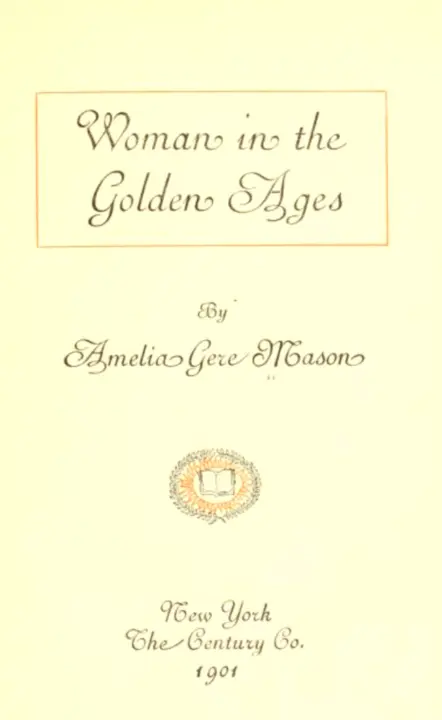
THE CLASSIC COLLECTION · 1901
"Woman in the Golden Ages" by Amelia Gere Mason is a collection of historical essays written in the early 20th century. The work explores the roles, influences, and intellectual contributions of women throughout pivotal periods of history, particularly focusing on Greece, Rome, and the Renaissance. The essays examine notable female figures and their significance in shaping cultural, social, and political landscapes, challenging the historical narrative that has often marginalized women's contributions. The opening of the book presents a preface in which the author articulates the challenge of uncovering the lives of women from ancient times, as traditional historical accounts have primarily reflected male perspectives. Mason expresses a desire to provide a more nuanced understanding of women's roles during different historical epochs, highlighting their intellectual achievements and the societal obstacles they faced. She emphasizes the contrast between the neglect and contempt women often received in historical discourse and the myriad ways in which they impacted history, culture, and society. The preface sets the stage for the essays that follow, which promise to illuminate the importance of women's voices in historical narratives.
Introduction adapted from the source catalogue; source summaries may be automatically generated.
Free to read · English · 93,434 words · No account needed
MAKE TIME FOR A GOOD BOOK
On by default. Untick to stop anonymous reading totals. Each page counts after 10 seconds in view. How this works.
Anonymous counting is on unless you have switched it off.
It is pleasant to record that the most ardent champions of feminine ability were men of more than ordinary caliber. As men rarely exaggerate the talents of women, though they sometimes make goddesses of them, we may safely conclude that their pictures were not overdrawn on that side. Truth, however, compels me to say that some of the eulogists were accomplished courtiers with special appreciation of queens and princesses who might make or mar their fortunes; also that this complaisance was by no means universal. Whether the satirists, novelists, and minor poets found the wicked more effective, from a dramatic point of view, than the good, as many of their successors do to-day, or the sensual age was more interested in pretty sinners than in saints, it is certain that these writers paid scant honor to women, and delighted to put them in the worst light, though satire was in the main directed against the ignorant and the frivolous, not against the intelligent or the strong. Even Montaigne refused to look upon a woman otherwise than as a useful but inferior animal, though he inconsistently chose one of these “inferior animals” as his confidante and literary executor, because she was the “only person he knew in whose literary judgment he could confide.” The scholarly Erasmus said she was “a foolish, silly creature, no doubt, but amusing and agreeable.” He was happy in the belief that “the great end of her existence is to please men”; but he pays his own sex a poorer compliment than we should like to when he adds that “she could not do this without folly.”
So much for the man’s point of view. But the women were not silent, and a few glorified themselves as naïvely as some of their modern sisters have done. If we ever had any doubts as to our own modesty they ought to convince us of it. Lucrezia Marinelli, a clever Venetian and a poet, defined herself quite clearly in a work entitled “The Nobleness and Excellence of Women and the Faults and Imperfections of Men.” As a comparison this seems rather unfair, but considering the fact that men had for ages given themselves all the noble qualities and women all the weak ones, they could not take serious exception to it. Indeed, they evidently found it refreshing. It furnished them with a new sensation, and was quite harmless on the practical side, as they still held the reins of power. Marguerite of France, the brilliant and lettered wife of Henry IV, tried to prove that women are very superior to men, but, unfortunately, in her category of superiorities morals had no place. Mlle. de Gournay was more generous, as well as more just, and declared herself content with simple equality, though one cannot help wondering how she settled that matter with her friend Montaigne. But Mlle. Schurmann of Cologne thought that even this was going too far. It seems as if she might fairly have claimed to be the peer of the average man, since she spoke nine languages and was more or less noted as painter, musician, sculptor, engraver, philosopher, mathematician, and theologian. Just how much solid learning was implied in this formidable list of accomplishments we cannot judge, but it is clear that there has been a time before to-day when women aimed to know everything, though there was a safeguard against shattered nerves in the fact that there were not so many books to read nor so many brain-splitting problems to solve. It is fair, however, to suppose that this learned lady did not waste much time on clothes or five-o’clock teas. Louise Labé, the poet and savante of Lyons, takes a more modern tone. In claiming intellectual equality for women, she begs them not to permit themselves to be despoiled of the “honest liberty so painfully won--the liberty of knowing, thinking, working, shining.” In spite of her courageous words, however, this paragon of so many talents and virtues, the glory of her sex and the pride of her city, asserts herself in a half-deprecating way, as if she were asking pardon for presuming to publish her little verses, and shelters herself behind the admiring friends who are willing to “take half the shame.” But she was a Frenchwoman, and her day was not yet. Women had so long hidden their light, if they had any, that it blinked perceptibly when exposed to the winds of heaven or the more chilly breezes of masculine criticism.
Your reading position is saved on this browser. Take it to another device with a library code. Reading pages adapt to text, rather than matching a printed edition.
BEHIND THE BOOK
This eBook is for the use of anyone anywhere in the United States and most other parts of the world at no cost and with almost no restrictions whatsoever. You may copy it, give it away or re-use it under the terms of the Project Gutenberg License included with this eBook or online at www.gutenberg.org. If you are not located in the United States, you will have to check the laws of the country where you are located before using this eBook. Read the source licence.
The original source file, including credits and licence, is retained by this library. Request an original-format copy at no charge. Please include the book title and Project Gutenberg identifier #67405.
KEEP YOUR CURIOSITY GOING

David Patterson (Spirit) Hatch

David Patterson (Spirit) Hatch

David Patterson (Spirit) Hatch
Cécile Tormay

Moritz Busch
John L. Ransom