
Last letters from the living dead man
David Patterson (Spirit) Hatch
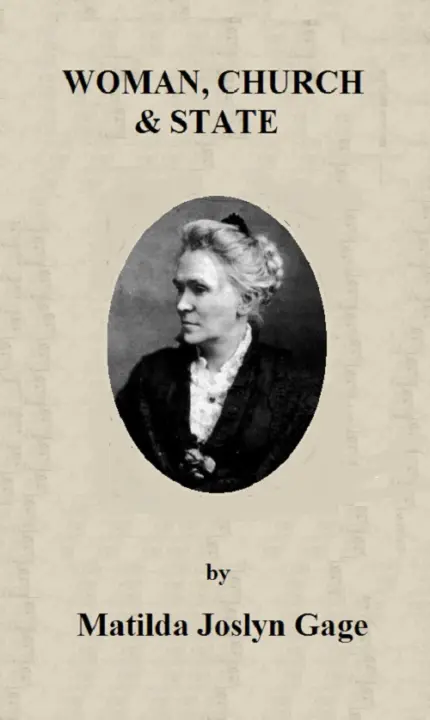
THE CLASSIC COLLECTION · 1893
"Woman, Church & State" by Matilda Joslyn Gage is a historical account written in the late 19th century. The book critically examines the historical treatment of women by both religious institutions and state authorities, challenging the widely held belief that the rise of Christianity improved women's status. Gage argues that women once held significant power in societies governed by matriarchal systems, and she seeks to illuminate the injustices faced by women as a result of patriarchal structures that have taken their place. At the start of the work, Gage presents a preface that outlines her motivations for writing this book, emphasizing her indignation towards the male-dominated Church and State that have perpetuated the subjugation of women throughout history. She asserts that women enjoyed greater liberties in ancient civilizations, particularly under matriarchal governance, and she aims to refute the notion that Christianity elevated women's status compared to earlier periods. Gage’s initial arguments set the stage for a thorough exploration of historical precedents that illustrate the systemic oppression of women as dictated by religious dogma and societal norms.
Introduction adapted from the source catalogue; source summaries may be automatically generated.
Free to read · English · 178,889 words · No account needed
MAKE TIME FOR A GOOD BOOK
On by default. Untick to stop anonymous reading totals. Each page counts after 10 seconds in view. How this works.
Anonymous counting is on unless you have switched it off.
The famous Iroquois Indians, or Six Nations, which at the discovery of America held sway from the great lakes to the Tombigbee river, from the Hudson to the Ohio, and of whom it has been said that another century would have found them master of all tribes to the Gulf of Mexico on the south, and the Mississippi on the west, showed alike in form of government, and in social life, reminiscences of the Matriarchate. The line of descent, feminine, was especially notable in all tribal relations such as the election of Chiefs, and the Council of Matrons, to which all disputed questions were referred for final adjudication. No sale of lands was valid without consent of the squaws and among the State Archives at Albany, New York, treaties are preserved signed by the “Sachems and Principal Women of the Six Nations.”[11] The women also possessed the veto power on questions of war. Sir William Johnston mentions an instance of Mohawk squaws forbidding the war-path to young braves. The family relation among the Iroquois demonstrated woman’s superiority in power. When an Indian husband brought the products of the chase to the wigwam, his control over it ceased. In the home, the wife was absolute; the sale of the skins was regulated by her, the price was paid to her. If for any cause the Iroquois husband and wife separated, the wife took with her all the property she had brought into the wigwam; the children also accompanied the mother, whose right to them was recognized as supreme. So fully to this day is descent reckoned through the mother, that blue-eyed, fair-haired children of white fathers are numbered in the tribe and receive both from state and nation their portion of the yearly dole paid to Indian tribes. The veriest pagan among the Iroquois, the renowned and important Keeper of the Wampum, and present sole interpreter of the Belts which give the most ancient and secret history of this confederation, is Ephraim Webster, descended from a white man, who, a hundred or more years since, became affiliated through marriage with an Indian woman, as a member of the principal nation of the Iroquois, the Onondagas. As of yore, so now, the greater and lesser Council Houses of the Iroquois are upon the “mountain” of the Onondaga reservation a few miles from the city of Syracuse, New York. Not alone the Iroquois but most Indians of North America trace descent in the female line; among some tribes woman enjoys almost the whole legislative authority and in others a prominent share.[12] Lafitte and other Jesuit missionary writers are corroborated in this statement by Schoolcraft, Catlin, Clark, Hubert Bancroft of the Pacific coast, and many students of Indian life and customs. But the most notable fact connected with woman’s participation in governmental affairs among the Iroquois is the statement of Hon. George Bancroft that the form of government of the United States, was borrowed from that of the Six Nations.[13] Thus to the Matriarchate or Mother-rule is the modern world indebted for its first conception of inherent rights, natural equality of condition, and the establishment of a civilized government upon this basis. Although the reputation of the Iroquois as warriors appears most prominent in history, we nevertheless find their real principles to have been the true Matriarchal one of peace and industry. Driven from the northern portion of America by vindictive foes, compelled to take up arms in self-protection, yet the more peaceful occupations of hunting and agriculture were continually followed. Their history was preserved by means of wampum, while under their women the science of government reached the highest form known to the world. Among the Zunis of New Mexico, woman still preserves supreme religious and political authority; the Paramount Council consisting of six priests under control of a supreme priestess who is the most important functionary of the tribe.[14] This form of government is traceable to their earliest civilization at which period their cities were grouped in sevens, six of them constructed upon a uniform plan; the supreme seventh containing six temples clustered about a supreme central seventh temple. While male priests ruled over the six primal cities the central and superior seventh was presided over by a priestess who not alone officiated at the central temple, but to whom the male priests of the six cities and six inferior temples were subservient. The ancient Lycians, the Sclavs, the Basques of Spain,[15] the Veddas of Ceylon,[16] the inhabitants of Malabar, the aborigines of widely separated lands, all show convincing proof of woman’s early superiority in religion, in the state, and in the family. Monogamy was a marked feature of the Matriarchate. Bachofen, who has written voluminously upon the Matriarchate, recognizes it as peculiarly characteristic of woman’s government. He also says the people who possessed the Mother-rule together with Gynaikokraty (girls’ rule) excelled in their love of peace and justice. Under the Matriarchal family and tribal system even long after its partial supersedence by the incoming Patriarchate, the marriage relation was less oppressive to woman than it has been under most centuries of christian civilization. Daughters were free in their choice of husbands, no form of a force or sale existing.[17]
Your reading position is saved on this browser. Take it to another device with a library code. Reading pages adapt to text, rather than matching a printed edition.
BEHIND THE BOOK
This eBook is for the use of anyone anywhere in the United States and most other parts of the world at no cost and with almost no restrictions whatsoever. You may copy it, give it away or re-use it under the terms of the Project Gutenberg License included with this eBook or online at www.gutenberg.org. If you are not located in the United States, you will have to check the laws of the country where you are located before using this eBook. Read the source licence.
The original source file, including credits and licence, is retained by this library. Request an original-format copy at no charge. Please include the book title and Project Gutenberg identifier #45580.
KEEP YOUR CURIOSITY GOING
David Patterson (Spirit) Hatch

David Patterson (Spirit) Hatch

David Patterson (Spirit) Hatch
Cécile Tormay

Moritz Busch
John L. Ransom