
Last letters from the living dead man
David Patterson (Spirit) Hatch
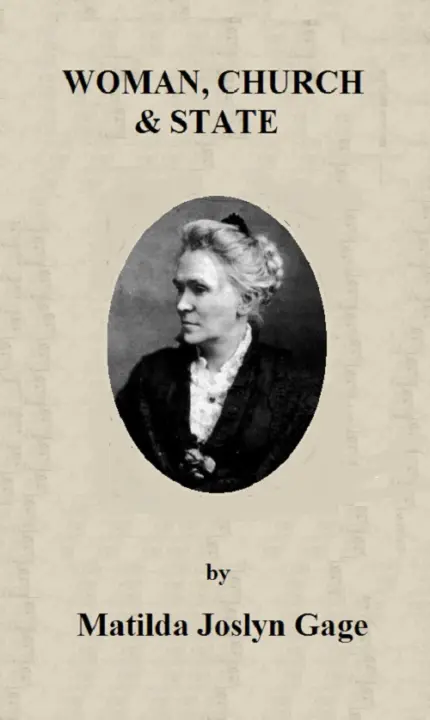
THE CLASSIC COLLECTION · 1893
"Woman, Church & State" by Matilda Joslyn Gage is a historical account written in the late 19th century. The book critically examines the historical treatment of women by both religious institutions and state authorities, challenging the widely held belief that the rise of Christianity improved women's status. Gage argues that women once held significant power in societies governed by matriarchal systems, and she seeks to illuminate the injustices faced by women as a result of patriarchal structures that have taken their place. At the start of the work, Gage presents a preface that outlines her motivations for writing this book, emphasizing her indignation towards the male-dominated Church and State that have perpetuated the subjugation of women throughout history. She asserts that women enjoyed greater liberties in ancient civilizations, particularly under matriarchal governance, and she aims to refute the notion that Christianity elevated women's status compared to earlier periods. Gage’s initial arguments set the stage for a thorough exploration of historical precedents that illustrate the systemic oppression of women as dictated by religious dogma and societal norms.
Introduction adapted from the source catalogue; source summaries may be automatically generated.
Free to read · English · 178,889 words · No account needed
MAKE TIME FOR A GOOD BOOK
On by default. Untick to stop anonymous reading totals. Each page counts after 10 seconds in view. How this works.
Anonymous counting is on unless you have switched it off.
When Father Wolonski arrived in Philadelphia he visited the Cathedral and sought an interview with Archbishop Ryan, but when that gentlemen then came to Shenandoah, as directed by Bishop Sembratowicz, of Limberg, who sent him on his mission, Father O’Reilly, of the Irish Catholic Church, warned his congregation, under pain of excommunication, to shun the church and priest, at the same time tacitly denying that the Roman Church recognized the right of any priest to marry. The matter led to great controversy, during which Father Wolonski established his congregation, and arrangements have been made for the erection of a church. To avoid further trouble, however, the Bishop of Limberg has selected and sent an unmarried priest to succeed him, and Father Wolonski will return to Austria. Father Wolonski is an intelligent and highly-educated gentleman, and has made a large number of friends during the few months he has been here. He speaks several languages, and during his stay here acquired a remarkable knowledge of English. He has worked incessantly since his arrival here for the temporal as well as the spiritual comfort of his people, and has made a large circle of acquaintances, who will regret his departure from the town.
[106] And yet the world “does move,” and the experience of the church is much that of the big elephant Jumbo, who in opposing his vast form to a train of cars met his death at the engine.
[107] The Chili mantas and skirts of white flannel are worn by penitentes, or women who have committed some heinous sin and thus advertise their penitence; or those who have taken some holy vow to get a measure nearer heaven, and go about the street with downcast eyes, looking at nothing and recognizing no one. They hover about the churches, and sit for hours crouched before some saint or crucifix, saying prayers and atoning for their sin. In the great Cathedral at Santiago, and in the smaller churches everywhere, these penitentes, in their snow-white garments, are always to be seen, on their knees, or posing in other uncomfortable postures, and looking for all the world like statues carved in marble. In the Santiago Cathedral they cluster in large groups around the confessionals, waiting to receive absolution from some fat and burly father, that they may rid their bodies of the mark of penitence they carry and their souls of sin. Some of them make vows, or are sentenced by their confessors to wear their white shrouds for a certain time, while others assume them voluntarily until they have assurance from their priest that their sin is atoned for. Ladies of the highest social position and great wealth are commonly found among the penitentes, as well as young girls of beauty and winning grace. Even the wives of merchants and bankers wander about the streets with all but their eyes covered with this white mantle, which gives notice to the world that they have sinned. The women of Chili are as pious as the men are proud, and this method of securing absolution is quite fashionable. Those souls that cannot be purged by this penitential dress retire to a convent in the outskirts of the city called the Convent of the Penitents, where they scourge themselves with whips, mortify the flesh with sackcloth, sleep in ashes and upon stone floors, and feed themselves on mouldy crusts. Some stay longer and some a less time in these houses of correction, until the priests by whose advice they go there, give them absolution; but it is seldom that the inmates are men. They are usually women who have been unfaithful to their marriage vows, or girls who have yielded to temptation. After the society season, after the carnival, at the end of the summer when people return from the fashionable resorts, and at the beginning of lent these places are full, and throngs of carriages surround them, waiting to bear back to their homes the belles who are sent here and can find no room to remain. For those whose sins have been too great to be washed out by this process, for those whose shame has been published to the world and are unfitted under social laws to associate with the pure, other convents are open, established purposely as a refuge or House of Detention. Young mothers without husbands are here cared for, and their babes are taken to an orphan asylum in the neighborhood to be reared by the nuns for the priesthood and other religious orders. It is the practice for parents to send wayward daughters to these homes, while society is given to understand that they are elsewhere visiting friends or finishing their education. After a time they return to their families and no questions are asked.
Your reading position is saved on this browser. Take it to another device with a library code. Reading pages adapt to text, rather than matching a printed edition.
BEHIND THE BOOK
This eBook is for the use of anyone anywhere in the United States and most other parts of the world at no cost and with almost no restrictions whatsoever. You may copy it, give it away or re-use it under the terms of the Project Gutenberg License included with this eBook or online at www.gutenberg.org. If you are not located in the United States, you will have to check the laws of the country where you are located before using this eBook. Read the source licence.
The original source file, including credits and licence, is retained by this library. Request an original-format copy at no charge. Please include the book title and Project Gutenberg identifier #45580.
KEEP YOUR CURIOSITY GOING
David Patterson (Spirit) Hatch

David Patterson (Spirit) Hatch

David Patterson (Spirit) Hatch
Cécile Tormay

Moritz Busch
John L. Ransom