
Last letters from the living dead man
David Patterson (Spirit) Hatch
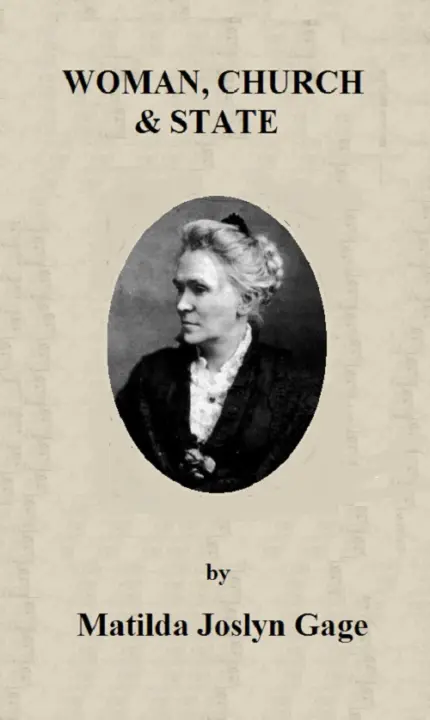
THE CLASSIC COLLECTION · 1893
"Woman, Church & State" by Matilda Joslyn Gage is a historical account written in the late 19th century. The book critically examines the historical treatment of women by both religious institutions and state authorities, challenging the widely held belief that the rise of Christianity improved women's status. Gage argues that women once held significant power in societies governed by matriarchal systems, and she seeks to illuminate the injustices faced by women as a result of patriarchal structures that have taken their place. At the start of the work, Gage presents a preface that outlines her motivations for writing this book, emphasizing her indignation towards the male-dominated Church and State that have perpetuated the subjugation of women throughout history. She asserts that women enjoyed greater liberties in ancient civilizations, particularly under matriarchal governance, and she aims to refute the notion that Christianity elevated women's status compared to earlier periods. Gage’s initial arguments set the stage for a thorough exploration of historical precedents that illustrate the systemic oppression of women as dictated by religious dogma and societal norms.
Introduction adapted from the source catalogue; source summaries may be automatically generated.
Free to read · English · 178,889 words · No account needed
MAKE TIME FOR A GOOD BOOK
On by default. Untick to stop anonymous reading totals. Each page counts after 10 seconds in view. How this works.
Anonymous counting is on unless you have switched it off.
In Church and in State, man has exhibited the wildest passions, the most ungovernable frenzy—has shown himself less controlled by reason than possible for woman under the most adverse circumstances. Judaism, and its offspring, Christianity, show the results of the Patriarchate in some of its most degenerate forms; industrial servitude, educational restrictions, legal thraldom, political slavery, false religious teachings, are but a portion of the evils existing under its most enlightened forms, and equally with the more pronounced polygamy and infanticide they show a total perversion of moral ideas. Woman dearly pays for the rights she has secured. Labor opposes, in less pay for the same work; literature, at first welcoming her only through the cook book, next compelled her to conceal her sex under a male pseudonym, in order that her writings might be received with the same respect as those of man; art has given her similar experiences, and while today admitting her to the same advantage of study with man, yet compels her to pay twice the price for the same instructions.
The careful student of history will discover that christianity has been of very little value in advancing civilization, but has done a great deal toward retarding it.[8] “Civilization, a recognition of the rights of others at every point of contact,” has been carried forward by means of rebellion against church teaching and church authority. The experience of science is familiar to all, even school children quoting Galileo and Dr. Faust. What are called reformations in religion, the work of Huss, of Luther, of the Waldenses, the Huguenots, are equally familiar instances to the youngest student, of rebellion against the church. These and a myriad of others known to the historian, have all been brought about by refusal to accept the authority of the church as final. The Peasant War, in France, the struggles of Wat Tyler and of Hampden in England, the French and the American revolutions looking toward equality of rights; and a thousand minor forms of political progress have all been opposed by the church as rebellions against its teachings, yet all have been marked steps in civilization. The church and civilization are antipodal; one means authority, the other freedom; one means conservatism, the other progress; one means the rights of God as interpreted by the priesthood, the other the rights of humanity as interpreted by humanity. Civilization advances by free-thought, free speech, free men. The uprising of the women of all peoples in assertion of their common humanity with man, is exemplification of that fact recognized in the Declaration of Independence, that while patient endurance of wrongs to which persons are accustomed, always long borne rather than by change perhaps to meet evils they know not of, shows its absolutely certain ultimate effect, no matter how long delayed, in rebellion. A time comes in the history of souls, as of nations, when forbearance ceases to be a virtue, and self-respecting life is only to be retained through defiance of and rebellion against, existing customs. The soul must assert its own supremacy or die. It is not one woman, or the women of one nation that have thus suddenly shown desire to rule themselves—to act for themselves alone. A strange identity of thought pervades all parts of the world—India, China, Japan, Russia and all of Europe, North and South America, the vast continents of the southern seas and the isles thereof, and even barbaric Africa, all evince proof of the wide psychic under-current which seething through women’s souls, is overthrowing the civilizations built upon the force principles of the patriarchate, and will soon reinstate the reign of truth and justice. During those long ages of priestly intolerance, of domestic and governmental tyranny, in which woman seemed to accept the authority of the priest as that of God, there still existed a consciousness hardly perceptible to herself, that she was an independent being to whom by virtue of her humanity all opportunities in life belonged. From century to century mothers transmitted this scarcely developed perception to daughters, until suddenly within the past fifty years, these dominant ideas woke to thought, and the women of all nations began to proclaim their same right to self-control as that claimed by man.
Your reading position is saved on this browser. Take it to another device with a library code. Reading pages adapt to text, rather than matching a printed edition.
BEHIND THE BOOK
This eBook is for the use of anyone anywhere in the United States and most other parts of the world at no cost and with almost no restrictions whatsoever. You may copy it, give it away or re-use it under the terms of the Project Gutenberg License included with this eBook or online at www.gutenberg.org. If you are not located in the United States, you will have to check the laws of the country where you are located before using this eBook. Read the source licence.
The original source file, including credits and licence, is retained by this library. Request an original-format copy at no charge. Please include the book title and Project Gutenberg identifier #45580.
KEEP YOUR CURIOSITY GOING
David Patterson (Spirit) Hatch

David Patterson (Spirit) Hatch

David Patterson (Spirit) Hatch
Cécile Tormay

Moritz Busch
John L. Ransom