
Last letters from the living dead man
David Patterson (Spirit) Hatch
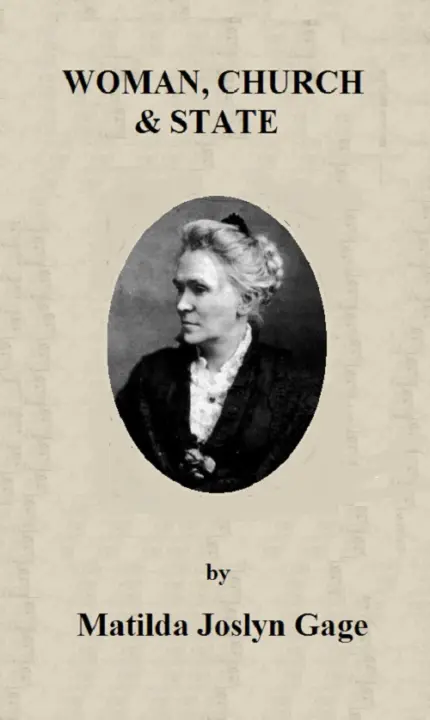
THE CLASSIC COLLECTION · 1893
"Woman, Church & State" by Matilda Joslyn Gage is a historical account written in the late 19th century. The book critically examines the historical treatment of women by both religious institutions and state authorities, challenging the widely held belief that the rise of Christianity improved women's status. Gage argues that women once held significant power in societies governed by matriarchal systems, and she seeks to illuminate the injustices faced by women as a result of patriarchal structures that have taken their place. At the start of the work, Gage presents a preface that outlines her motivations for writing this book, emphasizing her indignation towards the male-dominated Church and State that have perpetuated the subjugation of women throughout history. She asserts that women enjoyed greater liberties in ancient civilizations, particularly under matriarchal governance, and she aims to refute the notion that Christianity elevated women's status compared to earlier periods. Gage’s initial arguments set the stage for a thorough exploration of historical precedents that illustrate the systemic oppression of women as dictated by religious dogma and societal norms.
Introduction adapted from the source catalogue; source summaries may be automatically generated.
Free to read · English · 178,889 words · No account needed
MAKE TIME FOR A GOOD BOOK
On by default. Untick to stop anonymous reading totals. Each page counts after 10 seconds in view. How this works.
Anonymous counting is on unless you have switched it off.
Such a sermon as the above preached to women under the full blaze of nineteenth century civilization, needs few comments. In it woman’s inferiority and subordination are as openly asserted as at any time during the dark ages. According to Rev. Knox-Little, woman possesses no responsibility; she is deprived of conscience, intelligent thought, self-respect, and is simply an appendage to man, a thing. As the clergy in the Middle Ages divided rights into those of persons and things, themselves being the persons, the laity things, so the Rev. Knox-Little and his ilk of today, divide the world into persons and things, men being the persons, and woman the things. Rev. Dr. T. De Witt Talmage, of Brooklyn, New York, joins his brethren in preaching of “the first, fair, frail woman; her creation, her fall and her sorrow.” Speaking of the trials of housekeepers, he said:
Again, there is the trial of severe economy. Nine hundred and ninety-nine households out of the thousand are subject to it, some under more, and some under less stress of circumstances. Especially if a man smokes very expensive cigars and takes very costly dinners at the restaurants, he will be severe in demanding domestic economics. This is what kills thousands of women; attempting to make five dollars do the work of seven. How the bills come in. The woman is the banker of the household; she is the president, and cashier, and teller, discount clerk, and there is a panic every four weeks. This thirty years war against high prices; this perpetual study of economics, this lifelong attempt to keep the outgoes less than the income exhausts millions of housekeepers. O, my sister, this is part of divine discipline.
It should require but little thought upon woman’s part to see how closely her disabilities are interwoven with present religious belief and teaching as to her inferiority and pre-ordained subordination. If she needs aid to thought, the Cravens, the Knox-Littles, the Talmages, will help her. The spirit of the priesthood, Protestant equally with Catholic, is that of the early and middle ages. The foundation being the same, the teaching is of similar character. From the sermons referred to, we can justly declare they express the opinions of the priesthood as a body; we meet no protest against them. Not a single church has denied these degrading theories; no clergyman has preached against the doctrines mentioned, blasphemous as they are against the primal rights of the soul. These sermons stand as representatives, not only of high church theology in regard to woman, but as expressing the belief of all churches in her creation and existence as an inferior and appendage to man. All her suffering, material or spiritual, her restrictions, her sorrows, her deprivation of the right of unrestricted conscience are depicted as parts of her divine discipline, which she must accept with endurance and loving submission. Even from the criminal, she is not to free herself, or refuse him obedience. Scarcely a Protestant sect that has not within a few years, in some way, placed itself upon record as sustaining the doctrine of woman’s subordination. The Pan-Presbyterian Council that assembled in Edinburg a few years since refused to admit a woman even as a listener to its proceedings although women constitute at least two-thirds of the membership of that church. A solitary woman who persisted in remaining to listen to the discussions of this body was removed by force; “six stalwart Presbyterians” lending their ungentle aid to her ejection. The same Pan-Presbyterian body in session in Philadelphia, the summer of 1880, laughed to scorn the suggestion of a liberal member that the status to woman in that church should receive some consideration; referring to the work of the Sisters of Charity, in the Catholic church, and that of women among the Quakers. Although this question was twice introduced it was as often “met with derisive laughter,” and no action was taken upon it. But had this liberal member been wise enough to have brought before this body the fact that the Presbyterian church is losing its political influence because of the great preponderance of its women members without the ballot, he would have received more consideration. As all churches seek influence in politics, we may rest assured that when the church as a whole, or any sect thereof, shall be found sustaining the political rights of woman or her religious equality in the church, it will be from the worldly wisdom of a desire to retain fleeting political power. The life or the death of the church largely depends upon its political forethought.
Your reading position is saved on this browser. Take it to another device with a library code. Reading pages adapt to text, rather than matching a printed edition.
BEHIND THE BOOK
This eBook is for the use of anyone anywhere in the United States and most other parts of the world at no cost and with almost no restrictions whatsoever. You may copy it, give it away or re-use it under the terms of the Project Gutenberg License included with this eBook or online at www.gutenberg.org. If you are not located in the United States, you will have to check the laws of the country where you are located before using this eBook. Read the source licence.
The original source file, including credits and licence, is retained by this library. Request an original-format copy at no charge. Please include the book title and Project Gutenberg identifier #45580.
KEEP YOUR CURIOSITY GOING
David Patterson (Spirit) Hatch

David Patterson (Spirit) Hatch

David Patterson (Spirit) Hatch
Cécile Tormay

Moritz Busch
John L. Ransom