
Last letters from the living dead man
David Patterson (Spirit) Hatch
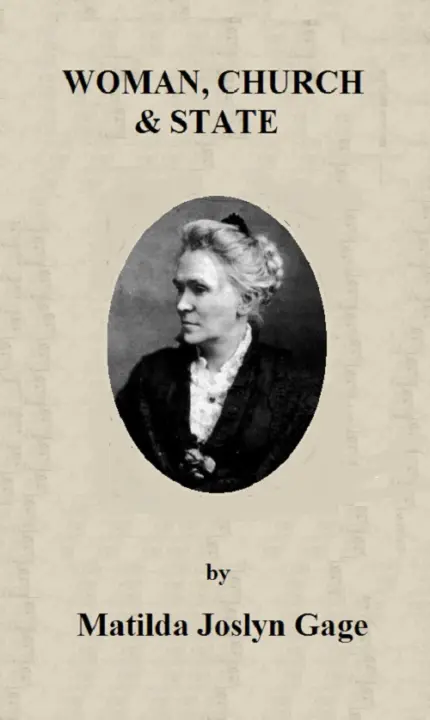
THE CLASSIC COLLECTION · 1893
"Woman, Church & State" by Matilda Joslyn Gage is a historical account written in the late 19th century. The book critically examines the historical treatment of women by both religious institutions and state authorities, challenging the widely held belief that the rise of Christianity improved women's status. Gage argues that women once held significant power in societies governed by matriarchal systems, and she seeks to illuminate the injustices faced by women as a result of patriarchal structures that have taken their place. At the start of the work, Gage presents a preface that outlines her motivations for writing this book, emphasizing her indignation towards the male-dominated Church and State that have perpetuated the subjugation of women throughout history. She asserts that women enjoyed greater liberties in ancient civilizations, particularly under matriarchal governance, and she aims to refute the notion that Christianity elevated women's status compared to earlier periods. Gage’s initial arguments set the stage for a thorough exploration of historical precedents that illustrate the systemic oppression of women as dictated by religious dogma and societal norms.
Introduction adapted from the source catalogue; source summaries may be automatically generated.
Free to read · English · 178,889 words · No account needed
MAKE TIME FOR A GOOD BOOK
On by default. Untick to stop anonymous reading totals. Each page counts after 10 seconds in view. How this works.
Anonymous counting is on unless you have switched it off.
The terrible condition of working women in Paris, has attracted the attention of the French government. In but three or four trades are they even fairly well paid, and these few require a peculiar adaptation, as well as an expensive training out of reach of most women laborers. And even in these best paid kinds of work, a discrimination in favor of man exists; at the China manufactory at Sevres where the men employed receive a retiring pension, the women do not. From fifteen to eighteen pence represents the daily earnings of the Parisian working girl, upon which sum it is impossible for her to properly support life. Many of these girls die of slow starvation, others are driven into prostitution, still others seek relief in the Seine. French women perform the most repulsive labors of the docks; they work in the mines dragging or pushing heavy trucks of coal like their English sisters, through narrow tunnels that run from the seams to the shaft; eating food of such poor quality that the lessening stature of the population daily shows the result. This decreasing size of Frenchmen especially among the peasantry, the majority not coming up to the regulation army height, has within the last fifteen or twenty years called attention of the government during conscription, yet without seeming to teach its cause as lying in the poor food and hard labor of women, the mothers of these men. The heaviest burdens of porters, the most offensive sanitary work, the severest agricultural labor in that country falls upon woman. “I pity the women, the donkeys, and the boys,” wrote Mrs. Stanton when traveling in the south of France. It is the poor nourishment and excessive labor of woman which makes France today a country of rapidly decreasing birth-rate, seriously affecting its population and calling the earnest attention of statistical bureaus and physicians to this vital question; a question which affects the standing of France among the nations of the earth. According to the report of the chief of the statistical bureau, 1890, there were fewer births than deaths that year, the births amounting to 838,059, the deaths to 876,505, an excess of 38,446 deaths. Commenting upon these returns, “Der Reichsbote” of Berlin, attributed the cause to a wide-spread aversion to large families; acknowledging, however, that the lower classes had become weakened and dwarfed by the tasks imposed upon them. What neither the statistical bureau, the press, or the church yet comprehend is the fact that the work imposed upon its Christian women, the “curse” of man thrust upon her, is the chief cause of the lessening size and lessening population of that country. A French gentleman employing a large number of women in a flax factory was appalled at the great amount of infant mortality among the children of his employees. Believing the excessive death rate to be in consequence of the continued labor of women, he released expectant mothers for a month previous, and two months after the birth of a child, with a marked diminution of the death rate. The ordinary food of the peasantry is of poor quality and meager quantity. Those employed in the manufacture of silk largely subsist upon a species of black broth proverbial for its lack of nutritive qualities. The absence of certain elements in food both creates specific diseases and inability to combat disease. Vital stamina is closely dependent upon the number of red corpuscles in the blood, the quality of food possessing direct connection with these corpuscles. Dr. Blackwell, of the London Anthropological Society, examined the blood of different races as related to the food eaten by them, finding the number and shape of the red corpuscles to be dependent upon the kind of food eaten. Dr. Richardson, a Philadelphia microscopist, said: “Any cause which interferes with perfect nutrition may diminish the red corpuscles in number.” These corpuscles are recognized as “oxygen carriers,” therefore any cause which tends to diminish the number of red corpuscles also deprives the system of a portion of the oxygen required for sanitary needs. Blood not fully oxygenated is poisonous to the system. Among the causes recognized by physiologists as creating that alteration in the functions of the body which materially changes the character of the red corpuscles, are poor food, bad air and overwork. These specifically produce blood poisoning, creating new substances in the body that are injurious to the organism.
Your reading position is saved on this browser. Take it to another device with a library code. Reading pages adapt to text, rather than matching a printed edition.
BEHIND THE BOOK
This eBook is for the use of anyone anywhere in the United States and most other parts of the world at no cost and with almost no restrictions whatsoever. You may copy it, give it away or re-use it under the terms of the Project Gutenberg License included with this eBook or online at www.gutenberg.org. If you are not located in the United States, you will have to check the laws of the country where you are located before using this eBook. Read the source licence.
The original source file, including credits and licence, is retained by this library. Request an original-format copy at no charge. Please include the book title and Project Gutenberg identifier #45580.
KEEP YOUR CURIOSITY GOING
David Patterson (Spirit) Hatch

David Patterson (Spirit) Hatch

David Patterson (Spirit) Hatch
Cécile Tormay

Moritz Busch
John L. Ransom