
Last letters from the living dead man
David Patterson (Spirit) Hatch
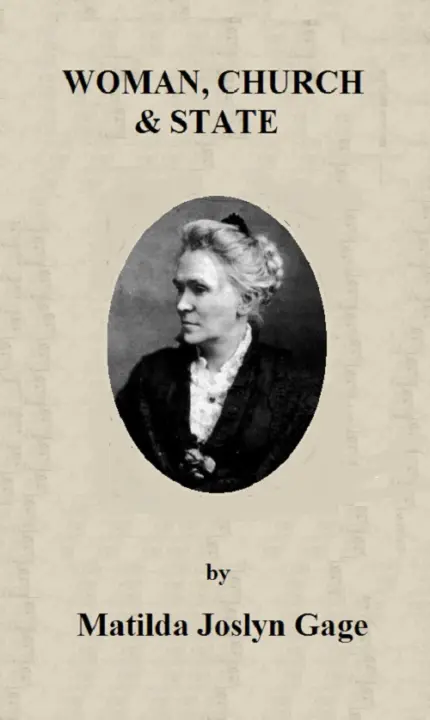
THE CLASSIC COLLECTION · 1893
"Woman, Church & State" by Matilda Joslyn Gage is a historical account written in the late 19th century. The book critically examines the historical treatment of women by both religious institutions and state authorities, challenging the widely held belief that the rise of Christianity improved women's status. Gage argues that women once held significant power in societies governed by matriarchal systems, and she seeks to illuminate the injustices faced by women as a result of patriarchal structures that have taken their place. At the start of the work, Gage presents a preface that outlines her motivations for writing this book, emphasizing her indignation towards the male-dominated Church and State that have perpetuated the subjugation of women throughout history. She asserts that women enjoyed greater liberties in ancient civilizations, particularly under matriarchal governance, and she aims to refute the notion that Christianity elevated women's status compared to earlier periods. Gage’s initial arguments set the stage for a thorough exploration of historical precedents that illustrate the systemic oppression of women as dictated by religious dogma and societal norms.
Introduction adapted from the source catalogue; source summaries may be automatically generated.
Free to read · English · 178,889 words · No account needed
MAKE TIME FOR A GOOD BOOK
On by default. Untick to stop anonymous reading totals. Each page counts after 10 seconds in view. How this works.
Anonymous counting is on unless you have switched it off.
For the same kind of work men are paid three times more wages than are
paid to women.
Women in the iron trade of the Midlands are compelled, according to a labor commission witness, to work in the sheds scantily covered and in the summer have to divest themselves of nearly all their clothing while hammering nuts and bolts. They bring their children to the factories and cover them up to prevent their being burnt by red-hot sparks. Often they have to carry bundles of iron weighing half a hundred weight. For such work they earn 4s. or 5s. a week, while the men make about 14s.
As early as 1840 an inquiry into the mining affairs of Great Britain, while showing a pitiable condition of the male laborers, exhibited that of women and children in a much worse light. As the natural guardians of children, well aware of their immaturity of body and mind, no mother allows their employment in severe labor at a tender age unless herself compelled to such work and unable to save her children. But at this investigation, men, women and children were found working together in the pits all either nude or nearly so, and according to the Report, not seeing daylight for weeks at a time. Women soon to become mothers were found yoked to carts in the pits; girls carried baskets of coal on their backs up ladders; while mere children crawling like dogs, on hands and feet, hauled carts along narrow rails, the system in operation requiring these victims to remain underground for weeks at a time, breathing foul air and deprived of the light of day. The spirit of ambition is not dead among these wretched serfs, these women working out man’s “curse”. The most degraded woman in the English coal mine will fight for precedence. She has all the force of the man by her side whose religious equal she is not; whose political equal she is not; he possessing those elements of power, entrance to the priesthood and use of the ballot, denied to her. Through the ballot he receives higher wages for the same kind and amount of work, the church having taught his superior rights upon every point; through the ballot he influences the action of government in his own favor to the injury of his fellow work-woman. A few years since the male miners petitioned against the employment of women in the mines, when a clause to that effect was immediately introduced to the Coal Mine Bill, then before Parliament, although in the Lancashire districts where one hundred and sixty-four women were employed, all but twenty-six were widows or single women entirely dependent upon their own earnings. As severe as the work, the women were remarkable for their bright and healthful appearance as contrasted with the woman workers in the factories of Great Britain. Man, hereditarily unjust to woman under the principles of the Patriarchate and the lessons of Christianity, is even more unjust in the fields of work he has compelled her to enter, than in those of education and the ballot which she is seeking for herself. Organizations, strikes, the eight hour law demand, are largely conducted by men for men. The grim humor originating the proverb “a man’s work is from sun to sun, a woman’s work is never done,” still clings with all its old force to women in most employments. To such small extent has man made the woman worker’s cause his own, that instances are to be found even in the United States, where men and women working together and together going out upon a strike, the men have been reinstated at the increase demanded, the women forced to return at the old wages. Nor is our own country the chief sinner in this respect. It was found imperative many years since, among the women of England to organize leagues of their own sex alone, if they desired their own interest in labor to be protected; the male Trades Unions of that country excluding women from some of the best paid branches of industry, as carpet making, cloth weaving, letter press printing.[2] In self defense, the Woman’s Protective and Provident League, and a Woman’s Union Labor Journal were founded. The principle of exclusion has not alone been shown against woman’s entrance into well paid branches of work, but in those they have been permitted to enter they have found themselves subjected to much petty annoyance. Among the male painters of pottery a combination was formed to prevent the use by woman of the arm-rests required in this work. Tram-way trains carry London workmen at reduced rates, but a combination was entered into by male laborers to prevent women workers from using the low-priced trains. Nor in many instances are employers less the enemies of women, unions having been found necessary for the purpose of moral protection. A most deplorable evidence of the low respect in which woman is held and the slavery that work and cheap wages mean for her, is the suggestion often made by employers that she shall supplement her wages by the sale of her body. The manager of an industrial league in New York City a few years since found that no young girl escaped such temptation. Neither extreme youth nor friendliness afforded security or protection but were rather additional inducements for betrayal, most of the victims numbering but fourteen short years. The late Jennie Collins, of Boston, one of the earliest persons in the United States, to devote herself to this branch of the “woman question,” said:
Your reading position is saved on this browser. Take it to another device with a library code. Reading pages adapt to text, rather than matching a printed edition.
BEHIND THE BOOK
This eBook is for the use of anyone anywhere in the United States and most other parts of the world at no cost and with almost no restrictions whatsoever. You may copy it, give it away or re-use it under the terms of the Project Gutenberg License included with this eBook or online at www.gutenberg.org. If you are not located in the United States, you will have to check the laws of the country where you are located before using this eBook. Read the source licence.
The original source file, including credits and licence, is retained by this library. Request an original-format copy at no charge. Please include the book title and Project Gutenberg identifier #45580.
KEEP YOUR CURIOSITY GOING
David Patterson (Spirit) Hatch

David Patterson (Spirit) Hatch

David Patterson (Spirit) Hatch
Cécile Tormay

Moritz Busch
John L. Ransom