
Last letters from the living dead man
David Patterson (Spirit) Hatch
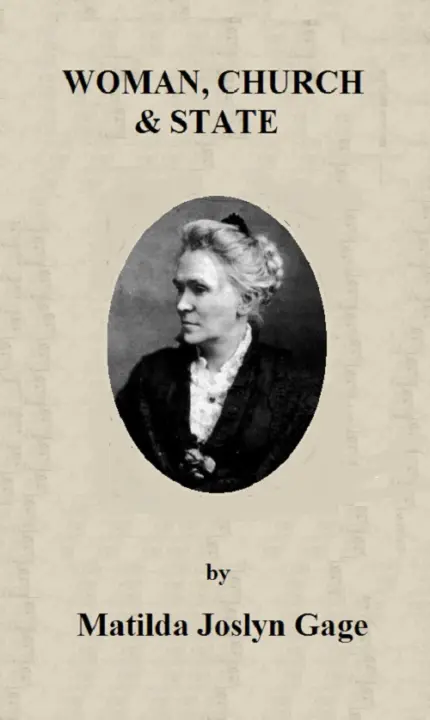
THE CLASSIC COLLECTION · 1893
"Woman, Church & State" by Matilda Joslyn Gage is a historical account written in the late 19th century. The book critically examines the historical treatment of women by both religious institutions and state authorities, challenging the widely held belief that the rise of Christianity improved women's status. Gage argues that women once held significant power in societies governed by matriarchal systems, and she seeks to illuminate the injustices faced by women as a result of patriarchal structures that have taken their place. At the start of the work, Gage presents a preface that outlines her motivations for writing this book, emphasizing her indignation towards the male-dominated Church and State that have perpetuated the subjugation of women throughout history. She asserts that women enjoyed greater liberties in ancient civilizations, particularly under matriarchal governance, and she aims to refute the notion that Christianity elevated women's status compared to earlier periods. Gage’s initial arguments set the stage for a thorough exploration of historical precedents that illustrate the systemic oppression of women as dictated by religious dogma and societal norms.
Introduction adapted from the source catalogue; source summaries may be automatically generated.
Free to read · English · 178,889 words · No account needed
MAKE TIME FOR A GOOD BOOK
On by default. Untick to stop anonymous reading totals. Each page counts after 10 seconds in view. How this works.
Anonymous counting is on unless you have switched it off.
In furtherance of its plan for temporal power, the astuteness of the Mormon theocracy is shown in this doctrine of pre-existent spirits[10] continually waiting birth upon the earth. This together with its other theory of the superior power and godhood in a future life, of the father of numerous children, imposes the condition of continual motherhood upon Mormon wives.
But during the christian ages this theory of woman’s duty to constantly bear children in order to the upholding of the church has ever been taught. Even Philip Melancthon, the great associate of Luther in the Reformation, saying: “If a woman becomes weary of bearing children, that matters not. Let her only die from bearing, she is there to do it.” So little does the church yet understand the right of woman to an existence for herself alone that not five years have passed since a minister of the Methodist church in the state of New York publicly declared he saw no reason for woman’s creation but the bearing of children. In a lecture upon Mormonism in Boston, Prof. Conyear, of the Salt Lake City Collegiate Institute, speaking of the sufferings endured by Mormon women in order thus to secure personal salvation, said:
Hate the system as you hate Satan, but have mercy on the people who are there in such a bondage—a bondage worse than that in which the negro in the South was ever held.
But these doctrines accepted as truth by devout Mormon women are not more degrading to them, not more injurious to civilization, than is the belief of orthodox christian women in regard to the frailty and primal sin of her sex and the curse of her Creator upon her in consequence. To this belief she has been trained from her childhood as her mother before her and her feminine relatives for innumerable centuries, and without investigation she has accepted these doctrines of the church as true. Yet all these theories so degrading to woman are of purely human masculine origin, their object, power for man, and the subordination of woman to him in every relation of life. The eternal continuance of the patriarchal order, a doctrine of the Mormons, is paralleled among orthodox christians by the teaching of an eternal continuance of the male priestly order, woman forever excluded. The Mormon woman no more fully places herself in position of servant to her husband, whom at the Endowment House marriage ceremony she promises to “obey,” than has the orthodox christian woman through the ages, when she has promised obedience to her husband at the marriage altar. Nor is the general religious training of the two very different. The Mormon woman is taught that her salvation depends upon polygamous marriage and her subjection to her husband in all things; the orthodox christian woman is taught that her salvation depends upon her belief that woman brought sin into the world, in punishment whereof God placed her in subjection to man; and during the ages her promise of obedience to man has been held as an integral part of the marriage ceremony. Nor did a change begin to take place until after the inauguration of the woman suffrage reform. Not until woman herself rebelled against such annihilation of her own conscience and responsibility, did a few sects in some instances omit this promise from their forms of marriage, although it still remains a portion of the Greek, Catholic and Anglican ceremony as well as of other Protestant sects. The shock of finding educated women of New England birth, members of the Mormon church as polygamous wives, is lessened upon a careful analysis of the Mormon doctrine in comparison with those of orthodox Christianity regarding women: all alike rest upon the same foundation; all teach that sin entered the world through woman; all alike darken the understanding through such false teaching. The women of the Mormon church received their training under orthodox Christianity, which laid the foundation of their self contempt.[11] With the professed revelation of the Book of Mormon, a class of priests arose who no less positively and authoritatively asserted its doctrines to be of God than the priesthood of other divisions of christianity assert the Bible to be of God; and alike each declare themselves and their followers to be his chosen people. “By authority of the priesthood of God,” has carried weight in all ages, and no greater weight among the Mormons of the present day than among Christians of all ages. Under the christian theory regarding the origin and duties of woman it is not surprising that polygamy should ever have found defenders in the christian world, nor is it at all singular that Mormonism as “the latest founded christian sect” should teach polygamy as a divinely organized institution, drawing its arguments from the Bible. Bishop Lunt of that church, defending polygamy as of divine origin, said:
Your reading position is saved on this browser. Take it to another device with a library code. Reading pages adapt to text, rather than matching a printed edition.
BEHIND THE BOOK
This eBook is for the use of anyone anywhere in the United States and most other parts of the world at no cost and with almost no restrictions whatsoever. You may copy it, give it away or re-use it under the terms of the Project Gutenberg License included with this eBook or online at www.gutenberg.org. If you are not located in the United States, you will have to check the laws of the country where you are located before using this eBook. Read the source licence.
The original source file, including credits and licence, is retained by this library. Request an original-format copy at no charge. Please include the book title and Project Gutenberg identifier #45580.
KEEP YOUR CURIOSITY GOING
David Patterson (Spirit) Hatch

David Patterson (Spirit) Hatch

David Patterson (Spirit) Hatch
Cécile Tormay

Moritz Busch
John L. Ransom