
Last letters from the living dead man
David Patterson (Spirit) Hatch
THE CLASSIC COLLECTION · 1893
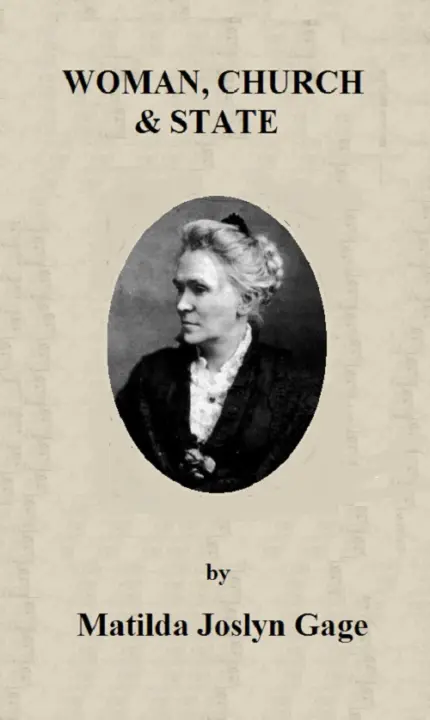
"Woman, Church & State" by Matilda Joslyn Gage is a historical account written in the late 19th century. The book critically examines the historical treatment of women by both religious institutions and state authorities, challenging the widely held belief that the rise of Christianity improved women's status. Gage argues that women once held significant power in societies governed by matriarchal systems, and she seeks to illuminate the injustices faced by women as a result of patriarchal structures that have taken their place. At the start of the work, Gage presents a preface that outlines her motivations for writing this book, emphasizing her indignation towards the male-dominated Church and State that have perpetuated the subjugation of women throughout history. She asserts that women enjoyed greater liberties in ancient civilizations, particularly under matriarchal governance, and she aims to refute the notion that Christianity elevated women's status compared to earlier periods. Gage’s initial arguments set the stage for a thorough exploration of historical precedents that illustrate the systemic oppression of women as dictated by religious dogma and societal norms.
Introduction adapted from the source catalogue; source summaries may be automatically generated.
Free to read · English · 178,889 words · No account needed
MAKE TIME FOR A GOOD BOOK
On by default. Untick to stop anonymous reading totals. Each page counts after 10 seconds in view. How this works.
Anonymous counting is on unless you have switched it off.
It probably portends indirect social effects much greater than the disposition of property, and it may in the end pulverize some ideas which have been at the basis of English life. Measures which affect the family economy are apt to be “epoch making”; and probably when the most talked of bills of the session are clean forgotten this obscure measure may be bearing fruit.
The exception of married women in the demand for political rights by the women of England, owes its origin to the old monkish theory that marriage is debasement, and celibate life in either man or woman a much higher condition. After the passage of the Emancipation Proclamation, during the civil war, John Stuart Mill declared that married women were the only class of slaves remaining on earth. As long as a condition of religious or political subjection continues for her, a belief in the sanctity of womanhood cannot exist and crimes against her will be lightly punished. The most debased men of England and the United States, if arrested for cruelty to wives, agree in the indignant questioning protest: “Is she not my own that I should punish her as I please?”
Such has been the power of the priesthood over the consciences and lives of men, that we find whatever is bad in the laws either directly or indirectly traceable to their influence.[68] Our Anglo Saxon forefathers were early amenable to religious authority and for a period of many hundred years clerical influence was exceedingly powerful over them.[69] The church is responsible for the severity with which the simplest infraction of law was visited upon the most humble and helpless classes, and the greater penalty awarded to those least capable of resistance. It was for the free man of low estate, for the slave, and for woman that the greatest atrocities were reserved. If a free woman stole she was to be thrown down a precipice or drowned, which Pike regards as the origin of dragging witches through a pond. If the thief was a slave and stole from any but her own master, she was condemned to be burnt alive, and her fellow slaves were compelled to assist at the incineration.[70] None dared to speak a good word for women in opposition to church teachings. All her instincts were held as evil. As the law and the father robbed the daughter, so the law and the church alike robbed the family. By ancient English law, as before noted, every person who made a will was bound to remember his lord with the best thing he possessed, and afterwards the church with the next best thing, but as the church gained power it took supreme place in the testament.[71] The peasant was looked upon as but slightly above the cattle he cared for. A certain degree of sameness in material and intellectual conditions everywhere existed. The masses over christendom were alike under bondage of the thought and modes of action; social life showed no marked change for many hundred years. Freedom was an unknown word, or if by chance spoken, found itself under the ban of the church and the state. Justice was unthought of; the only question being, “has the church ordered it?” A complete system of espionage existed under both church and state. As late as the time of Alfred, in England, every nine men were under charge of a tenth. No man could work outside of his father’s employment to which he was bound; at nine o’clock curfew bell, all fires and lights were extinguished. A mechanic could not find work outside of his own village; monasteries and castles contained all there was of power and comfort. As late as the reformation we find the condition of English society lax and immoral. Henry the VIII was a fair type of the nation; the court, the camp, the church were all in line moulding the sentiment of community. Although Henry had declared the church to be an entire and perfect body within itself, possessing authority to regulate and decide all things without dependence upon any foreign power—meaning the pope,—he did not fail to generally define the supremacy of the church as united with and dependent upon the temporal government of the realm; the king, instead of the pope, becoming its spiritual head. Many new and restrictive canons were promulgated. Under Henry the prohibitory laws regarding nearness of relationship in marriage exceeded those of the Catholic Church. It is but a few decades since these prohibitions commencing with “a man shall not marry his grandmother;” “a woman shall not marry her grandfather;” and extending down to remote cousinship,—were to be found printed upon the fly leaves of every New Testament.[72]
Your reading position is saved on this browser. Take it to another device with a library code. Reading pages adapt to text, rather than matching a printed edition.
BEHIND THE BOOK
This eBook is for the use of anyone anywhere in the United States and most other parts of the world at no cost and with almost no restrictions whatsoever. You may copy it, give it away or re-use it under the terms of the Project Gutenberg License included with this eBook or online at www.gutenberg.org. If you are not located in the United States, you will have to check the laws of the country where you are located before using this eBook. Read the source licence.
The original source file, including credits and licence, is retained by this library. Request an original-format copy at no charge. Please include the book title and Project Gutenberg identifier #45580.
KEEP YOUR CURIOSITY GOING
David Patterson (Spirit) Hatch

David Patterson (Spirit) Hatch

David Patterson (Spirit) Hatch
Cécile Tormay

Moritz Busch
John L. Ransom