
Last letters from the living dead man
David Patterson (Spirit) Hatch
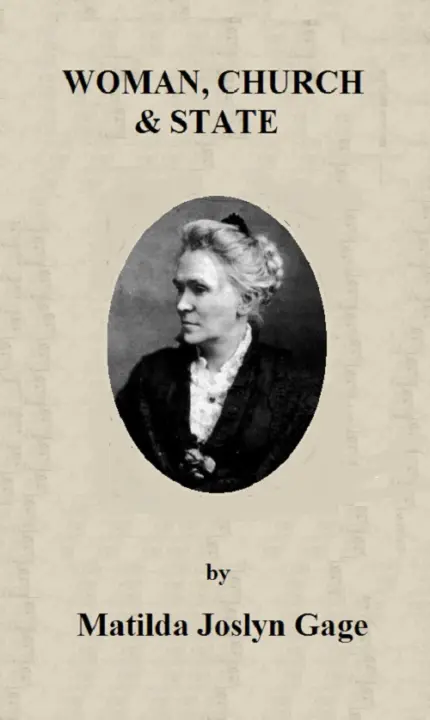
THE CLASSIC COLLECTION · 1893
"Woman, Church & State" by Matilda Joslyn Gage is a historical account written in the late 19th century. The book critically examines the historical treatment of women by both religious institutions and state authorities, challenging the widely held belief that the rise of Christianity improved women's status. Gage argues that women once held significant power in societies governed by matriarchal systems, and she seeks to illuminate the injustices faced by women as a result of patriarchal structures that have taken their place. At the start of the work, Gage presents a preface that outlines her motivations for writing this book, emphasizing her indignation towards the male-dominated Church and State that have perpetuated the subjugation of women throughout history. She asserts that women enjoyed greater liberties in ancient civilizations, particularly under matriarchal governance, and she aims to refute the notion that Christianity elevated women's status compared to earlier periods. Gage’s initial arguments set the stage for a thorough exploration of historical precedents that illustrate the systemic oppression of women as dictated by religious dogma and societal norms.
Introduction adapted from the source catalogue; source summaries may be automatically generated.
Free to read · English · 178,889 words · No account needed
MAKE TIME FOR A GOOD BOOK
On by default. Untick to stop anonymous reading totals. Each page counts after 10 seconds in view. How this works.
Anonymous counting is on unless you have switched it off.
While the external government of Finland, as declarations of war, peace, treaties, etc., is under control of the Czar, or Grand Duke, yet in the internal administration of affairs this country is an Independent State, under a Constitution dating 1772, and confirmed by three successive czars. It became christianized in the twelfth century but is not under the Greek church; its established religion is Evangelical and Lutheran, under control of the archbishop of Abo, and the bishops of Bogia and Knopo; an ecclesiastical assembly meeting every ten years; and the Diet, composed of representatives of the clergy, nobility, citizens and peasants, every five years. Without consent of these bodies no laws are enacted or repealed; but woman possesses no representation either in ecclesiastical or civil affairs.
The old law of marriage instituted by the church, which held the wife as belonging body and soul to the husband who not alone possessed control over her actions but decided her religion, is still extant. In but few countries do we see a tendency towards its abolition, even those that have somewhat favorably legislated upon the question, still retaining the general principle of a wife’s subserviency to her husband. A few years since an English lady desirous of uniting with the Catholic church was refused consent by her husband, “a staunch churchman.” Unknown to him she was received into that body, which proved occasion of an animated controversy between the husband and the late Cardinal Manning, the former basing his opposition and his letter of remonstrance to the cardinal upon the ground of the admitted legal right of a husband, under English law, to ordain the form of his wife’s religion.[40] Nor do we find material difference in the United States. In Virginia, in the winter of 1891, a wife, despite the opposition of her husband caused her infant to be baptized by an Episcopal clergyman into that church, the husband openly expressing his disapproval while the ceremony was in progress, and afterwards suing the clergyman for an interference with his vested rights over wife and child. This supreme authority of the husband in christian countries is shown in many strange ways. Among the Hindoos the naming of the child belongs to the mother. If the father expresses desire for a different name, each one is written upon a paper over which lighted lamps are set, the one burning the longest deciding the choice of name. But in Rhode Island as late as 1892, a controversy between the parents as to the naming of a child was settled by law. The father and mother each filed a certificate with the registrar; the father employing a lawyer who to the satisfaction of the city solicitor proved his client’s prior right, and an order was issued to the registrar in favor of the father’s choice of name.[41] The claim of the christian husband in each of these instances was that of his supreme and prior right, on the church theory incorporated into law, that both wife and child belong to the husband. The celebrated Agar-Ellis case in England during the latter part of the seventies, was brought by a wife to compel the keeping by a husband of his pledges in regard to the religious education of his children. The decision was against the wife, upon the general ground that a wife had no rights in law as against a husband. A man’s pledged word broken at the gaming table renders him infamous and subjects him to dishonor through life. But a husband’s pledged word broken to his wife, under ruling of the highest court and the profoundest legal talent of England, the Court of Appeals, and the Vice-Chancellor, is just, implying no dishonor, but rather entitling him to respect as a man who in a befitting manner has maintained his marital rights and authority. The judge instructed the wife that she had no right to teach her children what her husband did not believe, even though she herself most fully believed what she taught. He impressed upon her that she was not rearing her children for herself, but as her husband’s property, over which she possessed no control only in so far as the husband made her his agent. In affirming the order of the Vice-Chancellor, the court of appeals declared that the father had the legal right to bring up the children in his own faith, and in pledging his word to the contrary he had in no way forfeited or abandoned his authority. This decision of the English Court of Appeals, is in accord with the laws of the United States. The Albany N.Y. Law Journal in commenting upon this case under the head of “Curious Question,” declared the decision to be in harmony with the general rule as to religious education; the child is to be educated in the religion of the father.
Your reading position is saved on this browser. Take it to another device with a library code. Reading pages adapt to text, rather than matching a printed edition.
BEHIND THE BOOK
This eBook is for the use of anyone anywhere in the United States and most other parts of the world at no cost and with almost no restrictions whatsoever. You may copy it, give it away or re-use it under the terms of the Project Gutenberg License included with this eBook or online at www.gutenberg.org. If you are not located in the United States, you will have to check the laws of the country where you are located before using this eBook. Read the source licence.
The original source file, including credits and licence, is retained by this library. Request an original-format copy at no charge. Please include the book title and Project Gutenberg identifier #45580.
KEEP YOUR CURIOSITY GOING
David Patterson (Spirit) Hatch

David Patterson (Spirit) Hatch

David Patterson (Spirit) Hatch
Cécile Tormay

Moritz Busch
John L. Ransom