
Last letters from the living dead man
David Patterson (Spirit) Hatch
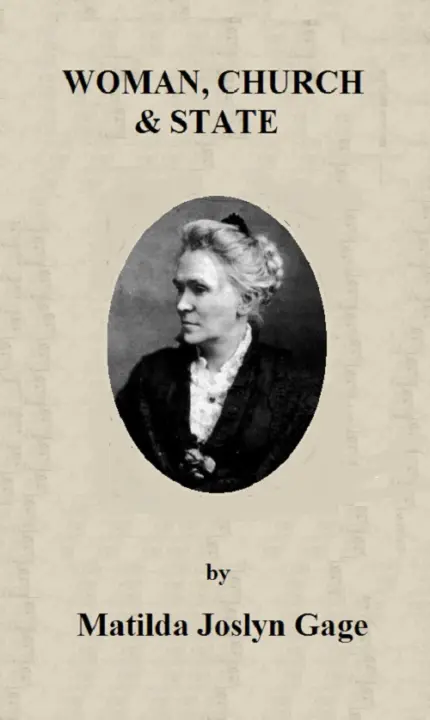
THE CLASSIC COLLECTION · 1893
"Woman, Church & State" by Matilda Joslyn Gage is a historical account written in the late 19th century. The book critically examines the historical treatment of women by both religious institutions and state authorities, challenging the widely held belief that the rise of Christianity improved women's status. Gage argues that women once held significant power in societies governed by matriarchal systems, and she seeks to illuminate the injustices faced by women as a result of patriarchal structures that have taken their place. At the start of the work, Gage presents a preface that outlines her motivations for writing this book, emphasizing her indignation towards the male-dominated Church and State that have perpetuated the subjugation of women throughout history. She asserts that women enjoyed greater liberties in ancient civilizations, particularly under matriarchal governance, and she aims to refute the notion that Christianity elevated women's status compared to earlier periods. Gage’s initial arguments set the stage for a thorough exploration of historical precedents that illustrate the systemic oppression of women as dictated by religious dogma and societal norms.
Introduction adapted from the source catalogue; source summaries may be automatically generated.
Free to read · English · 178,889 words · No account needed
MAKE TIME FOR A GOOD BOOK
On by default. Untick to stop anonymous reading totals. Each page counts after 10 seconds in view. How this works.
Anonymous counting is on unless you have switched it off.
The German word Heke, (witch) is a compound word from “hag” and “idisan” or “disan.” Hag means a beautiful landscape, woodland, meadow, field, altogether. Idisen means female deities, wise-women. Hexen-Sabbat, or Walpurgis Night is May twelfth. Perfume and avocation—originally the old gods—perverted by the priests. It is a remnant of the great gathering to worship the old deities, when Christianity had overshadowed them. A monument of the wedding of Woden or Odin with Freia—Sun and Earth at spring time.
The Saxon festival “Eostre,” the christian Easter, was celebrated in April, each of these festivals at a time when winter having released its sway, smiling earth giving her life to healing herbs and leaves, once more welcomed her worshipers. In the south of Europe, the month of October peculiarly belonged to the witches.[32] The first of May, May-day, was especially devoted by those elementals known as fairies, whose special rites were dances upon the green sward, leaving curious mementoes of their visits in the circles known as “Fairies Rings.” In reality the original meaning of “witch” was a wise woman. So also the word Sab means sage or wise, and Saba a host or congregation;[33] while Bac, Boc and Bacchus[34] all originally signified book.[35] Sabs was the name of the day when the Celtic Druids gave instruction and is the origin of our words Sabbath and Sunday. But the degradation of learning, its almost total loss among christian nations, an entire change in the signification of words, owing to ignorance and superstition led to the strangest and most infamous results. The earliest doctors among the common people of christian Europe were women[36] who had learned the virtues and use of herbs. The famous works of Paracelsus were but compilations of the knowledge of these “wise women” as he himself stated. During the feudal ages women were excellent surgeons, wounded warriors frequently falling under their care and to the skill of these women were indebted for recovery from dangerous wounds. Among the women of savage races to much greater extent than among the men, a knowledge of the healing powers of plants and herbs is to this day found. But while for many hundred years the knowledge of medicine, and its practice among the poorer classes was almost entirely in the hands of women and many discoveries in science are due to them, yet an acquaintance of herbs soothing to pain, or healing in their qualities, was then looked upon as having been acquired through diabolical agency. Even those persons cured through the instrumentality of some woman, were ready when the hour came to assert their belief in her indebtedness to the devil for her knowledge. Not only were the common people themselves ignorant of all science, but their brains were filled with superstitious fears, and the belief that knowledge had been first introduced to the world through woman’s obedience to the devil. In the fourteenth century the church decreed that any woman who healed others without having duly studied, was a witch and should suffer death; yet in that same century, 1527, at Basle, Paracelsus threw all his medical works, including those of Hippocrates and Galen into the fire, saying that he knew nothing except what he had learned from witches.[37] As late as 1736, the persecution of her male compeers cast Elizabeth Blackwell, an English woman physician, into prison for debt. Devoting herself even behind the bars to her loved science, she prepared the first medical botany given to the world. The modern discovery of anaesthetics by means of whose use human suffering can be so greatly ameliorated, is justly claimed as the greatest boon that science has conferred upon mankind, yet it must not be forgotten that this medical art of mitigating pain, is but an olden one rediscovered. Methods of causing insensibility to pain were known to the ancient world. During the middle ages these secrets were only understood by the persecuted women doctors of that period, subjected under church rule to torture, burning at the stake or drowning as witches. The use of pain-destroying medicaments by women, can be traced back from five hundred to a thousand years. At the time that witchcraft became the great ogre against which the church expended all its terrific powers, women doctors employed anaesthetics to mitigate the pains and perils of motherhood,[38] throwing the sufferer into a deep sleep when the child entered the world. They made use of Solanae, especially Belladonna. But that woman should find relief at this hour of intense suffering and peril when a new being entered the world, provoked open hostility from the church. The use of mitigating herbs assailed that theory of the church which having placed the creation of sin upon woman, still further inculcated the doctrine that she must undergo continual penance, the greatest suffering being a punishment in nowise equal to her deserts. Its teachings that she had therefore been especially cursed by her Maker with suffering and sorrow at this period, rendered the use of mitigating remedies during childbirth, dangerous alike to the “wise woman” and the mother for whose relief they were employed[39]. Although the present century has shown similar opposition by the church to the use of anaesthetics for women at this time, it is almost impossible to depict the sentiment against such relief which made the witchcraft period one of especial terror to womankind—an age that looked upon the slightest attempt at such alleviation as proof of collusion with the devil. So strong was the power of the church, so universal the belief in the guilt of all women, that even those sufferers who had availed themselves of the knowledge of the “wise woman” did so in fear as calling in the aid of evil, and were ready to testify against her to whom they had been indebted for alleviation of pain, whenever required by the dread mandate of the church. A strong natural bias toward the study of medicine, together with deepest sympathy for suffering humanity, were required in order to sustain the “wise woman” amid the perils constantly surrounding her; many such women losing their lives as witches simply because of their superior medical and surgical knowledge. Death by torture was the method of the church for the repression of woman’s intellect, knowledge being held as evil and dangerous in her hands. Ignorance was regarded as an especial virtue in woman, and fear held her in this condition. Few women dared be wise, after thousands of their sex had gone to death by drowning or burning because of their knowledge. The superior learning of witches was recognized in the widely extended belief of their ability to work miracles. The witch was in reality the profoundest thinker, the most advanced scientist of those ages. The persecution which for ages waged against witches was in reality an attack upon science at the hands of the church. As knowledge has ever been power, the church feared its use in woman’s hands, and leveled its deadliest blows at her. Although the church in its myth of the fall attributes knowledge to woman’s having eaten of its tree, yet while not scrupling to make use of the results of her disobedience for its own benefit, it has been most earnest in its endeavors to prevent her from like use. No less today than during the darkest period of its history, is the church the great opponent of woman’s education, every advance step for her having found the church antagonistic.
Your reading position is saved on this browser. Take it to another device with a library code. Reading pages adapt to text, rather than matching a printed edition.
BEHIND THE BOOK
This eBook is for the use of anyone anywhere in the United States and most other parts of the world at no cost and with almost no restrictions whatsoever. You may copy it, give it away or re-use it under the terms of the Project Gutenberg License included with this eBook or online at www.gutenberg.org. If you are not located in the United States, you will have to check the laws of the country where you are located before using this eBook. Read the source licence.
The original source file, including credits and licence, is retained by this library. Request an original-format copy at no charge. Please include the book title and Project Gutenberg identifier #45580.
KEEP YOUR CURIOSITY GOING
David Patterson (Spirit) Hatch

David Patterson (Spirit) Hatch

David Patterson (Spirit) Hatch
Cécile Tormay

Moritz Busch
John L. Ransom