
Last letters from the living dead man
David Patterson (Spirit) Hatch
THE CLASSIC COLLECTION · 1893
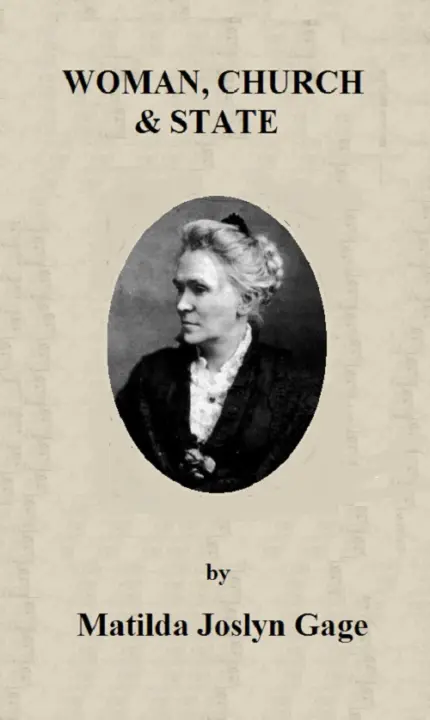
"Woman, Church & State" by Matilda Joslyn Gage is a historical account written in the late 19th century. The book critically examines the historical treatment of women by both religious institutions and state authorities, challenging the widely held belief that the rise of Christianity improved women's status. Gage argues that women once held significant power in societies governed by matriarchal systems, and she seeks to illuminate the injustices faced by women as a result of patriarchal structures that have taken their place. At the start of the work, Gage presents a preface that outlines her motivations for writing this book, emphasizing her indignation towards the male-dominated Church and State that have perpetuated the subjugation of women throughout history. She asserts that women enjoyed greater liberties in ancient civilizations, particularly under matriarchal governance, and she aims to refute the notion that Christianity elevated women's status compared to earlier periods. Gage’s initial arguments set the stage for a thorough exploration of historical precedents that illustrate the systemic oppression of women as dictated by religious dogma and societal norms.
Introduction adapted from the source catalogue; source summaries may be automatically generated.
Free to read · English · 178,889 words · No account needed
MAKE TIME FOR A GOOD BOOK
On by default. Untick to stop anonymous reading totals. Each page counts after 10 seconds in view. How this works.
Anonymous counting is on unless you have switched it off.
The World reporter saw them strung up by the thumbs, beaten with clubs, kicked by drunken brutes and driven with switches over the snow. He afterwards interviewed a rescued girl who had engaged to work in a lumberman’s hotel, supposing it to be a respectable place, but instead she was taken to a rough building, surrounded by a slab fence nearly twenty feet in height, within which was a cordon of thirteen bull dogs chained to iron stakes driven in the ground. Many of the details given by this girl are too horrible for relation. Three times she tried to escape and three times she was caught and beaten. The visitors by whom she tried to smuggle notes to the outer world would hand them to the proprietor, who liberally paid for such treason. Even county officers visited the place to drink and dance with the girls, who were not permitted to refuse any request of the visitors. A complaint of any kind, even of sickness, meant a whipping, frequently with a rawhide upon the naked body; some times with the butt of a revolver. Many den-keepers wield a powerful influence in the local elections; one of the worst of such after paying the constable twelve dollars for the return of a girl who had tried to escape, beat her with a revolver until tired and was then only prevented by a woodman from turning loose a bull dog upon her; but such was his political influence that he was elected justice of the peace the following spring.
Under the head of “White Slaves in Michigan” the New York World of January 24, 1887, published a special dispatch from Detroit, Mich., in regard to the case of a rescued girl.
DETROIT, Jan. 23.—One of the infamous resorts maintained in the new iron region in the upper peninsulas, near the Wisconsin state line, was raided last September by the Sheriff’s officers. Hers is the first word to reach the world direct from one of those dens. Many of the details she gave were too horrible to be even hinted. On the strength of inducements now familiar, she went to work in a lumberman’s hotel in the North. She went, accompanied by another girl, both believing the situation to be respectable. She and her companion were taken to a rough two story building, four and a half miles from Iron Mountain, in Wisconsin. The house was surrounded by a slab fence nearly twenty feet high, within which about the building was a cordon of bull dogs, thirteen in number, chained to iron stakes driven into the ground. She said, “Scarcely a day passed that I was not knocked down and kicked. Several times when I was undressed for bed I was beaten with a rawhide on my bare back. There were always from eleven to thirty-two girls in the house and I did not fare a bit worse than the rest. A complaint of any kind, even of sickness, meant a whipping every time. When the log drives were going on there would be hundreds of men there night and day. They were not human beings, but fiends, and we were not allowed to refuse any request of them. Oh, it was awful, awful! I would rather stay in this prison until I die than to go back there for one day. I tried to escape three times and was caught. They unchained the dogs and let them get so near me that I cried out in terror and begged them to take the dogs away and I would go back. Then, of course, I was beaten. I tried, too, to smuggle out notes to the Sheriff by visitors, but they would take them to the proprietor instead and he would pay them. Once I did get a note to the deputy sheriff at Florence, Wis., and he came and inquired, but the proprietor gave him $50 and he went away. I was awfully beaten then. While I lived the life, from March until September, two inmates died, both from brutal treatment. They were as good as murdered. Nearly all the girls came without knowing the character of the house at first implored to get away. The county officers came to the places to drink and dance with the girls. They are controlled by a rich man in Iron Mountain, who owns the houses and rents them for $100 a month. I am twenty-four years old and was a healthy woman when I went into the first house, weighing 156 pounds. I was transferred to the house from which I was released by the officers in August last. When I left it I weighed 120. I now weigh less. When I go home I will be a good woman, if I can only let liquor alone. I was forced to drink that while there.”
Your reading position is saved on this browser. Take it to another device with a library code. Reading pages adapt to text, rather than matching a printed edition.
BEHIND THE BOOK
This eBook is for the use of anyone anywhere in the United States and most other parts of the world at no cost and with almost no restrictions whatsoever. You may copy it, give it away or re-use it under the terms of the Project Gutenberg License included with this eBook or online at www.gutenberg.org. If you are not located in the United States, you will have to check the laws of the country where you are located before using this eBook. Read the source licence.
The original source file, including credits and licence, is retained by this library. Request an original-format copy at no charge. Please include the book title and Project Gutenberg identifier #45580.
KEEP YOUR CURIOSITY GOING
David Patterson (Spirit) Hatch

David Patterson (Spirit) Hatch

David Patterson (Spirit) Hatch
Cécile Tormay

Moritz Busch
John L. Ransom