
Last letters from the living dead man
David Patterson (Spirit) Hatch
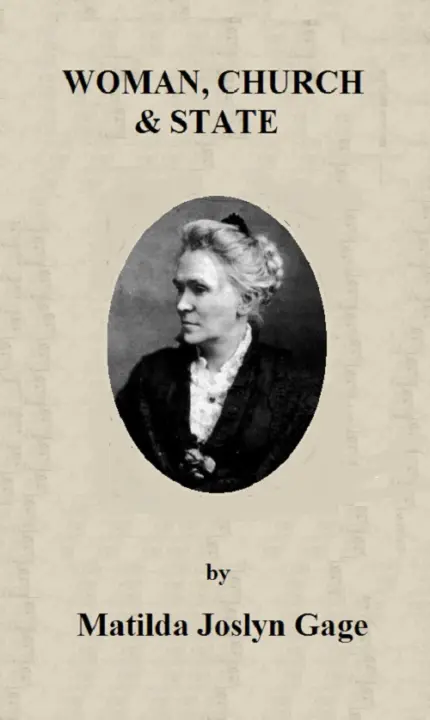
THE CLASSIC COLLECTION · 1893
"Woman, Church & State" by Matilda Joslyn Gage is a historical account written in the late 19th century. The book critically examines the historical treatment of women by both religious institutions and state authorities, challenging the widely held belief that the rise of Christianity improved women's status. Gage argues that women once held significant power in societies governed by matriarchal systems, and she seeks to illuminate the injustices faced by women as a result of patriarchal structures that have taken their place. At the start of the work, Gage presents a preface that outlines her motivations for writing this book, emphasizing her indignation towards the male-dominated Church and State that have perpetuated the subjugation of women throughout history. She asserts that women enjoyed greater liberties in ancient civilizations, particularly under matriarchal governance, and she aims to refute the notion that Christianity elevated women's status compared to earlier periods. Gage’s initial arguments set the stage for a thorough exploration of historical precedents that illustrate the systemic oppression of women as dictated by religious dogma and societal norms.
Introduction adapted from the source catalogue; source summaries may be automatically generated.
Free to read · English · 178,889 words · No account needed
MAKE TIME FOR A GOOD BOOK
On by default. Untick to stop anonymous reading totals. Each page counts after 10 seconds in view. How this works.
Anonymous counting is on unless you have switched it off.
It must also be remembered that the historians of that period were generally priests by whom the fact of such usage or custom would pass unmentioned, especially as the church taught that woman was created to meet the special demands of man. Other important historical facts have been as lightly touched upon, or passed over entirely. The deification of Julius Caesar while Emperor of Rome, is scarcely referred to in the more familiar literary sources of Roman history. And yet his worship was almost universal in the provinces, where he was adored as a god. The records of this worship are only to be found in scattered monuments and inscriptions but recently brought to light, and deciphered within the last few years. Through these it is proven that there was an organized worship of this emperor, and an order of consecrated priests devoted to him.[57] Higgins refers to this deification of Caesar.[58] It is not alone proof of the low condition of morality at this period, but also of the universal disbelief in woman’s authority over, or right to herself, that so few writers upon feudal subjects have treated of the libidinous powers of the lord over his female serfs. Even those presenting the evils of feudalism in other respects, have merely expressed a mild surprise that christian people should have admitted that right of the lord over his feminine vassals. The various names under which this right was known as jus primae noctis,[59] droit de seigneur,[60] droit de jambage,[61] droit de cuissage,[62] droit d’ afforage,[63] droit de marquette,[64] and many other terms too indelicate for repetition, indicating this right of the lord over all the women in his domain, is still another incontestable proof of the universality of the custom.
The Mosaic teaching as to sacredness of “first fruits,” under Judaism, dedicated to the Lord of Heaven, doubtless was in part the origin of the claim of the feudal lord. The law of primogeniture, or precedence of the first born son as the beginning of “his father’s strength” is also a translation from Judaism into the customs of many nations, but nowhere under the law of primogeniture at the present day does even a first born daughter receive as high consideration as a first born son. This is especially noticeable in royal families. It is not therefore singular that men who took the literal sense of the bible in science, who believed that the world had been created in six days, this work having so greatly fatigued the Lord Almighty as to make rest of the seventh day necessary for him, should under example of that lord, claim the first fruits in all their possessions. No Christians of the present day, except the Mormons, so fully base their lives upon the teachings of the bible as the Catholics of the middle ages. If we accord divine authority to this book, accepting the literal word as infallible and sacred, we must admit that both Church and State were at this period in unison with its teachings, and even during the nineteenth century have not freed themselves from the stigma of sustaining woman’s degradation; the theory of the feudal ages remains the same, although the practice is somewhat different. Legal bigamy or polygamy, non-marital unions, are common in every large city of christendom. Government license has created a class in many European countries devoted to the most degraded lives under government sanction, protection, and control; in England known as “Queen’s Women,” “Government Women.” Thus the State places itself before the world as a trafficker in women’s bodies for the vilest purposes. The culmination of nearly two thousand years of christian teaching is the legalization of vice for women and the creation of a new crime. Previous to the enactment of this law the rules of modern jurisprudence held an accused person as innocent until proven guilty. Under this legalization of vice all women within a certain radius of recruiting, or other army stations, are “suspects,” looked upon as immoral, and liable to arrest, examination, and registration upon government books as government women. It required seventeen years of arduous work to repeal this law in England. This legalization of prostitution in the nineteenth century by the State is its open approval of that doctrine of the Church that woman was created for man. It is an acknowledgment by men that vice is an inherent quality of their natures. It is in accord with man’s repeated assertion that only through means of a class of women pursuing immorality as a business, is any woman safe from violence.
Your reading position is saved on this browser. Take it to another device with a library code. Reading pages adapt to text, rather than matching a printed edition.
BEHIND THE BOOK
This eBook is for the use of anyone anywhere in the United States and most other parts of the world at no cost and with almost no restrictions whatsoever. You may copy it, give it away or re-use it under the terms of the Project Gutenberg License included with this eBook or online at www.gutenberg.org. If you are not located in the United States, you will have to check the laws of the country where you are located before using this eBook. Read the source licence.
The original source file, including credits and licence, is retained by this library. Request an original-format copy at no charge. Please include the book title and Project Gutenberg identifier #45580.
KEEP YOUR CURIOSITY GOING
David Patterson (Spirit) Hatch

David Patterson (Spirit) Hatch

David Patterson (Spirit) Hatch
Cécile Tormay

Moritz Busch
John L. Ransom