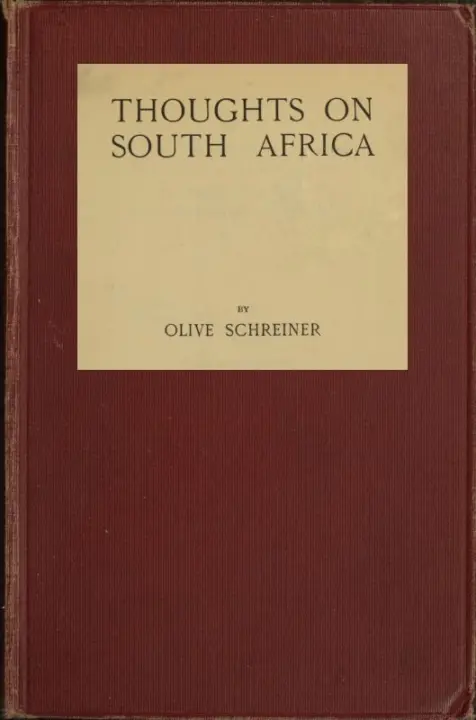
Thoughts on South Africa
Olive Schreiner
THE CLASSIC COLLECTION · 1911
"Woman and Labour" by Olive Schreiner is a sociological examination written in the early 20th century that explores the roles and labor of women throughout history and in contemporary society. The text investigates the evolution of women’s work, societal expectations, and how these realities have impacted women's rights and roles, particularly in the context of economic changes brought by modern civilization. At the start of the work, Schreiner outlines her motivations and the book's overarching themes, sharing personal connections to her studies of women in various societal classes. The opening sets the stage for an exploration of the historical progression of women's roles, from active contributors to societies in primitive times to the "parasitism" that has developed in certain contexts as civilizations advanced. She suggests that women have historically been both the backbone of societal labor and simultaneously marginalized, a duality that demands attention and reassessment in the face of modern labor structures that often exclude them. The emotional resonance and philosophical depth of Schreiner's reflections lay the groundwork for a compelling and critical discourse on the need for greater recognition and opportunity for women in the labor force, hinting at the broader implications of these issues for society as a whole.
Introduction adapted from the source catalogue; source summaries may be automatically generated.
Free to read · English · 56,920 words · No account needed
MAKE TIME FOR A GOOD BOOK
On by default. Untick to stop anonymous reading totals. Each page counts after 10 seconds in view. How this works.
Anonymous counting is on unless you have switched it off.
The parasitism of the human female becomes a possibility only when a point in civilisation is reached (such as that which was attained in the ancient civilisations of Greece, Rome, Persia, Assyria, India, and such as today exists in many of the civilisations of the East, such as those of China and Turkey), when, owing to the extensive employment of the labour of slaves, or of subject races or classes, the dominant race or class has become so liberally supplied with the material goods of life, that mere physical toil on the part of its own female members has become unnecessary. It is when this point has been reached, and never before, that the symptoms of female parasitism have in the past almost invariably tended to manifest themselves, and have become a social danger. The males of the dominant class have almost always contrived to absorb to themselves the new intellectual occupations, with the absence of necessity for the old forms of physical toil made possible in their societies; and the females of the dominant class or race, for whose muscular labours there was now also no longer any need, not succeeding in grasping or attaining to these new forms of labour, have sunk into a state in which, performing no species of active social duty, they have existed through the passive performance of sexual functions alone, with how much or how little of discontent will now never be known, since no literary record has been made by the woman of the past, of her desires or sorrows. Then, in place of the active labouring woman, upholding society by her toil, has come the effete wife, concubine, or prostitute, clad in fine raiment, the work of others’ fingers; fed on luxurious viands, the result of others’ toil, waited on and tended by the labour of others. The need for her physical labour having gone, and mental industry not having taken its place, she bedecked and scented her person, or had it bedecked and scented for her, she lay upon her sofa, or drove or was carried out in her vehicle, and, loaded with jewels, she sought by dissipations and amusements to fill up the inordinate blank left by the lack of productive activity. And as the hand whitened and frame softened, till, at last, the very duties of motherhood, which were all the constitution of her life left her, became distasteful, and, from the instant when her infant came damp from her womb, it passed into the hands of others, to be tended and reared by them; and from youth to age her offspring often owed nothing to her personal toil. In many cases so complete was her enervation, that at last the very joy of giving life, the glory and beatitude of a virile womanhood, became distasteful; and she sought to evade it, not because of its interference with more imperious duties to those already born of her, or to her society, but because her existence of inactivity had robbed her of all joy in strenuous exertion and endurance in any form. Finely clad, tenderly housed, life became for her merely the gratification of her own physical and sexual appetites, and the appetites of the male, through the stimulation of which she could maintain herself. And, whether as kept wife, kept mistress, or prostitute, she contributed nothing to the active and sustaining labours of her society. She had attained to the full development of that type which, whether in modern Paris or New York or London, or in ancient Greece, Assyria, or Rome, is essentially one in its features, its nature, and its results. She was the “fine lady,” the human female parasite--the most deadly microbe which can make its appearance on the surface of any social organism. (The relation of female parasitism generally, to the peculiar phenomenon of prostitution, is fundamental. Prostitution can never be adequately dealt with, either from the moral or the scientific standpoint, unless its relation to the general phenomenon of female parasitism be fully recognised. It is the failure to do this which leaves so painful a sense of abortion on the mind, after listening to most modern utterances on the question, whether made from the emotional platform of the moral reformer, or the intellectual platform of the would-be scientist. We are left with a feeling that the matter has been handled but not dealt with: that the knife has not reached the core.)
Your reading position is saved on this browser. Take it to another device with a library code. Reading pages adapt to text, rather than matching a printed edition.
Olive Schreiner
Olive Schreiner
Olive Schreiner
Olive Schreiner
BEHIND THE BOOK
This eBook is for the use of anyone anywhere in the United States and most other parts of the world at no cost and with almost no restrictions whatsoever. You may copy it, give it away or re-use it under the terms of the Project Gutenberg License included with this eBook or online at www.gutenberg.org. If you are not located in the United States, you will have to check the laws of the country where you are located before using this eBook. Read the source licence.
The original source file, including credits and licence, is retained by this library. Request an original-format copy at no charge. Please include the book title and Project Gutenberg identifier #1440.
KEEP YOUR CURIOSITY GOING

Charles G. (Charles Griffith) Ross
Hannah Webster Foster

Emily Lawless
Edwin Hamlin Carr

Charles De Lano Hine
Andrew Ure