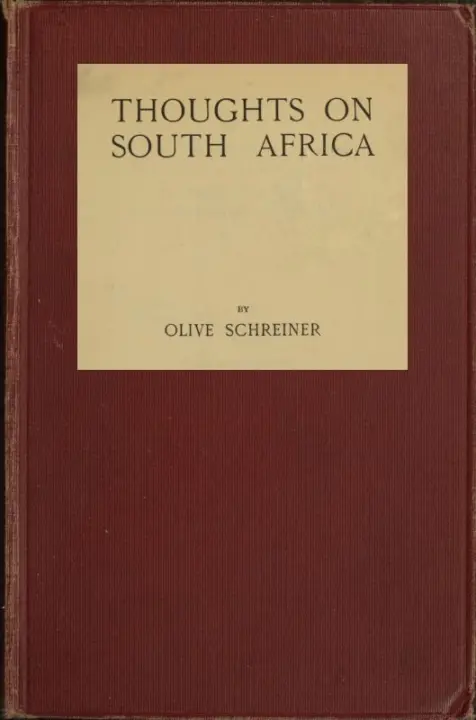
Thoughts on South Africa
Olive Schreiner
THE CLASSIC COLLECTION · 1911
"Woman and Labour" by Olive Schreiner is a sociological examination written in the early 20th century that explores the roles and labor of women throughout history and in contemporary society. The text investigates the evolution of women’s work, societal expectations, and how these realities have impacted women's rights and roles, particularly in the context of economic changes brought by modern civilization. At the start of the work, Schreiner outlines her motivations and the book's overarching themes, sharing personal connections to her studies of women in various societal classes. The opening sets the stage for an exploration of the historical progression of women's roles, from active contributors to societies in primitive times to the "parasitism" that has developed in certain contexts as civilizations advanced. She suggests that women have historically been both the backbone of societal labor and simultaneously marginalized, a duality that demands attention and reassessment in the face of modern labor structures that often exclude them. The emotional resonance and philosophical depth of Schreiner's reflections lay the groundwork for a compelling and critical discourse on the need for greater recognition and opportunity for women in the labor force, hinting at the broader implications of these issues for society as a whole.
Introduction adapted from the source catalogue; source summaries may be automatically generated.
Free to read · English · 56,920 words · No account needed
MAKE TIME FOR A GOOD BOOK
On by default. Untick to stop anonymous reading totals. Each page counts after 10 seconds in view. How this works.
Anonymous counting is on unless you have switched it off.
It is from these men, men who, viewed from the broad humanitarian standpoint, are often of the most lovable and interesting type, and who might in a simpler state of society, where physical force was the dominating factor, have been the heroes, leaders, and chiefs of their people, that there arises in the modern world the bitter cry of the male unemployed: “Give us labour or we die!” (The problem of the unemployed male is, of course, not nearly so modern as that of the unemployed female. It may be said in England to have taken its rise in almost its present form as early as the fifteenth century, when economic changes began to sever the agricultural labourer from the land, and rob him of his ancient forms of social toil. Still, in its most acute form, it may be called a modern problem.)
Yet it is only upon one, and a comparatively small, section of the males of the modern civilised world that these changes in the material conditions of life have told in such fashion as to take all useful occupation from them and render them wholly or partly worthless to society. If the modern man’s field of labour has contracted at one end (the physical), at the other (the intellectual) it has immeasurably expanded! If machinery and the command of inanimate motor-forces have rendered of comparatively little value the male’s mere physical motor-power, the demand upon his intellectual faculties, the call for the expenditure of nervous energy, and the exercise of delicate manipulative skill in the labour of human life, have immeasurably increased.
In a million new directions forms of honoured and remunerative social labour are opening up before the feet of the modern man, which his ancestors never dreamed of; and day by day they yet increase in numbers and importance. The steamship, the hydraulic lift, the patent road-maker, the railway-train, the electric tram-car, the steam-driven mill, the Maxim gun and the torpedo boat, once made, may perform their labours with the guidance and assistance of comparatively few hands; but a whole army of men of science, engineers, clerks, and highly-trained workmen is necessary for their invention, construction, and maintenance. In the domains of art, of science, of literature, and above all in the field of politics and government, an almost infinite extension has taken place in the fields of male labour. Where in primitive times woman was often the only builder, and patterns she daubed on her hut walls or traced on her earthen vessels the only attempts at domestic art; and where later but an individual here and there was required to design a king’s palace or a god’s temple or to ornament it with statues or paintings, today a mighty army of men, a million strong, is employed in producing plastic art alone, both high and low, from the traceries on wall-paper and the illustrations in penny journals, to the production of the pictures and statues which adorn the national collections, and a mighty new field of toil has opened before the anciently hunting and fighting male. Where once one ancient witch-doctress may have been the only creature in a whole district who studied the nature of herbs and earths, or a solitary wizard experimenting on poisons was the only individual in a whole territory interrogating nature; and where later, a few score of alchemists and astrologers only were engaged in examining the structure of substances, or the movement of planets, today thousands of men in every civilised community are labouring to unravel the mysteries of nature, and the practical chemist, the physician, the anatomist, the engineer, the astronomer, the mathematician, the electrician, form a mighty and always increasingly important army of male labourers. Where once an isolated bard supplied a nation with its literatures, or where later a few thousand priests and men of letters wrote and transcribed for the few to read, today literature gives labour to a multitude almost as countless as a swarm of locusts. From the penny-a-liner to the artist and thinker, the demand for their labour continually increases. Where one town-crier with stout legs and lusty lungs was once all-sufficient to spread the town and country news, a score of men now sit daily pen in hand, preparing the columns of the morning’s paper, and far into the night a hundred compositors are engaged in a labour which requires a higher culture of brain and finger than most ancient kings and rulers possessed. Even in the labours of war, the most brutal and primitive of the occupations lingering on into civilised life from the savage state, the new demand for labour of an intellectual kind is enormous. The invention, construction, and working of one Krupp gun, though its mere discharge hardly demands more crude muscular exertion than a savage expends in throwing his boomerang, yet represents an infinitude of intellectual care and thought, far greater than that which went to the shaping of all the weapons of a primitive army. Above all, in the domain of politics and government, where once a king or queen, aided by a handful of councillors, was alone practically concerned in the labours of national guidance or legislation; today, owing to the rapid means of intercommunication, printing, and the consequent diffusion of political and social information throughout a territory, it has become possible, for the first time, for all adults in a large community to keep themselves closely informed on all national affairs; and in every highly-civilised state the ordinary male has been almost compelled to take his share, however small, in the duties and labours of legislation and government. Thus there has opened before the mass of men a vast new sphere of labour undreamed of by their ancestors. In every direction the change which material civilisation has wrought, while it has militated against that comparatively small section of males who have nothing to offer society but the expenditure of their untrained muscular energy (inflicting much and often completely unmerited suffering upon them), has immeasurably extended the field of male labour as a whole. Never before in the history of the earth has the man’s field of remunerative toil been so wide, so interesting, so complex, and in its results so all-important to society; never before has the male sex, taken as a whole, been so fully and strenuously employed.
Your reading position is saved on this browser. Take it to another device with a library code. Reading pages adapt to text, rather than matching a printed edition.
Olive Schreiner
Olive Schreiner
Olive Schreiner
Olive Schreiner
BEHIND THE BOOK
This eBook is for the use of anyone anywhere in the United States and most other parts of the world at no cost and with almost no restrictions whatsoever. You may copy it, give it away or re-use it under the terms of the Project Gutenberg License included with this eBook or online at www.gutenberg.org. If you are not located in the United States, you will have to check the laws of the country where you are located before using this eBook. Read the source licence.
The original source file, including credits and licence, is retained by this library. Request an original-format copy at no charge. Please include the book title and Project Gutenberg identifier #1440.
KEEP YOUR CURIOSITY GOING

Charles G. (Charles Griffith) Ross
Hannah Webster Foster

Emily Lawless
Edwin Hamlin Carr

Charles De Lano Hine
Andrew Ure