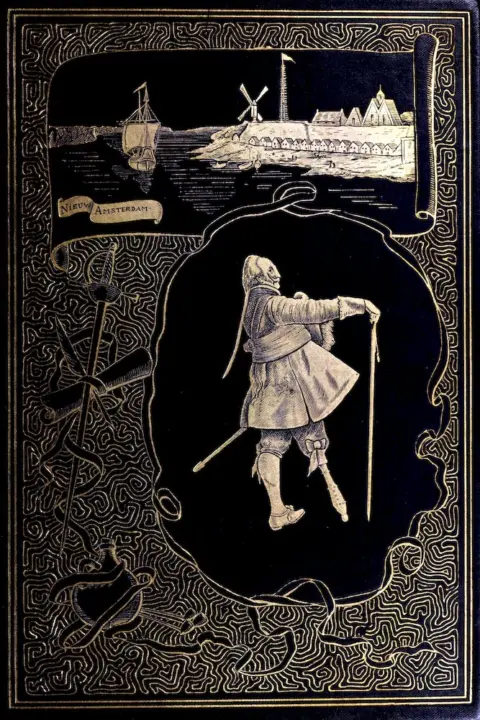
Knickerbocker’s history of New York, vol. 2 (of 2)
Washington Irving
THE CLASSIC COLLECTION · 1800
"Wolfert's Roost and Miscellanies" by Washington Irving is a collection of essays and stories written in the early 19th century. The narrative is anchored in the historical and cultural landscapes of the Hudson River Valley, particularly centered around the fictionalized mansion known as Wolfert's Roost. Through the voice of the narrator, Geoffrey Crayon, the text offers a blend of reflection and anecdotal tales, showcasing both personal memories and broader historical themes related to Dutch-American heritage, local folklore, and human experience. The opening of the work sets the tone for a rich exploration of the past through a contemplative lens. Geoffrey Crayon introduces his thoughts on the life and times surrounding the Roost, recounting his friendship with Diedrich Knickerbocker, a character of significance in Irving's earlier works. Crayon nostalgically recalls his youth spent in this locale, painting vivid imagery of the serene landscape while establishing a connection to the Dutch settlers' history, folklore, and the charm of rural life. As he reflects on Wolfert Acker, the house's original proprietor, the reader is drawn into a narrative filled with humor, local color, and themes of retreat from the modern world, hinting at tales of adventure, memories of witchcraft, and the enduring legacy of a bygone era.
Introduction adapted from the source catalogue; source summaries may be automatically generated.
Free to read · English · 64,286 words · No account needed
MAKE TIME FOR A GOOD BOOK
On by default. Untick to stop anonymous reading totals. Each page counts after 10 seconds in view. How this works.
Anonymous counting is on unless you have switched it off.
Sir: I have already given you a legend or two drawn from ancient Spanish sources, and may occasionally give you a few more. I love these old Spanish themes, especially when they have a dash of the Morisco in them, and treat of the times when the Moslems maintained a foot-hold in the peninsula. They have a high, spicy, oriental flavor, not to be found in any other themes that are merely European. In fact, Spain is a country that stands alone in the midst of Europe; severed in habits, manners, and modes of thinking, from all its continental neighbors. It is a romantic country; but its romance has none of the sentimentality of modern European romance: it is chiefly derived from the brilliant regions of the East, and from the high-minded school of Saracenic chivalry.
The Arab invasion and conquest brought a higher civilization and a nobler style of thinking into Gothic Spain. The Arabs were a quick-witted, sagacious, proud-spirited, and poetical people, and were imbued with oriental science and literature. Wherever they established a seat of power, it became a rallying place for the learned and ingenious; and they softened and refined the people whom they conquered. By degrees, occupancy seemed to give them a hereditary right to their foothold in the land; they ceased to be looked upon as invaders, and were regarded as rival neighbors. The peninsula, broken up into a variety of states, both Christian and Moslem, became for centuries a great campaigning ground, where the art of war seemed to be the principal business of man, and was carried to the highest pitch of romantic chivalry. The original ground of hostility, a difference of faith, gradually lost its rancor. Neighboring states, of opposite creeds, were occasionally linked together in alliances, offensive and defensive; so that the cross and crescent were to be seen side by side fighting against some common enemy. In times of peace, too, the noble youth of either faith resorted to the same cities, Christian or Moslem, to school themselves in military science. Even in the temporary truces of sanguinary wars, the warriors who had recently striven together in the deadly conflicts of the field, laid aside their animosity, met at tournaments, jousts, and other military festivities, and exchanged the courtesies of gentle and generous spirits. Thus the opposite races became frequently mingled together in peaceful intercourse, or if any rivalry took place, it was in those high courtesies and nobler acts which bespeak the accomplished cavalier. Warriors of opposite creeds became ambitious of transcending each other in magnanimity as well as valor. Indeed, the chivalric virtues were refined upon to a degree sometimes fastidious and constrained; but at other times, inexpressibly noble and affecting. The annals of the times teem with illustrious instances of high-wrought courtesy, romantic generosity, lofty disinterestedness, and punctilious honor, that warm the very soul to read them. These have furnished themes for national plays and poems, or have been celebrated in those all-pervading ballads which are as the life-breath of the people, and thus have continued to exercise an influence on the national character which centuries of vicissitude and decline have not been able to destroy; so that, with all their faults, and they are many, the Spaniards, even at the present day, are on many points the most high-minded and proud-spirited people of Europe. It is true, the romance of feeling derived from the sources I have mentioned, has, like all other romance, its affectations and extremes. It renders the Spaniard at times pompous and grandiloquent; prone to carry the "pundonor," or point of honor, beyond the bounds of sober sense and sound morality; disposed, in the midst of poverty, to affect the "grande caballero," and to look down with sovereign disdain upon "arts mechanical," and all the gainful pursuits of plebeian life; but this very inflation of spirit, while it fills his brain with vapors, lifts him above a thousand meannesses; and though it often keeps him in indigence, ever protects him from vulgarity.
Your reading position is saved on this browser. Take it to another device with a library code. Reading pages adapt to text, rather than matching a printed edition.
Washington Irving
William Irving & Washington Irving & James Kirke Paulding
Washington Irving
Washington Irving
BEHIND THE BOOK
This eBook is for the use of anyone anywhere in the United States and most other parts of the world at no cost and with almost no restrictions whatsoever. You may copy it, give it away or re-use it under the terms of the Project Gutenberg License included with this eBook or online at www.gutenberg.org. If you are not located in the United States, you will have to check the laws of the country where you are located before using this eBook. Read the source licence.
The original source file, including credits and licence, is retained by this library. Request an original-format copy at no charge. Please include the book title and Project Gutenberg identifier #8571.
KEEP YOUR CURIOSITY GOING

David Patterson (Spirit) Hatch

David Patterson (Spirit) Hatch

David Patterson (Spirit) Hatch

Ralph Waldo Emerson

Maurice Baring

Oscar Wilde & James McNeill Whistler