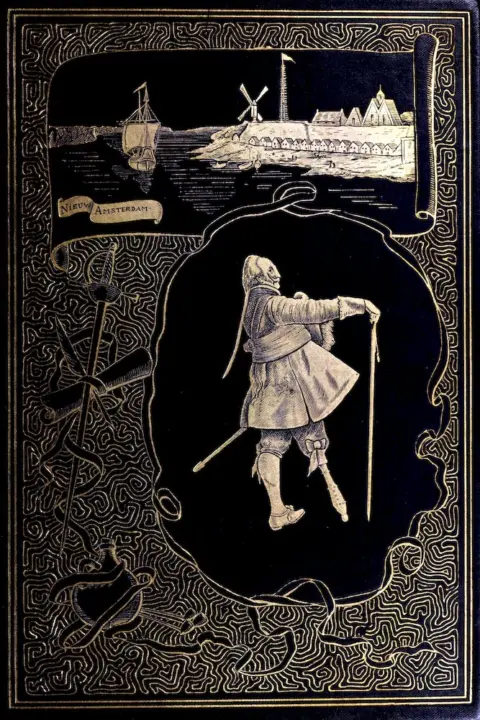
Knickerbocker’s history of New York, vol. 2 (of 2)
Washington Irving
THE CLASSIC COLLECTION · 1800
"Wolfert's Roost and Miscellanies" by Washington Irving is a collection of essays and stories written in the early 19th century. The narrative is anchored in the historical and cultural landscapes of the Hudson River Valley, particularly centered around the fictionalized mansion known as Wolfert's Roost. Through the voice of the narrator, Geoffrey Crayon, the text offers a blend of reflection and anecdotal tales, showcasing both personal memories and broader historical themes related to Dutch-American heritage, local folklore, and human experience. The opening of the work sets the tone for a rich exploration of the past through a contemplative lens. Geoffrey Crayon introduces his thoughts on the life and times surrounding the Roost, recounting his friendship with Diedrich Knickerbocker, a character of significance in Irving's earlier works. Crayon nostalgically recalls his youth spent in this locale, painting vivid imagery of the serene landscape while establishing a connection to the Dutch settlers' history, folklore, and the charm of rural life. As he reflects on Wolfert Acker, the house's original proprietor, the reader is drawn into a narrative filled with humor, local color, and themes of retreat from the modern world, hinting at tales of adventure, memories of witchcraft, and the enduring legacy of a bygone era.
Introduction adapted from the source catalogue; source summaries may be automatically generated.
Free to read · English · 64,286 words · No account needed
MAKE TIME FOR A GOOD BOOK
On by default. Untick to stop anonymous reading totals. Each page counts after 10 seconds in view. How this works.
Anonymous counting is on unless you have switched it off.
Dripping and shivering, Vanderscamp crawled homeward. He was completely sobered by the storm; the water soaked from without, having diluted and cooled the liquor within. Arrived at the Wild Goose, he knocked timidly and dubiously at the door, for he dreaded the reception he was to experience from his wife. He had reason to do so. She met him at the threshold, in a precious ill humor.
"Is this a time," said she, "to keep people out of their beds, and to bring home company, to turn the house upside down?"
"Company?" said Vanderscamp, meekly; "I have brought no company with me,
wife."
"No, indeed! they have got here before you, but by your invitation; and blessed-looking company they are, truly!"
Vanderscamp's knees smote together. "For the love of heaven, where are
they, wife?"
"Where?--why, in the blue-room, up-stairs, making themselves as much at home as if the house were their own."
Vanderscamp made a desperate effort, scrambled up to the room, and threw open the door. Sure enough, there at a table, on which burned a light as blue as brimstone, sat the three guests from Gibbet-Island, with halters round their necks, and bobbing their cups together, as if they were hob-or-nobbing, and trolling the old Dutch freebooter's glee, since translated into English:
"For three merry lads be we,
And three merry lads be we;
I on the land, and thou on the sand,
And Jack on the gallows-tree."
Vanderscamp saw and heard no more. Starting back with horror, he missed his footing on the landing-place, and fell from the top of the stairs to the bottom. He was taken up speechless, and, either from the fall or the fright, was buried in the yard of the little Dutch church at Bergen, on the following Sunday.
From that day forward, the fate of the Wild Goose was sealed. It was pronounced a haunted house, and avoided accordingly. No one inhabited it but Vanderscamp's shrew of a widow, and old Pluto, and they were considered but little better than its hobgoblin visitors. Pluto grew more and more haggard and morose, and looked more like an imp of darkness than a human being. He spoke to no one, but went about muttering to himself; or, as some hinted, talking with the devil, who, though unseen, was ever at his elbow. Now and then he was seen pulling about the bay alone, in his skiff, in dark weather, or at the approach of night-fall; nobody could tell why, unless on an errand to invite more guests from the gallows. Indeed it was affirmed that the Wild Goose still continued to be a house of entertainment for such guests, and that on stormy nights, the blue chamber was occasionally illuminated, and sounds of diabolical merriment were overheard, mingling with the howling of the tempest. Some treated these as idle stories, until on one such night, it was about the time of the equinox, there was a horrible uproar in the Wild Goose, that could not be mistaken. It was not so much the sound of revelry, however, as strife, with two or three piercing shrieks, that pervaded every part of the village. Nevertheless, no one thought of hastening to the spot. On the contrary, the honest burghers of Communipaw drew their night-caps over their ears, and buried their heads under the bed-clothes, at the thoughts of Vanderscamp and his gallows companions.
Your reading position is saved on this browser. Take it to another device with a library code. Reading pages adapt to text, rather than matching a printed edition.
Washington Irving
William Irving & Washington Irving & James Kirke Paulding
Washington Irving
Washington Irving
BEHIND THE BOOK
This eBook is for the use of anyone anywhere in the United States and most other parts of the world at no cost and with almost no restrictions whatsoever. You may copy it, give it away or re-use it under the terms of the Project Gutenberg License included with this eBook or online at www.gutenberg.org. If you are not located in the United States, you will have to check the laws of the country where you are located before using this eBook. Read the source licence.
The original source file, including credits and licence, is retained by this library. Request an original-format copy at no charge. Please include the book title and Project Gutenberg identifier #8571.
KEEP YOUR CURIOSITY GOING

David Patterson (Spirit) Hatch

David Patterson (Spirit) Hatch

David Patterson (Spirit) Hatch

Ralph Waldo Emerson

Maurice Baring

Oscar Wilde & James McNeill Whistler