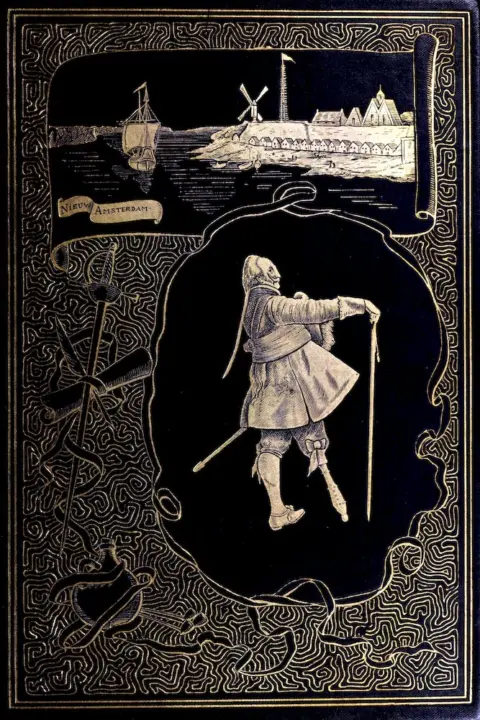
Knickerbocker’s history of New York, vol. 2 (of 2)
Washington Irving
THE CLASSIC COLLECTION · 1800
"Wolfert's Roost and Miscellanies" by Washington Irving is a collection of essays and stories written in the early 19th century. The narrative is anchored in the historical and cultural landscapes of the Hudson River Valley, particularly centered around the fictionalized mansion known as Wolfert's Roost. Through the voice of the narrator, Geoffrey Crayon, the text offers a blend of reflection and anecdotal tales, showcasing both personal memories and broader historical themes related to Dutch-American heritage, local folklore, and human experience. The opening of the work sets the tone for a rich exploration of the past through a contemplative lens. Geoffrey Crayon introduces his thoughts on the life and times surrounding the Roost, recounting his friendship with Diedrich Knickerbocker, a character of significance in Irving's earlier works. Crayon nostalgically recalls his youth spent in this locale, painting vivid imagery of the serene landscape while establishing a connection to the Dutch settlers' history, folklore, and the charm of rural life. As he reflects on Wolfert Acker, the house's original proprietor, the reader is drawn into a narrative filled with humor, local color, and themes of retreat from the modern world, hinting at tales of adventure, memories of witchcraft, and the enduring legacy of a bygone era.
Introduction adapted from the source catalogue; source summaries may be automatically generated.
Free to read · English · 64,286 words · No account needed
MAKE TIME FOR A GOOD BOOK
On by default. Untick to stop anonymous reading totals. Each page counts after 10 seconds in view. How this works.
Anonymous counting is on unless you have switched it off.
The only being for whom he seemed to have any liking, was Yan Yost Vanderscamp, and him he liked for his very wickedness. He in a manner took the boy under his tutelage, prompted him to all kinds of mischief, aided him in every wild, harum-scarum freak, until the lad became the complete scapegrace of the village; a pest to his uncle, and to every one else. Nor were his pranks confined to the land; he soon learned to accompany old Pluto on the water. Together these worthies would cruise about the broad bay, and all the neighboring straits and rivers; poking around in skiffs and canoes; robbing the set-nets of the fishermen; landing on remote coasts, and laying waste orchards and water-melon patches; in short, carrying on a complete system of piracy, on a small scale, Piloted by Pluto, the youthful Vanderscamp soon became acquainted with all the bays, rivers, creeks, and inlets of the watery world around him; could navigate from the Hook to Spiting-devil on the darkest night, and learned to set even the terrors of Hell-gate at defiance.
At length, negro and boy suddenly disappeared, and days and weeks elapsed, but without tidings of them. Some said they must have run away and gone to sea; others jocosely hinted, that old Pluto, being no other than his namesake in disguise, had spirited away the boy to the nether regions. All, however, agreed in one thing, that the village was well rid of them.
In the process of time, the good Teunis Van Gieson slept with his fathers, and the tavern remained shut up, waiting for a claimant, for the next heir was Yan Yost Vanderscamp, and he had not been heard of for years. At length, one day, a boat was seen pulling for the shore, from a long, black, rakish-looking schooner, that lay at anchor in the bay. The boat's crew seemed worthy of the craft from which they debarked. Never had such a set of noisy, roistering, swaggering varlets landed in peaceful Communipaw. They were outlandish in garb and demeanor, and were headed by a rough, burly, bully ruffian, with fiery whiskers, a copper nose, a scar across his face, and a great Flaunderish beaver slouched on one side of his head, in whom, to their dismay, the quiet inhabitants were made to recognize their early pest, Yan Yost Vanderscamp. The rear of this hopeful gang was brought up by old Pluto, who had lost an eye, grown grizzly-headed, and looked more like a devil than ever. Vanderscamp renewed his acquaintance with the old burghers, much against their will, and in a manner not at all to their taste. He slapped them familiarly on the back, gave them an iron grip of the hand, and was hail fellow well met. According to his own account, he had been all the world over; had made money by bags full; had ships in every sea, and now meant to turn the Wild Goose into a country seat, where he and his comrades, all rich merchants from foreign parts, might enjoy themselves in the interval of their voyages. Sure enough, in a little while there was a complete metamorphose of the Wild Goose. From being a quiet, peaceful Dutch public house, it became a most riotous, uproarious private dwelling; a complete rendezvous for boisterous men of the seas, who came here to have what they called a "blow out" on dry land, and might be seen at all hours, lounging about the door, or lolling out of the windows; swearing among themselves, and cracking rough jokes on every passer-by. The house was fitted up, too, in so strange a manner: hammocks slung to the walls, instead of bedsteads; odd kinds of furniture, of foreign fashion; bamboo couches, Spanish chairs; pistols, cutlasses, and blunderbusses, suspended on every peg; silver crucifixes on the mantel-pieces, silver candle-sticks and porringers on the tables, contrasting oddly with the pewter and Delf ware of the original establishment. And then the strange amusements of these sea-monsters! Pitching Spanish dollars, instead of quoits; firing blunderbusses out of the window; shooting at a mark, or at any unhappy dog, or cat, or pig, or barn-door fowl, that might happen to come within reach.
Your reading position is saved on this browser. Take it to another device with a library code. Reading pages adapt to text, rather than matching a printed edition.
Washington Irving
William Irving & Washington Irving & James Kirke Paulding
Washington Irving
Washington Irving
BEHIND THE BOOK
This eBook is for the use of anyone anywhere in the United States and most other parts of the world at no cost and with almost no restrictions whatsoever. You may copy it, give it away or re-use it under the terms of the Project Gutenberg License included with this eBook or online at www.gutenberg.org. If you are not located in the United States, you will have to check the laws of the country where you are located before using this eBook. Read the source licence.
The original source file, including credits and licence, is retained by this library. Request an original-format copy at no charge. Please include the book title and Project Gutenberg identifier #8571.
KEEP YOUR CURIOSITY GOING

David Patterson (Spirit) Hatch

David Patterson (Spirit) Hatch

David Patterson (Spirit) Hatch

Ralph Waldo Emerson

Maurice Baring

Oscar Wilde & James McNeill Whistler